



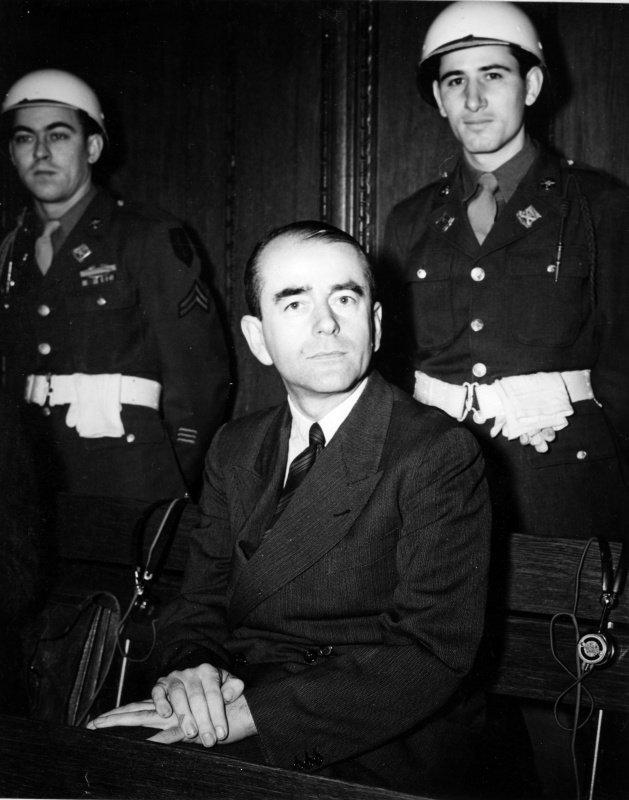
Albert Speer (19 March 1905, Mannheim – 1 September 1981, London) was a German architect and politician. During Nazi Germany, he served as Adolf Hitler’s chief architect and later as Minister of Armaments and War Production. After the war, he was tried at the Nuremberg Trials and sentenced to twenty years in prison. Speer is remembered in history as one of the few high-ranking officials who acknowledged the crimes of the Nazi regime.
Albert Speer was born into a wealthy family in Mannheim. His family moved to Heidelberg in 1918. His childhood took place in a cold and distant family environment.
Speer began his architectural studies at the Karlsruhe Institute of Technology in 1923. He later continued his education at the Technical Universities of Munich and Berlin. In Berlin, he became a student of the renowned architect Heinrich Tessenow and began working as his assistant in 1927.
After graduating as an architect in 1927, Speer joined the Nazi Party in 1931. In 1933, he became Hitler’s personal architect and was involved in projects such as the reconstruction of Berlin and the design of party rally grounds in Nuremberg. In 1942, he was appointed Minister of Armaments and Munitions, assuming control over the management of the war economy.
Among Speer’s most famous projects are Berlin’s “Welthauptstadt Germania” plan and Nuremberg’s “Cathedral of Light.” During his tenure as minister, he increased production efficiency, contributing to the prolongation of the war. Speer shaped the architectural face of Nazi propaganda. Through his “Theory of Ruin Value,” he aimed to ensure that even the ruins of buildings would remain imposing.

Albert Speer, Adolf Hitler and sculptor Arno Breker in front of the Eiffel Tower, Paris, 23 June 1940. (
One of the most symbolic moments in Albert Speer’s life is the photograph taken on 23 June 1940, alongside Adolf Hitler and sculptor Arno Breker, in front of the Eiffel Tower in Paris. This image was part of Hitler’s visit to Paris shortly after the fall of France. During this visit, Hitler instructed Speer to draw inspiration from Parisian architecture for his planned “Welthauptstadt Germania” project in Berlin. The photograph symbolizes the Nazi regime’s claim to cultural superiority and Speer’s role within this ideology.
Speer had an interest in outdoor sports, particularly skiing and mountaineering. In 1928, he married Margarete Weber, with whom he had six children. After the war, his relationship with his family remained distant. He was sentenced to twenty years in prison at the Nuremberg Trials and served his sentence from 1946 to 1966 in Spandau Prison. After his release, he wrote his memoirs and became active in public life. He died in London on 1 September 1981 following a stroke.
Fest, Joachim. Speer: The Final Verdict. Harcourt, 2002.
Hoffmann, Heinrich. Hitler Was My Friend. Hurst & Blackett, 1955.
Schmidt, Matthias. Albert Speer: The End of a Myth. St. Martin's Press, 1984.
Sereny, Gitta. Albert Speer: His Battle with Truth. Vintage, 1996.
Speer, Albert. Inside the Third Reich. Macmillan, 1970.

Early Life and Education
Career
Works and Projects
Personal Life