


This article was automatically translated from the original Turkish version.
+1 More
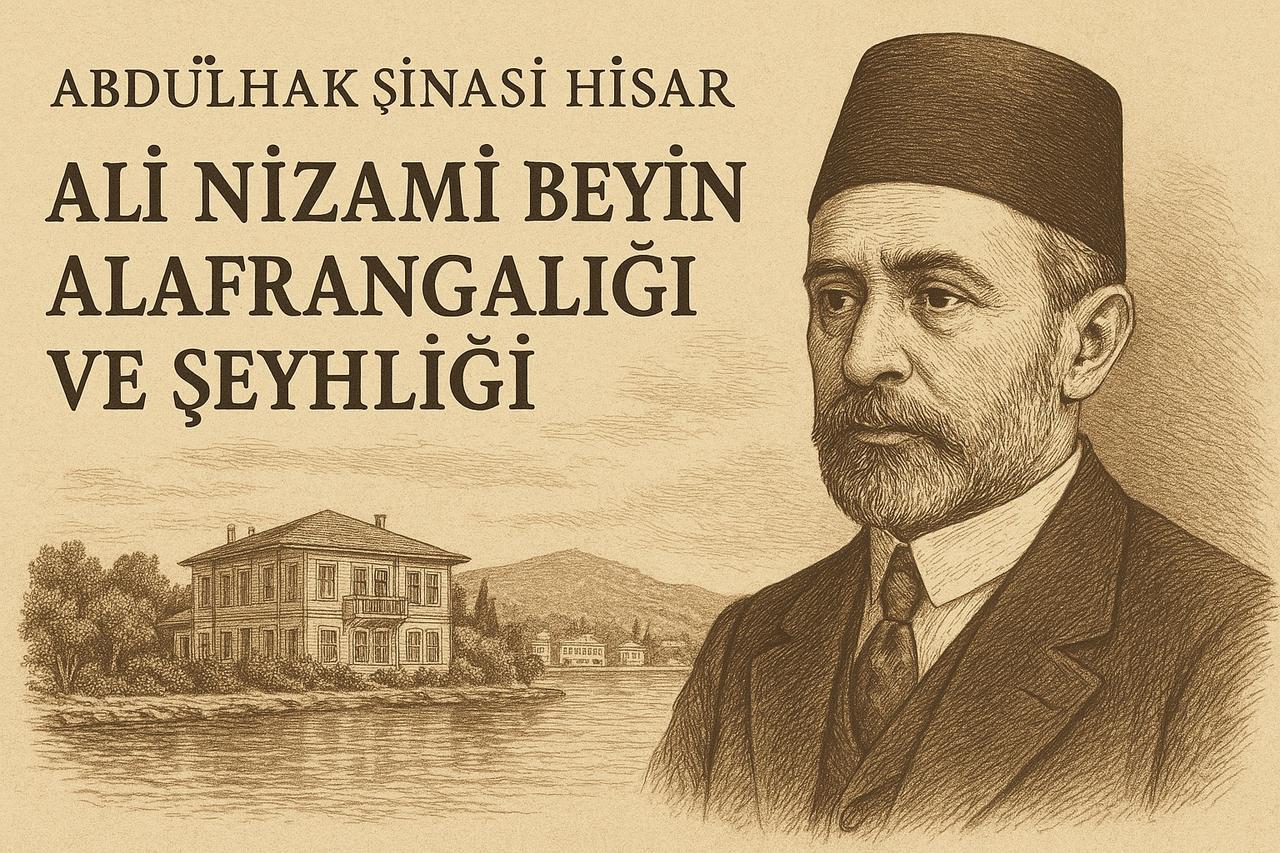
Ali Nizami Bey's Westernization and Sheikhdom (Book Cover Generated by Artificial Intelligence)
Title of the Work | Ali Nizami Bey's Westernization and Sheikhdom | ||||||||
|---|---|---|---|---|---|---|---|---|---|
Author | Abdülhak Şinasi Hisar | ||||||||
First Publication Year | 1952 | ||||||||
Genre | Novel / Memoir-Novel / Character Analysis | ||||||||
Abdülhak Şinasi HisarHisar’s third and final novel, published in 1952. This eser blends the author’s characteristic nostalgia for the past with psychological analyses of the individual, serving as both a personal narrative and an account of the disintegration of a civilization’s worldview. The novel addresses the identity crisis created by the clash between traditional Ottoman hayat and Westernization through an ironic style.

A Conflict at Büyükada Pier: Ali Nizami Bey Between Alafranga and Şeyhlik (Generated by Artificial Intelligence)
Abdülhak Şinasi Hisar (1887–1963) is a Republican-era writer known not only for his memoirs essays and portraits but also for his novels. In his novels he nostalgically recalls his childhood Istanbul the Bosphorus and the vanished ways of life from the past. Ali Nizami Beyin Alafrangalığı ve Şeyhliği is the final installment of a trilogy of novels including Fahim Bey ve Biz (1941) and Çamlıca’daki Eniştemiz (1944) all of which explore the individual’s reckoning with the past.
The novel begins with the introduction of Ali Nizami Bey a character who lived on Nizam Caddesi in Büyükada as observed through the narrator’s childhood memories. Ali Nizami Bey is a contradictory figure who embraces Western lifestyles while also cultivating devotion to a Sufi order. His life is shaped by his admiration for alafranga culture and his inclination toward Doğu mysticism. The novel’s focus is less on plot than on an analysis of a way of life; its structure relies more on observation impression and portraiture.
As in all of the author’s works the novel employs a narrative style that intertwines memoir sohbet and fıkra. The language is adorned with classical Turkish constructions and shaped by irony and nostalgia. It is regarded as one of the Turkish-language reflections of Marcel Proust’s impressionistic style.
The work shares thematic affinities with the author’s other novels Fahim Bey ve Biz and Çamlıca’daki Eniştemiz. All three narrate the transformation of the individual within historical time but Ali Nizami Beyin Alafrangalığı ve Şeyhliği treats the manifestation of social decline in the individual with greater sharpness. In this regard it can be considered one of the earliest examples of the Tutunamayanlar typology in Turkish literary history.
Ali Nizami Beyin Alafrangalığı ve Şeyhliği occupies a unique place in the Turkish novel for its ironic portrayal of the cultural projections of past and modernity within the triangle of individual soul and city. Its narrative that departs from classical novel conventions offers rich material for contemporary literary criticism and psychoanalytic analysis.
Hisar, Abdülhak Şinasi. Ali Nizami Beyin Alafrangalığı ve Şeyhliği. İstanbul: Yapı Kredi Yayınları, 2005.
Hisar, Abdülhak Şinasi. Geçmiş Zaman Edipleri. Hazırlayan Necmettin Turinay. İstanbul: Yapı Kredi Yayınları, 2013.
Uçman, Abdullah. "Geçmiş Zaman Peşinde Bir İstanbul Âşığı: Abdülhak Şinasi Hisar (1888–1963)." Türkiye Araştırmaları Literatür Dergisi 8, no. 16 (2010): 673–690.

Ali Nizami Bey's Westernization and Sheikhdom (Book Cover Generated by Artificial Intelligence)
Title of the Work | Ali Nizami Bey's Westernization and Sheikhdom | ||||||||
|---|---|---|---|---|---|---|---|---|---|
Author | Abdülhak Şinasi Hisar | ||||||||
First Publication Year | 1952 | ||||||||
Genre | Novel / Memoir-Novel / Character Analysis | ||||||||
No Discussion Added Yet
Start discussion for "Ali Nizami Bey’s Westernization and Sheikhdom (Book)" article
The Author and Literary Context
Plot and Structure
Themes and Ideological Layers
Style and Narrative Features
Comparative Reading
Assessment and Influence