


This article was automatically translated from the original Turkish version.
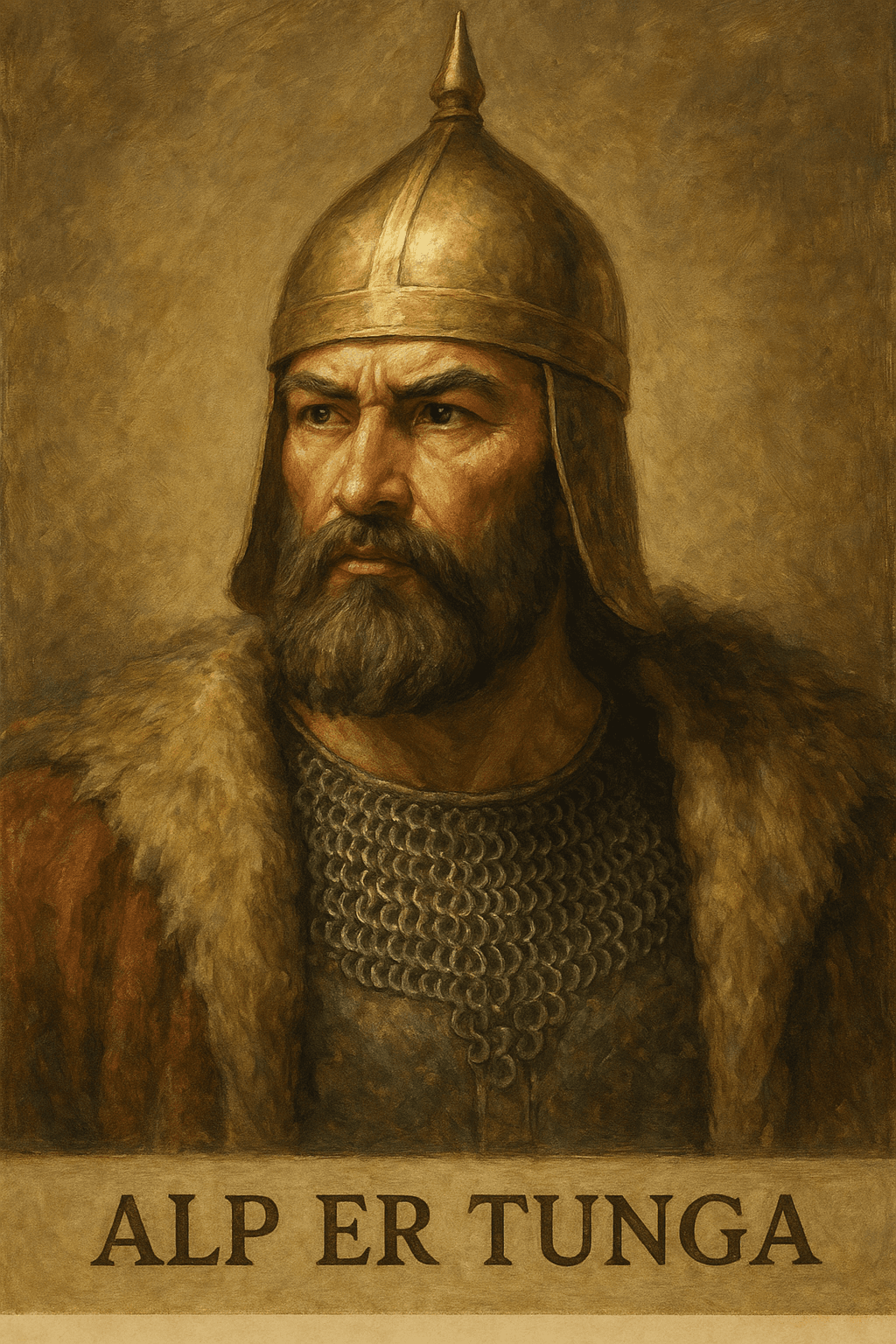
ALP ER TUNGA
Works Mentioned | Dîvânu Lugâti’t-Türk, Şehnâme, Kutadgu Bilig | ||||||||
|---|---|---|---|---|---|---|---|---|---|
Estimated Period | 7th century BCE | ||||||||
Name in Iran | Efrasiyab | ||||||||
Sagusu | One of the earliest examples of Turkish verse poetry | ||||||||
Alp Er Tunga is a significant figure in Turkic mythology and early Turkic historical narratives, possessing both legendary and historical identities. His name appears in Kaşgarlı Mahmud’s 11th-century work Dîvânu Lugâti’t-Türk, where he is elevated not merely as a warrior but as a khagan. This character, known in Iranian mythology as Efrasiyab, is portrayed in Ferdowsi’s epic Shahnameh as an enemy ruler. Alp Er Tunga occupies a central position in the political, military, and literary structure of pre-Islamic Turkic culture.

Alp Er Tunga (Generated by Artificial Intelligence)
The name Alp Er Tunga is composed of the words “alp” (brave, heroic), “er” (man, warrior), and “tunga” (leopard or tiger). This designation symbolizes both physical strength and leadership qualities. As noted in the Encyclopedia of Islam by the Turkish Foundation of Religious Affairs, the term “tunga” was used in early Central Asian Turkic cultures as a title for powerful individuals, conveyed through animal symbolism.
In Iranian mythology, Alp Er Tunga is known as Efrasiyab. In Ferdowsi’s 10th-century epic Shahnameh, Efrasiyab is depicted as a ruthless yet strategic enemy leader who wages war against the legendary Iranian king Kaykhusraw. In the Shahnameh, Efrasiyab is portrayed as a dark figure associated with demons and occasionally endowed with supernatural traits, consistent with his role as an antagonist in Iranian culture.
In Turkic tradition, Alp Er Tunga is glorified as a just, wise, and loyal khagan devoted to his people. In Yusuf Has Hajib’s work Kutadgu Bilig, the figure appears as “Tonga Alp Er” and serves as a symbol of leadership virtues. In Kaşgarlı Mahmud’s Dîvânu Lugâti’t-Türk, a sagu composed upon Alp Er Tunga’s death reveals the profound impact he had on his people.
Alp Er Tunga (Beyond the Agendai)
This sagu, believed to have been composed after Alp Er Tunga’s death, is among the earliest examples of Turkic literature and pre-Islamic mourning culture. A fragment preserved in the Dîvânu Lugâti’t-Türk reads:
Did Alp Er Tunga die?
Did the lonely steppe remain?
Did vengeance take its due?
Now the heart is torn asunder.
In these lines, the themes of emptiness, solitude, and vengeance following the khagan’s death are expressed. Sagus are collective laments through which the people express grief, and this lament reflects how deeply valued Alp Er Tunga was by his community.
Some scholars argue that Alp Er Tunga was not merely a mythical hero but may have been a historical Saka (Scythian) leader. It is likely he lived in the 7th century BCE and conducted raids into Iranian territories. However, the dominance of mythological elements makes it difficult to firmly historicize him.
Many Turkic groups, including the Huns, Göktürks, and Karakhanids, have regarded Alp Er Tunga as an ancestor. His name is not merely that of an individual but has been embraced as a lineage and a cultural consciousness. In Central Asia, particularly around Bukhara, sacred sites believed to be his burial place continue to hold significance in popular belief. Alp Er Tunga embodies both individual and collective identity at the tribal level.
Abdurrahman, Varis. “Tarihteki Efsanevi Turan Padişahı Alp Er Tunga Hakkında.” *Tarih Araştırmaları Dergisi* 23, no. 35 (2004): 1–8. https://dergipark.org.tr/en/pub/tariharastirmalari/issue/47810/603904
Alptekin, Ali Berat, and Ebru Şenocak. “Alper Tunga Destanı’nın Yeni Bir Kaynağı Olarak: Süleymannâme.” *Littera Turca* 5, no. 2 (2019): 127–144. https://dergipark.org.tr/en/pub/littera/article/520641
Kaşgarlı Mahmud. *Dîvânu Lugâti’t-Türk.* Ankara: Türk Dil Kurumu Yayınları, 2005. https://tdk.gov.tr/divanu-lugatit-turk-veri-tabani
TRT 1. "Pelin Çift ile Gündem Ötesi – 297. Bölüm: Alp Er Tunga ve Efsanesi." Date Published December 6, 2023. Accessed May 30, 2025. https://www.trt1.com.tr/programlar/pelin-cift-ile-gundem-otesi/bolum/297-bolum
Yazıcı, Tahsin. “Efrâsiyâb.” *TDV İslâm Ansiklopedisi.* https://islamansiklopedisi.org.tr/efrasiyab

ALP ER TUNGA
Works Mentioned | Dîvânu Lugâti’t-Türk, Şehnâme, Kutadgu Bilig | ||||||||
|---|---|---|---|---|---|---|---|---|---|
Estimated Period | 7th century BCE | ||||||||
Name in Iran | Efrasiyab | ||||||||
Sagusu | One of the earliest examples of Turkish verse poetry | ||||||||
Etimology and Nomenclature
Historical and Legendary Identity
Efrasiyab in Iranian Sources
Alp Er Tunga in Turkic Sources
The Sagun of Alp Er Tunga
Cultural Legacy and Interpretations