


This article was automatically translated from the original Turkish version.
+1 More
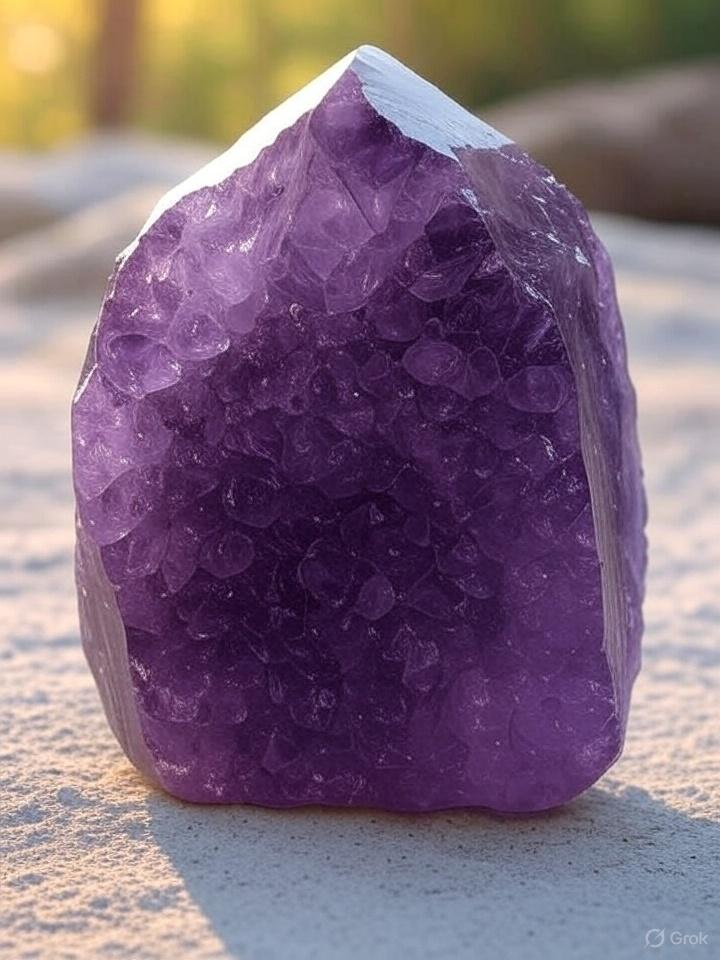
Amethyst
Chemical Formula | SiO₂ | ||||||||
|---|---|---|---|---|---|---|---|---|---|
Crystal System | Trigonal | ||||||||
Color | Shades ranging from light lavender to dark purple | ||||||||
Hardness (Mohs) | 7 | ||||||||
Luster | Glassy | ||||||||
Transparency | From transparent to translucent | ||||||||
Specific Gravity | 2.65 | ||||||||
Formation Environment | Voids in volcanic rocks, hydrothermal vein systems | ||||||||
Primary Occurrence Regions | Zambia Russia Canada Uruguay Brazil | ||||||||
Amethyst is a purple variety of the quartz mineral and has the chemical formula SiO₂ (silicon dioxide). This stone acquires its purple color due to the presence of iron (Fe³⁺) ions and the effect of natural radiation. Amethyst is a mineral formed through geological processes and is used for various industrial and decorative purposes.
Amethyst is a mineral belonging to the quartz group and has a trigonal crystal system. With a hardness of 7 on the Mohs scale, amethyst exhibits a vitreous luster and can range from transparent to translucent in appearance. The shades of purple vary from pale lavender to deep violet.
The purple color of amethyst results from the interaction between iron ions (Fe³⁺) within the crystal structure and natural radiation. This interaction creates color centers in the crystal lattice, giving amethyst its characteristic purple hue. When exposed to high temperatures, amethyst can turn yellowish, transforming during this process into another variety of quartz known as citrine.
Amethyst typically forms in cavities within volcanic rocks or in hydrothermal vein systems. Silica-rich hydrothermal fluids seep into these cavities and gradually crystallize to form amethyst. Formation temperatures generally range between 30°C and 400°C.

An infographic illustrating the geological formation process of amethyst. (Generated by artificial intelligence.)
The iron ions required for amethyst formation are transported by these hydrothermal fluids and incorporated into the crystal structure. Natural radiation alters the valence state of these iron ions, contributing to the formation of color centers. This process plays a critical role in developing amethyst’s distinctive purple color.
Amethyst is widely used in jewelry and ornamental objects. It is also employed in certain industrial applications. Amethyst is mined and traded in various regions around the world.
The economic value of amethyst varies according to its color, clarity, cut, and size. In addition to natural amethysts, synthetic amethysts are also produced in laboratory environments. Synthetic amethysts may possess physical and chemical properties similar to natural ones but typically exhibit a more uniform color distribution.

Use of amethyst in jewelry and ornamental objects. (Generated by artificial intelligence.)
Götze, Jens, Pan, Yuanming, Müller, Axel. "Mineralogy and mineral chemistry of quartz: A review." *Mineralogical Magazine* 85, no. 3 (2021): 332–350. Accessed May 22, 2025. https://www.cambridge.org/core/journals/mineralogical-magazine/article/mineralogy-and-mineral-chemistry-of-quartz-a-review/68D0E3F05734D0E1B25F6A9A267B12EF
Santos, H. C. dos, and A. M. Souza Filho. "Fluid inclusions in amethyst quartz of different geological environments from Brazil." *Mineralogical Magazine* 85, no. 3 (2021): 332-350. Accessed May 22, 2025. https://www.cambridge.org/core/journals/mineralogical-magazine/article/abs/fluid-inclusions-in-amethyst-quartz-of-different-geological-environments-from-brazil/5E0844E2EA3AE4F56B261CA3F57C3C68
Zhang, Y., et al. "Comparative Study of Mineralogical Characteristics of Natural and Synthetic Amethyst and Smoky Quartz." *Crystals* 12, no. 12 (2022): 1735. Accessed May 22, 2025. https://www.mdpi.com/2073-4352/12/12/1735

Amethyst
Chemical Formula | SiO₂ | ||||||||
|---|---|---|---|---|---|---|---|---|---|
Crystal System | Trigonal | ||||||||
Color | Shades ranging from light lavender to dark purple | ||||||||
Hardness (Mohs) | 7 | ||||||||
Luster | Glassy | ||||||||
Transparency | From transparent to translucent | ||||||||
Specific Gravity | 2.65 | ||||||||
Formation Environment | Voids in volcanic rocks, hydrothermal vein systems | ||||||||
Primary Occurrence Regions | Zambia Russia Canada Uruguay Brazil | ||||||||
Physical and Chemical Properties
Geological Formation Process
Applications and Economic Importance