


This article was automatically translated from the original Turkish version.
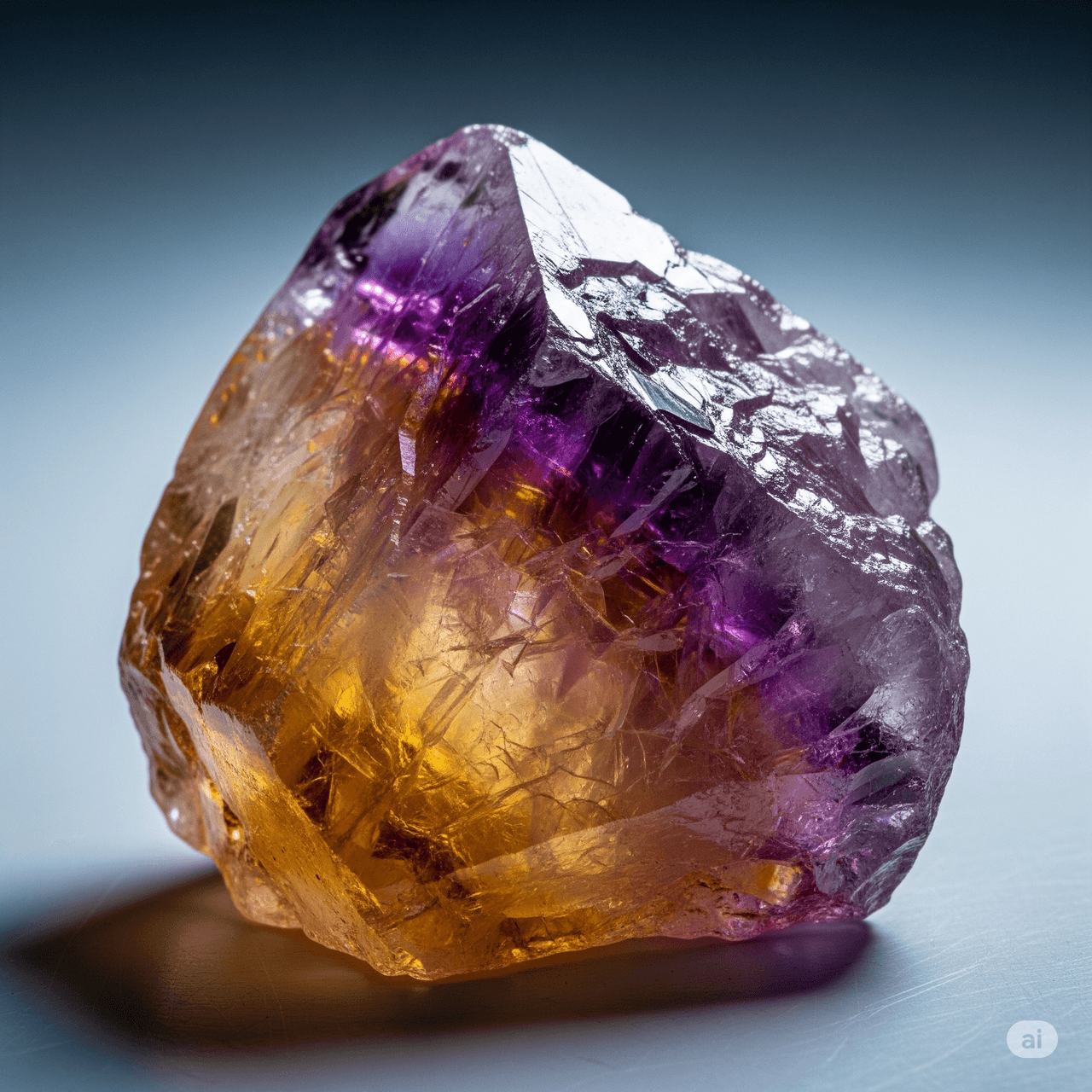
Ametrine
Chemical Formula | SiO₂ | ||||||||
|---|---|---|---|---|---|---|---|---|---|
Mineral Group | Quartz | ||||||||
Crystal System | Trigonal | ||||||||
Hardness (Mohs) | 7 | ||||||||
Color | yellow (citrine) zones Purple (amethyst) | ||||||||
Density | 2.65 g/cm³ | ||||||||
Refractive Index | nω = 1.543–1.553, nε = 1.552–1.554 | ||||||||
Birefringence | +0.009 | ||||||||
Pleochroism | Amethyst zones: weak to moderate purple/reddish purple; citrine zones: very pale yellow/orange | ||||||||
Main Deposits | Bolivia Santa Cruz Anahí Mine | ||||||||
Applications | decorative objects collections Jewelry | ||||||||
Synthetic Production | By hydrothermal methods, especially in Russia | ||||||||
Ametrine is a rare silicate mineral belonging to the quartz group, characterized by the coexistence of purple (amethyst) and yellow (citrine) color zones within a single crystal. This bicolored structure forms due to iron ions undergoing different oxidation states during crystal growth. Natural ametrine is commercially found only at the Anahí Mine in Bolivia, the sole known and continuously operated source of ametrine since the 17th century.
Ametrine is a variety of quartz with the chemical formula silicon dioxide (SiO₂). It crystallizes in the trigonal system and typically forms hexagonal prismatic crystals. With a Mohs hardness of 7, it is suitable for use in jewelry. Ametrine is distinguished by the presence of both amethyst and citrine color zones within the same crystal. These color variations arise from different oxidation states of iron ions: the purple color is attributed to Fe³⁺ ions, while the yellow color is due to Fe²⁺ ions. This phenomenon is linked to fluctuations in temperature and oxygen levels during crystal formation.

Ametrine Crystal Structure. (Generated by artificial intelligence.)
Ametrine exhibits uniaxial (+) optical properties with a birefringence value of approximately 0.009. Its refractive indices range from nω = 1.543–1.553 and nε = 1.552–1.554. It displays pleochroism: amethyst zones show weak to moderate purple to reddish-purple hues, while citrine zones exhibit very faint yellow to orange tones.
The only known commercial source of ametrine is the Anahí Mine in the Santa Cruz region of Bolivia. The mine was introduced to Europe in the 17th century after a Spanish conquistador married a princess of the Ayoreos tribe. The crystals occur in hydrothermal quartz veins. The bicolored structure results from variations in temperature and oxygen levels within the crystal during its formation.
Ametrine-like quartz crystals have been reported in Brazil and India; however, specimens from these regions are not commercially significant. Consequently, the vast majority of ametrine on the market originates from Bolivia.

Geological formation of ametrine. (Generated by artificial intelligence.)
Synthetic ametrine has been produced in Russia since 1994 using hydrothermal methods. These synthetic crystals exhibit optical and physical properties similar to natural ametrine but can be distinguished under microscopic examination. In synthetic ametrine, growth bands and color zones are more regular and symmetrical. Chemical analyses also reveal different concentrations of potassium, manganese, iron, and zinc compared to natural samples.
Microscopic examination under polarized light can differentiate natural from synthetic ametrine. In natural specimens, color zones are typically irregular and asymmetric, whereas synthetic ones show more uniform patterns. Additionally, natural ametrine often displays crystal twinning known as "Brazilian twinning."
Ametrine is widely used in the jewelry industry due to its aesthetic appeal and durability. It is commonly set in rings, necklaces, earrings, and bracelets. Specimens with pronounced color transitions and high transparency command higher value.
Ametrine is also sought after by collectors and mineral enthusiasts. Large, well-crystallized specimens hold significant collectible value. It is also used in decorative objects and small sculptures.
The value of ametrine varies according to the distinctness of its color zones, transparency, cut quality, and carat weight. Natural and high-quality ametrine specimens are sold at significantly higher prices than synthetic or low-quality examples.

Use of ametrine in jewelry. (Generated by artificial intelligence.)
Balitsky, V. S., Lu, T., Rossman, G. R., Makhina, I. B., Mar’in, A. A., Shigley, J. E., Elen, S., & Dorogovin, B. A. (1999). Russian synthetic ametrine. *Gems & Gemology*, 35(2), 122–134. Accessed May 23, 2025. https://www.gia.edu/doc/Russian-Synthetic-Ametrine.pdf
Mindat.org. "Ametrine: Mineral Information, Data and Localities." *Mindat.org*. Last modified: April 10, 2025. Accessed May 23, 2025. https://www.mindat.org/min-7606.html
Renfro, Nathan, Skalwold, Elisa A., Kolvula, J. “Ametrine Optical Dishes: Windows into the Effects of Crystal Structure.” *Gems & Gemology* 53, no. 1 (Spring 2017): 102–108. Accessed May 23, 2025. https://www.gia.edu/doc/GG-SP17-Micro-World-v2.pdf
Vasconcelos, P., H.-R. Wenk, Rossman, G. R. “The Anahí Ametrine Mine, Bolivia.” *Gems & Gemology* 30, no. 1 (1994): 4–23. Accessed May 23, 2025. https://www.gia.edu/doc/the-anahi-ametrine-mine-bolivia.pdf

Ametrine
Chemical Formula | SiO₂ | ||||||||
|---|---|---|---|---|---|---|---|---|---|
Mineral Group | Quartz | ||||||||
Crystal System | Trigonal | ||||||||
Hardness (Mohs) | 7 | ||||||||
Color | yellow (citrine) zones Purple (amethyst) | ||||||||
Density | 2.65 g/cm³ | ||||||||
Refractive Index | nω = 1.543–1.553, nε = 1.552–1.554 | ||||||||
Birefringence | +0.009 | ||||||||
Pleochroism | Amethyst zones: weak to moderate purple/reddish purple; citrine zones: very pale yellow/orange | ||||||||
Main Deposits | Bolivia Santa Cruz Anahí Mine | ||||||||
Applications | decorative objects collections Jewelry | ||||||||
Synthetic Production | By hydrothermal methods, especially in Russia | ||||||||
Mineralogical Properties
Chemical Composition and Crystal Structure
Optical Properties
Geological Formation and Deposits
Anahí Mine (Bolivia)
Other Potential Deposits
Synthetic Ametrine and Distinguishing Features
Applications and Economic Value
Jewelry and Ornamental Use
Collection and Decorative Use
Economic Value