


This article was automatically translated from the original Turkish version.
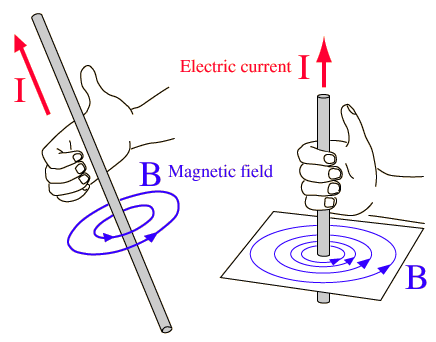
Ampère’s Law is a fundamental concept in electromagnetism and defines the magnetic field generated by an electric current. This law is related to the circulation of the electric current in a given environment. Ampère’s Law, also known as Ampère’s circuital law, states that the total line integral of the magnetic field around any closed path is equal to the total electric current passing through that path. In this article, the fundamental principles of Ampère’s Law will be examined in detail, from its basic concepts to its mathematical formulation, along with examples of its applications in daily life and engineering.
Ampère was a French physicist and mathematician who lived between 1775 and 1836. He discovered the relationship between electricity and magnetism, demonstrating that an electric current produces a magnetic field. This discovery led to his recognition as the “father of electrodynamics.” Ampère’s observations that electric currents generate magnetic fields preceded Faraday’s work on magnetic fields, and these complementary investigations were later unified by Maxwell.

André-Marie Ampère
Ampère’s Law states that the magnetic field originates from an electric current. The law specifies that the magnetic field is proportional to the magnitude of the current and includes the permeability of free space (μ₀) as the proportionality constant. Mathematically, Ampère’s Law can be expressed as:

In this equation:

This law helps us understand how the magnetic field relates to electric current and serves as a crucial tool for calculating magnetic fields.
Ampère’s Law is commonly used to calculate the magnetic field around a current-carrying conductor. Suppose we have a long, straight wire carrying a steady current. To determine the magnetic field around this wire, we imagine a circular path centered on the wire. This path forms a circle, and we integrate the magnetic field along this path.
Because the magnetic field has the same magnitude at every point due to symmetry, and the path length equals the circumference of the circle, Ampère’s Law gives the magnetic field as:


Ampère’s Law is used in various electromagnetic calculations and has practical applications across fields ranging from electrical engineering to physical research. Below are some key application areas of this law:
Ampère’s Law is critical for understanding the magnetic fields produced by electric currents. It forms one of the foundational pillars of electromagnetic theory and has broad applications across physics disciplines in conjunction with modern electrical engineering. Ampère’s Law is an indispensable tool for magnetic field calculations and the design of electrical systems. Ampère’s discoveries, combined with Maxwell’s equations, laid the foundation for the theory of electromagnetic fields. Therefore, Ampère’s Law is not merely a theoretical concept but also a frequently used tool within everyday technology.

André-Marie Ampère
Determining the Magnetic Field Around a Circular Conductor
Applications of Ampère’s Law