


This article was automatically translated from the original Turkish version.
+2 More
Location | Edremit Balıkesir – 4 km east of Altınoluk | ||||||||
|---|---|---|---|---|---|---|---|---|---|
Establishment | 10th century BC | ||||||||
Founder(s) | Pelasgians Aeolians | ||||||||
Strategic Location | Adramyttion–Assos road, foothills of Kaz Dağı | ||||||||
Economy | Timber trade shipbuilding | ||||||||
The Ancient City of Antandros is located approximately 4 kilometers east of the Altınoluk village, within the Edremit district of Balıkesir Province, at the foot of Mount Kaz (ancient Mount Ida). Situated between Adramyttion (Burhaniye-Ören) and Assos (Behramkale), the city held a strategically important military position in antiquity. Henri Kiepert noted that the acropolis was situated on a hill known as Yarmataş, between Altınoluk and Avcılar, at an elevation of 215 meters, extending toward the east.

The Ancient City of Antandros (Anadolu Agency)
The foundation of Antandros is dated to the 10th century BCE, but given that nearby settlements such as Assos have histories extending back to the 2nd millennium BCE, it is considered likely that Antandros was also inhabited during this earlier period. Ancient sources offer differing views regarding the city’s foundation and settlement phases. Alkaios described it as a Lelegian settlement, while Demetrios of Skepsis claimed it originated from Cilicia. Herodotus stated that Antandros was a Pelasgian settlement, whereas Thucydides identified it as an Aeolian settlement. According to Aristotle, the city’s alternative names such as Edonis and Kimmeris reflect the influence of dominant tribes in the region.
Ancient sources indicate that Antandros was a significant military target during the period of the Persian Empire. Following the Ionian Revolt of 499–494 BCE, the city was captured by Otoneis, a commander of the Persian king Darius. Herodotus recorded that Xerxes’ army passed by Antandros during his campaign against Greece. During the Peloponnesian Wars, the city changed hands multiple times and was required to pay tribute while under Athenian control. After the Sicilian Expedition, it reverted to Persian dominance. From the second half of the 4th century BCE, it is known to have minted its own coins as an independent city. During the late Roman period, coin production continued from the time of Titus through the reign of Elagabalus. In the Christian era, it became a bishopric center.
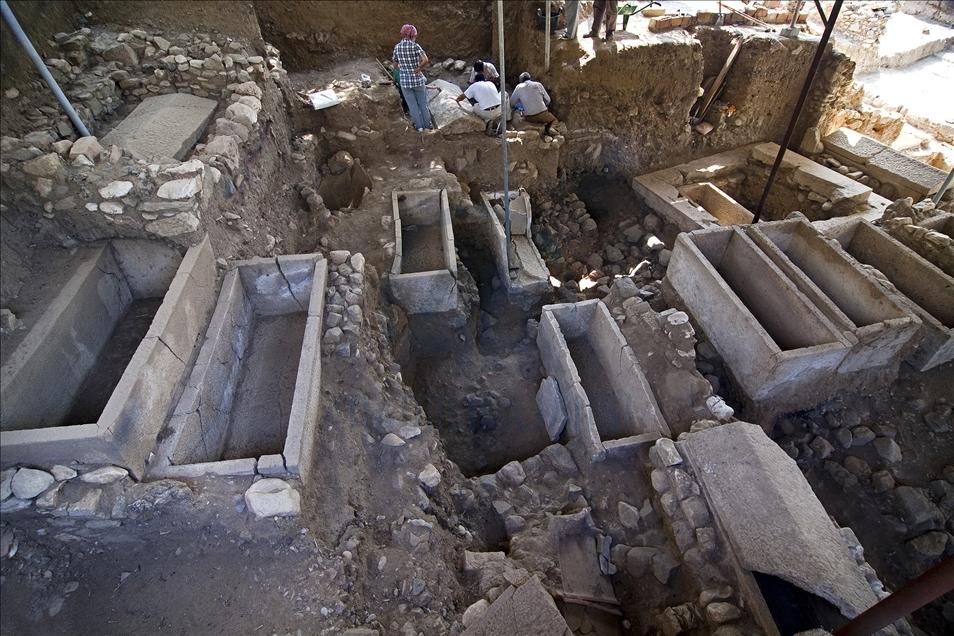
The necropolis of the ancient city lies approximately 2 kilometers west of Yarmataş Hill. The necropolis area was uncovered during modern construction activities, and rescue excavations were conducted between 1989 and 1996. Excavation work, initiated in 2001 under the leadership of the Balıkesir Museum Directorate and with scientific guidance from Assistant Professor Dr. Gürcan Polat of the Ege University Department of Archaeology, continues to the present day. The necropolis, in use from the 7th to the 2nd century BCE, reveals burial practices including stacked sarcophagi constructed along the slope of the terrain, as well as cremation and direct inhumation burials. Artifacts from the graves are exhibited in the museums of Balıkesir and Bandırma.

The Ancient City of Antandros (Anadolu Agency)
Archaeological excavations in the city, particularly around a Roman-era floor mosaic discovered as a result of illegal digs, have led to systematic investigations. These efforts revealed a Roman villa dating to the 1st century CE, featuring mosaic flooring and wall frescoes. This structure provides significant insights into the urban layout and domestic architecture of Antandros during the Roman period.

The Ancient City of Antandros (Anadolu Agency)
According to ancient sources and coinage, timber trade, particularly wood harvested from Mount Ida and widely used in shipbuilding, played a major role in Antandros’ economic activities. This demonstrates the city’s effective utilization of its natural resources and its integration into regional trade networks.
Anadolu Ajansı. 2021. “Altınoluk Antandros Antik Kenti’ndeki Kazıların Yıl Boyu Süreceği Açıklandı.” *Anadolu Ajansı*, January 14, 2021. Accessed June 17, 2025. https://www.aa.com.tr/tr/kultur-sanat/altinoluk-antandros-antik-kentindeki-kazilarin-yil-boyu-surecegi-aciklandi/2124584.
Ministry of Culture and Tourism of the Republic of Turkey. 2025. “Antandros Antik Kenti - Balıkesir.” *Türkiye Kültür Portalı*. Accessed June 17, 2025. https://www.kulturportali.gov.tr/turkiye/balikesir/gezilecekyer/antandros-edremit-altinoluk-antik-kenti.
Ministry of Culture and Tourism of the Republic of Türkiye. 2025. “Antandros Antik Kenti.” *Balıkesir İl Kültür veTurizm Müdürlüğü - Müzeler ve Ören Yerleri*. Accessed June 17, 2025. https://balikesir.ktb.gov.tr/TR-65921/muzeler-ve-oren-yerleri.html.
Ministry of Culture and Tourism of the Republic of Türkiye. 2025. “Antik Kentler (Ören Yerleri).” *Balıkesir İl Kültür veTurizm Müdürlüğü. Accessed June 17, 2025. https://balikesir.ktb.gov.tr/TR-90612/antik-kentler-oren-yerleri.html.

Location | Edremit Balıkesir – 4 km east of Altınoluk | ||||||||
|---|---|---|---|---|---|---|---|---|---|
Establishment | 10th century BC | ||||||||
Founder(s) | Pelasgians Aeolians | ||||||||
Strategic Location | Adramyttion–Assos road, foothills of Kaz Dağı | ||||||||
Economy | Timber trade shipbuilding | ||||||||
No Discussion Added Yet
Start discussion for "Ancient City of Antandros" article
Foundation and Historical Development
Political and Military History
Necropolis and Burial Practices
Roman Period Remains
Economy and Trade