This article was automatically translated from the original Turkish version.
+1 More
Location | Eskipazar Türkiye Karabük | ||||||||
|---|---|---|---|---|---|---|---|---|---|
Period(s) | Late Hellenistic Roman and Early Byzantine | ||||||||
Foundation | 1st–2nd century CE | ||||||||
Notable Structures | Two churches, Bathhouse, Theatre, Fountain, Mosaics, Cistern | ||||||||
Notable Discoveries | Asklepios inscription (2nd century CE), mosaics | ||||||||
Hadrianaupolis Ancient City is a significant settlement site located within the boundaries of Eskipazar district in Karabük province, dating to the Late Hellenistic, Roman, and Early Byzantine periods. Named after the Roman Emperor Hadrian (r. 117–138 CE), this ancient city is situated in the interior of the Black Sea region and is notable for its religious significance during the Byzantine era, rich mosaics, and architectural remains. It is regarded as one of the most comprehensive archaeological sites in northwestern Anatolia.
The name of the ancient city was bestowed in the 2nd century CE in honor of the Roman Emperor Hadrian. Based on inscriptions and archaeological findings, Hadrianaupolis emerged not merely as a regional center but also as an important bishopric during the early Christian period. It is evident that during the Late Roman and Byzantine periods, the settlement played a key role in supporting the region’s religious and commercial networks.

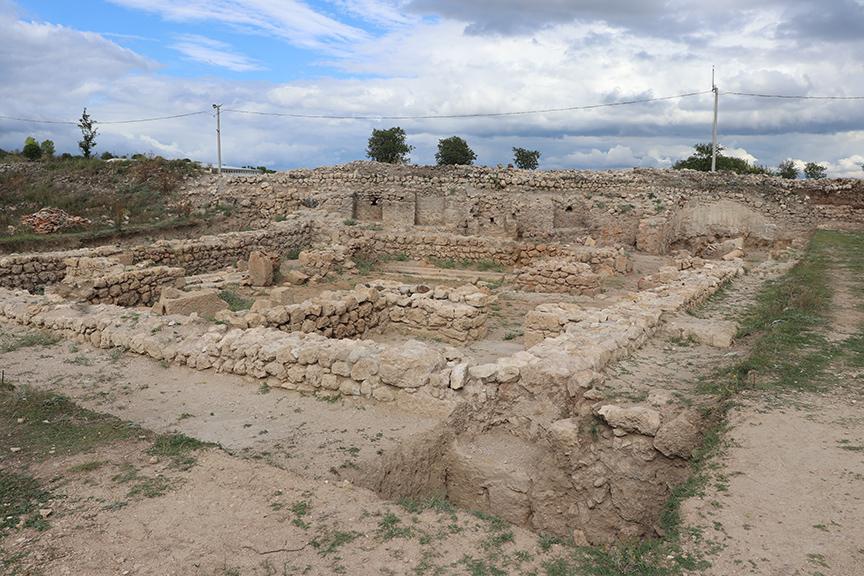
Hadrianaupolis Ancient City ( Anadolu Agency)
Excavations and surface surveys at Hadrianaupolis have so far identified 14 distinct building complexes. Among these, the most prominent include:
One of the city’s most striking features is its floor mosaics. Particularly those found in the floors of the large churches hold significant importance in terms of Christian iconography and animal motifs. Figures such as peacocks, deer, and birds depicted in the mosaics are interpreted as symbolic expressions of early Christian art.
In 2022, during excavations in the city, a 1,800-year-old inscription dating to the 2nd century CE was discovered, dedicated to Asklepios (the god of medicine). This inscription suggests that Hadrianaupolis may have also been an important center for health and medical practices, beyond its religious and administrative roles. The inscription also contains information about local officials of the period alongside the name of Asklepios.
During the early Christian period, Hadrianaupolis functioned as an important bishopric center. Basilica church remains dated between the 4th and 8th centuries CE attest to the city’s spiritual status and the density of the Christian population in the region. Inscriptions and symbolic decorations within the churches provide representative examples of early Christian art in the area.
Excavation efforts are conducted in collaboration between the Ministry of Culture and Tourism, the Department of Archaeology at Karabük University, and the Turkish Culture Foundation. These archaeological investigations not only reveal the city’s historical layers but also contribute to the region’s cultural tourism potential. Most of the structures uncovered through excavations are being restored without compromising their original fabric.
In addition to possessing a unique mosaic heritage, Hadrianaupolis holds the historical value of a multi-layered cultural structure spanning from the Hellenistic to the Byzantine periods. The city provides crucial insights into the ancient religious geography of the Black Sea region and offers archaeologists and art historians an extensive field of research through its mosaics, inscriptions, and architectural details.
Anadolu Ajansı. “Hadrianaupolis’te Asklepios Varlığına İşaret Eden 1800 Yıllık Yazıt Bulundu.” Anadolu Ajansı, November 28, 2022. Accessed June 20, 2025. https://www.aa.com.tr/tr/kultur/hadrianaupoliste-asklepios-varligina-isaret-eden-1800-yillik-yazit-bulundu/2677290.
Culture Portal. "Hadrianopolis Antik City." *Republic of Turkey Ministry of Culture and Tourism Culture Portal*. Accessed June 20, 2025. https://www.kulturportali.gov.tr/turkiye/karabuk/gezilecekyer/hadrianopolis-antik-kenti.
Türk Kültür Vakfı. “Hadrianapolis Antik Kenti.” TÜKAV – Türk Kültür Vakfı. Accessed June 20, 2025. https://tukav.org.tr/hadrianapolis-antik-kenti/.

Location | Eskipazar Türkiye Karabük | ||||||||
|---|---|---|---|---|---|---|---|---|---|
Period(s) | Late Hellenistic Roman and Early Byzantine | ||||||||
Foundation | 1st–2nd century CE | ||||||||
Notable Structures | Two churches, Bathhouse, Theatre, Fountain, Mosaics, Cistern | ||||||||
Notable Discoveries | Asklepios inscription (2nd century CE), mosaics | ||||||||
No Discussion Added Yet
Start discussion for "Ancient City of Hadrianaupolis" article
History and Nomenclature
Archaeological Remains and Structures
Mosaics
Asklepios Inscription
Religious Significance
Conservation and Excavation Projects
Contemporary Significance