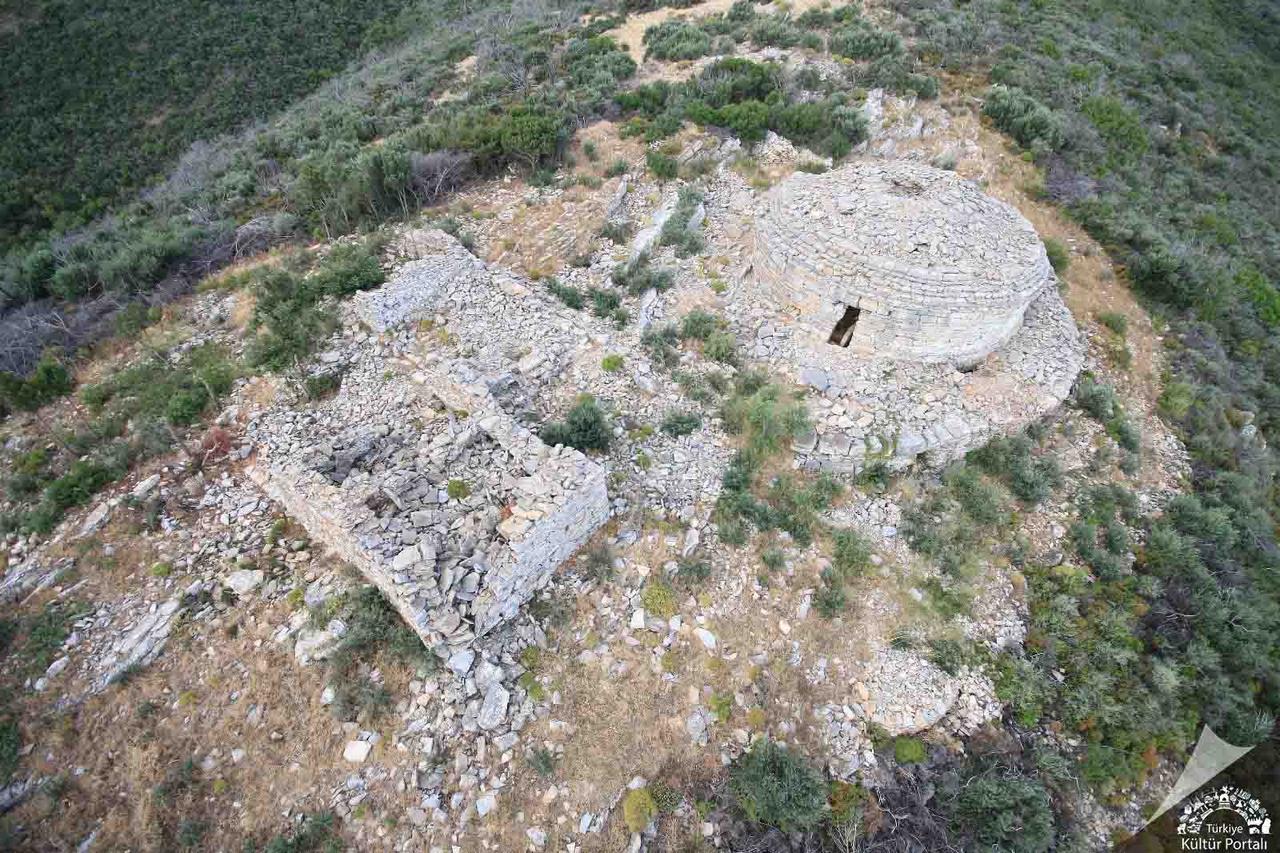


This article was automatically translated from the original Turkish version.
+2 More
Location | Konacık Neighborhood Türkiye Muğla Bodrum | ||||||||
|---|---|---|---|---|---|---|---|---|---|
Founder(s) | Leleges | ||||||||
Establishment | Late Bronze Age – Early Iron Age Transition Period | ||||||||
Affiliated Region | Caria | ||||||||
Status | Studies Are Ongoing | ||||||||
Pedasa Ancient City is an ancient settlement located in the Gökçeler locality, within the boundaries of Konacık Village, Bodrum District, Muğla Province. It is one of the eight cities founded by the Leleges, regarded in ancient written sources as the ancestors of the Carians. Pedasa, one of the Leleg settlements occupying the broadest region of the peninsula, is among the rare ancient cities to have experienced continuous habitation from the Archaic Period through the Byzantine Period.
The ancient city of Pedasa was established during the transition between the Late Bronze Age and the Early Iron Age. The ancient writer Homer recounts that the Leleges, under their king Altes, lived in a city named Pedasos on the banks of the Satnioeis River south of Troy, and after the Trojan War migrated southward to settle on the Halicarnassus Peninsula in Caria. This narrative suggests that Pedasa on the Bodrum Peninsula was founded as a continuation of Pedasos, the ancestral homeland of Altes.
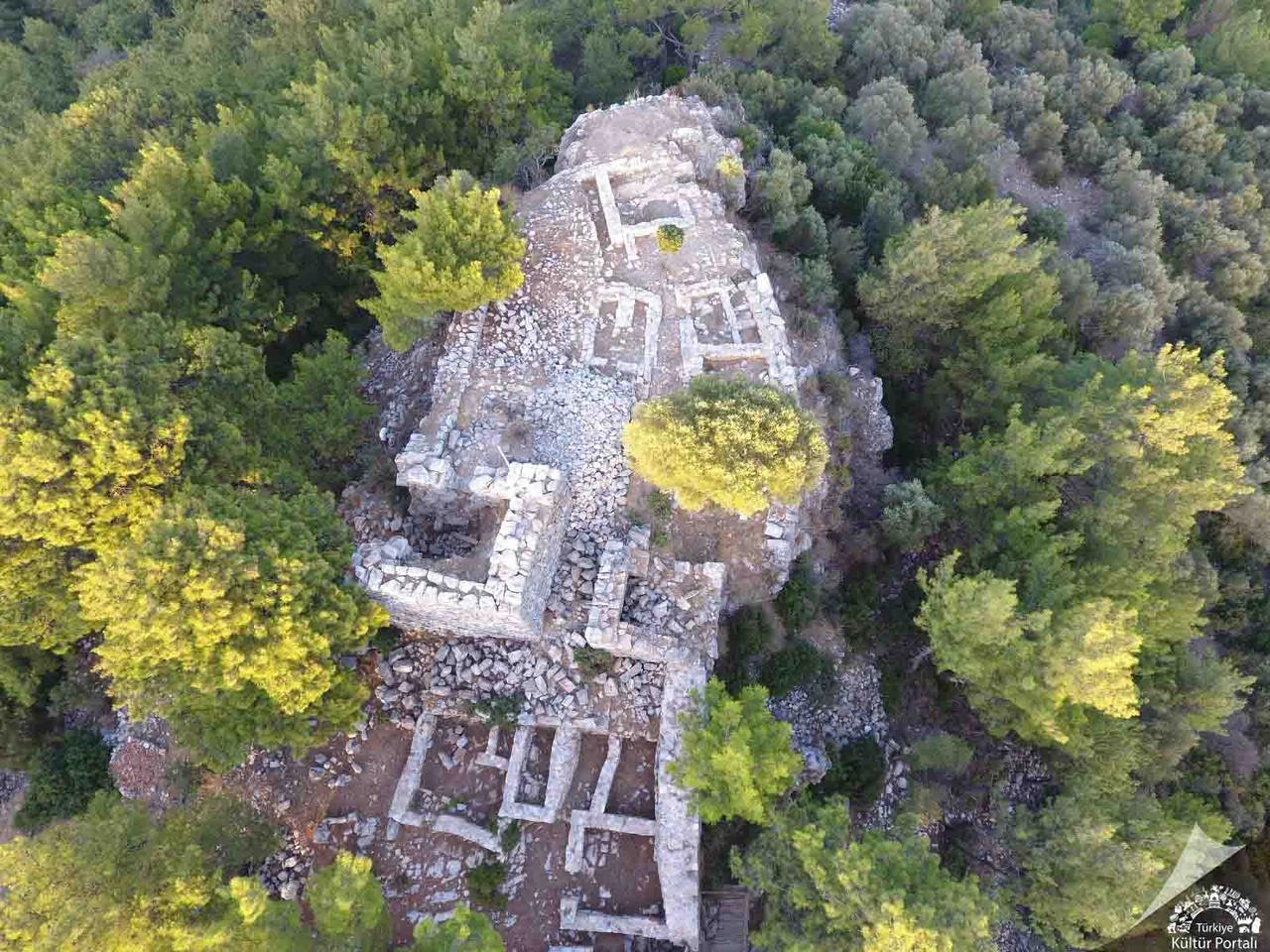
Pedasa Ancient City (Culture Portal)
The city was constructed in a geographically remote, mountainous, and defensible location away from the sea. Like other Leleg settlements on the peninsula, Pedasa was organized as a settlement on difficult-to-access hills and slopes, designed to provide protection against pirate raids. Archaeological findings reveal that intensive settlement began in the Early Iron Age and continued uninterrupted through the Archaic, Classical, Hellenistic, Roman, and Byzantine periods.
The ancient source Herodotus notes that Pedasa was situated inland above Halicarnassus. Strabo records that in his own time, this abandoned settlement was known as “Pedasis.”
During the 6th century BCE, as the Persian invasions began with the conquest of Lydia, Pedasa became historically notable as the only Carian city to resist the Persians. According to Herodotus, when the Persian army under Harpagos marched against Caria, only the people of Pedasa offered resistance. Furthermore, during the Ionian Revolt after 499 BCE, they ambushed the Persian forces on the road to Pedasa, inflicting heavy losses.
The 6th to 5th centuries BCE marked the peak of Pedasa’s prosperity. During this period, the city’s acropolis defense system was reinforced with outer walls, towers, and bastions, all constructed in response to the Persian threat. The sanctuary of Athena, the city’s sacred area, also took shape in this era. The site, which had been in use since the 10th century BCE, reached its most intense phase of activity in the third quarter of the 6th century BCE.
Pedasa’s independent status ended in the second quarter of the 4th century BCE. Mausolus incorporated the Leleg settlements into Halicarnassus, establishing a centralized administration, and Pedasa became part of Halicarnassus. However, epigraphic evidence indicates that the city was not entirely abandoned after this integration; the cult of Athena persisted into the Roman period and even into the 1st century CE.
According to excavation findings, life in Pedasa continued uninterrupted until the Middle Byzantine Period. This continuity demonstrates that the region was not merely a Leleg settlement but also a multi-layered cultural center of Carian culture spanning from the Early Iron Age to the Byzantine Period.
Pedasa occupies a vast area of 2,500 hectares. The city consists of a walled acropolis, the Sanctuary of Athena located outside the walls, necropolises containing various types of tombs, residential areas, and agricultural terraces.
The acropolis served as both the geographical and administrative center of the city during the Archaic and Classical periods. The structure, fortified with inner and outer walls, is regarded as a precursor to the defensive techniques developed during the Hecatomnid period.
The Sanctuary of Athena in Pedasa is the city’s most important religious center. Evidence shows that its use dates back to the 10th century BCE, that it was organized as a temple terrace in the 7th century BCE, and that it reached its most magnificent phase in the 6th century BCE. The statue of Athena, inscriptions, and other finds found here support the regional significance of the sanctuary.
Pedasa’s defense system comprises an inner wall, an outer wall, and a citadel structure. The inner wall was constructed from roughly worked limestone blocks measuring 1.5–1.8 meters in thickness. The tower located on the southwest side of the wall occupies a strategic position controlling the main access route.
The “Dipyrgon,” a two-towered structure situated at the highest point of the acropolis, dates to the 5th century BCE and functioned as a residence for a local ruler. This building is considered one of the earliest examples of Hecatomnid-period citadel architecture in the Carian region.
Many stone tumuli and platform tombs have been identified in Pedasa. These tomb types are regarded as distinctive elements of Leleg identity and have no known parallels elsewhere in Western Anatolia. Platform tombs play a key role in understanding burial traditions in the region.
The localization of the city was definitively established thanks to an altar inscription to Athena discovered by Paton and Myres in 1896. This inscription, dated to the 5th century BCE, confirms the presence of the cult of Athena in Pedasa. Herodotus also mentions an event involving the priestess of Athena and the ritual removal of her beard, associated with oracular practice. Coins from Pedasa depict Athena wearing a crested helmet and an owl; these motifs reflect the city’s religious and cultural identity.
Since 2007, excavation, conservation, and environmental improvement works have been carried out under the leadership of Professor Dr. Adnan Diler on behalf of the Ministry of Culture and Tourism of the Republic of Türkiye and Muğla Sıtkı Koçman University. These efforts have revealed Pedasa’s history from the Leleg period through the Byzantine era, its settlement pattern, and its religious life.
Diler, Adnan, Bekir Özer, Hülya Bulut et al. "Pedasa Kazı ve Araştırmaları." *Bitig Edebiyat Fakültesi Dergisi*, no. 1 (2021): 182-267. Accessed October 13, 2025. https://dergipark.org.tr/en/pub/bitigefd/issue/66284/1042338
Türkiye Kültür Portalı. "Pedasa Antik Kenti - Muğla." *kulturportali*. Accessed October 13, 2025. https://www.kulturportali.gov.tr/turkiye/mugla/gezilecekyer/pedasa-antik-kenti
Özgüneş, Reşad Emre, and Hüseyin Çeken. "Kültürel Miras Turizmi Olgusu ve Bodrum Pedasa Antik Kenti." *4. Uluslararası Tarih ve Kültürel Miras Kongresi*. Bodrum (December 2022): 231-239. Accessed October 13, 2025. https://www.researchgate.net/publication/366702319_Kulturel_Miras_Turizmi_Olgusu_ve_Bodrum_Pedasa_Antik_Kenti

Location | Konacık Neighborhood Türkiye Muğla Bodrum | ||||||||
|---|---|---|---|---|---|---|---|---|---|
Founder(s) | Leleges | ||||||||
Establishment | Late Bronze Age – Early Iron Age Transition Period | ||||||||
Affiliated Region | Caria | ||||||||
Status | Studies Are Ongoing | ||||||||
No Discussion Added Yet
Start discussion for "Ancient City of Pedasa" article
History
Archaeological Structures and Settlement Layout
Architectural Elements
Tomb Types and Necropolis Areas
Epigraphic Evidence and the Cult of Athena
Contemporary Research