

This article was automatically translated from the original Turkish version.
+1 More
Location | Sığacık İzmir Seferihisar | ||||||||
|---|---|---|---|---|---|---|---|---|---|
Establishment | Around 1000 BCE (Ionian migration period) | ||||||||
Founder(s) | Athamas's son Athames or Codrus's son Naucles | ||||||||
Prominent Structures | Temple of Dionysus, Theatre, Bouleuterion (Council House) | ||||||||
Teos is one of the Ionian cities located in western Anatolia, within the boundaries of the Sığacık neighborhood of the Seferihisar district in present-day İzmir. In antiquity, Teos was one of the important port cities along the Aegean coast, renowned particularly for its religious and cultural life, as well as for its Temple of Dionysus and the association of artists (Dionysiac technitai).
The foundation of Teos dates back to around 1000 BCE. Its founder is traditionally identified as Athames, son of Athamas, or Nauklides, son of Kodros. The area was initially thought to have been settled by Carians, but later reshaped during the Ionian migrations as part of the broader Ionian colonization. Teos joined the Ionian League and became one of the region’s key cultural and religious centers.
Teos came under the rule of several successive powers including Lydians, Persians, Alexander the Great, the Seleucids, the Kingdom of Pergamon, and the Roman Empire, undergoing significant architectural and administrative transformations during these periods. In the 6th century BCE, during the Persian occupation, part of the population abandoned the city and migrated to Abdera in Thrace.

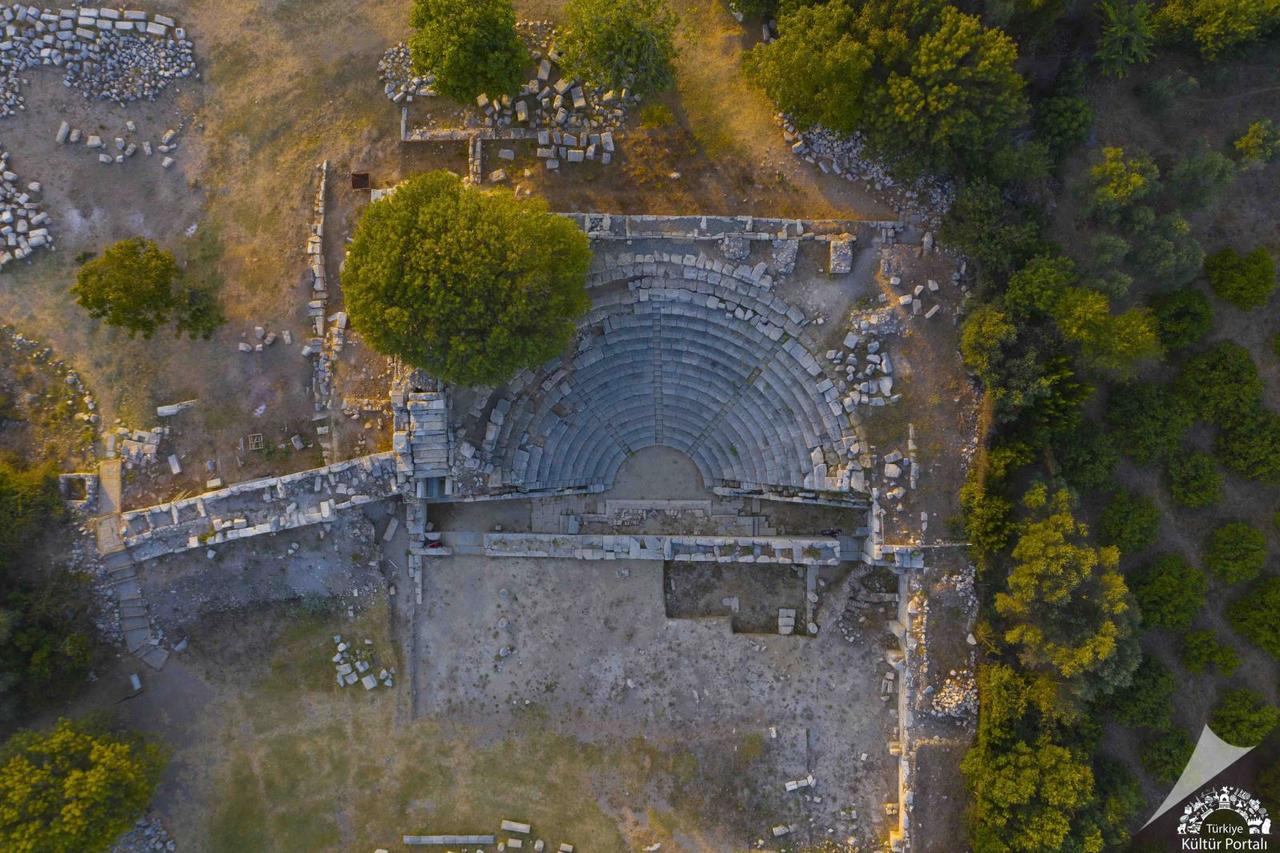
Teos Ancient City (Anadolu Agency)
One of the most prominent structures in Teos is the temple dedicated to Dionysus, the god of wine and theater. This building was regarded as one of the central cult sites of Dionysus in antiquity. Constructed in the 2nd century BCE by Hermogenes, it is among the largest temples built in the Ionic order.
Teos was also distinguished in antiquity by another feature: the Association of Dionysiac Artists (Dionysiac Technitai). This organization comprised actors, poets, musicians, and other artists, establishing Teos as an artist city in the ancient world. The association enhanced the city’s cultural influence and played a role in its diplomatic relations.
The main structures remaining in the Ancient City of Teos include:

Teos Ancient City (Anadolu Agency)
Teos developed economically through agricultural activities such as wine production, olive cultivation, and olive oil trade. With its two distinct harbors, it established commercial ties with other cities of the Aegean and Mediterranean, becoming an active center of maritime trade and commerce.
Today, the Ancient City of Teos holds the status of an archaeological site under excavation and conservation by the Ministry of Culture and Tourism. Work carried out at the Teos Temple of Dionysus and the theater area is of significant importance both scientifically and for the preservation of cultural heritage. The site is open to visitors and serves as one of the key destinations for archaeological and cultural tourism.
Anadolu Ajansı. “Sığacık'taki Tarihi Sanatçılar Kenti: Teos.” Anadolu Ajansı, Accessed June 20, 2025. https://www.aa.com.tr/tr/pg/foto-galeri/sigaciktaki-tarihi-sanatcilar-kenti-teos/0
Güler, Türkan Banu. “Teos Antik Kenti ve Dionysos Sanatçılar Birliği.” *Tarih Araştırmaları Dergisi* 34, no. 57 (May 2015): 30–47. https://dergipark.org.tr/tr/pub/tariharastirmalari/issue/47745/603053
Kültür Portalı. “Teos Antik Kenti.” Türkiye Kültür Portalı, Accessed June 20, 2025. https://www.kulturportali.gov.tr/turkiye/izmir/gezilecekyer/teos-antik-kenti-
Museum Directorate. "Teos Antik City." Ministry of Culture and Tourism of the Republic of Türkiye, General Directorate of Museums, Accessed June 20, 2025. https://muze.gov.tr/muze-detay?sectionId=TEO01&distId=MRK
Müzeler.org. "Teos Antik Kenti." Accessed June 20, 2025. https://muzeler.org/teos-antik-kenti--37057
Vardar, Serdar, Rıfat İlhan, and Ertuğ Öner. “Teos Antik Yerleşimi Çevresinde Paleocoğrafya-Jeoarkeoloji Araştırmalarının İlk Sonuçları (Seferihisar-İzmir).” *Journal of Geography*, no. 40 (April 2020): 323–338. https://dergipark.org.tr/tr/pub/iucografya/issue/53585/761198

Location | Sığacık İzmir Seferihisar | ||||||||
|---|---|---|---|---|---|---|---|---|---|
Establishment | Around 1000 BCE (Ionian migration period) | ||||||||
Founder(s) | Athamas's son Athames or Codrus's son Naucles | ||||||||
Prominent Structures | Temple of Dionysus, Theatre, Bouleuterion (Council House) | ||||||||
No Discussion Added Yet
Start discussion for "Ancient City of Teos" article
History
Cultural and Religious Structures
Temple of Dionysus
Association of Artists (Dionysiac Technitai)
Archaeological Remains
Economy and Port City Identity
Teos Today