This article was automatically translated from the original Turkish version.
+2 More
Period(s) | Hellenistic-Roman-Byzantine | ||||||||
|---|---|---|---|---|---|---|---|---|---|
Structure(s) | Wall nymphaeum necropolis basilica bath | ||||||||
Feature(s) | Independent ancient site | ||||||||
Necropolis | Barrel-vaulted tomb, sarcophagus, eagle figure | ||||||||
Water Source | Nymphaeum | ||||||||
Titiopolis is an ancient settlement located within the boundaries of the Anamur district of Mersin province in Türkiye. Based on archaeological surveys conducted between 1964 and 1968 in the Cilicia region by George Ewart Bean and Terence Bruce Mitford, the area now occupied by the modern village of Kalınören has been identified as Titiopolis. The ancient city contains remains from the Hellenistic, Roman, and Byzantine periods and is described in ancient sources as an independent site not subordinate to Anemurium.

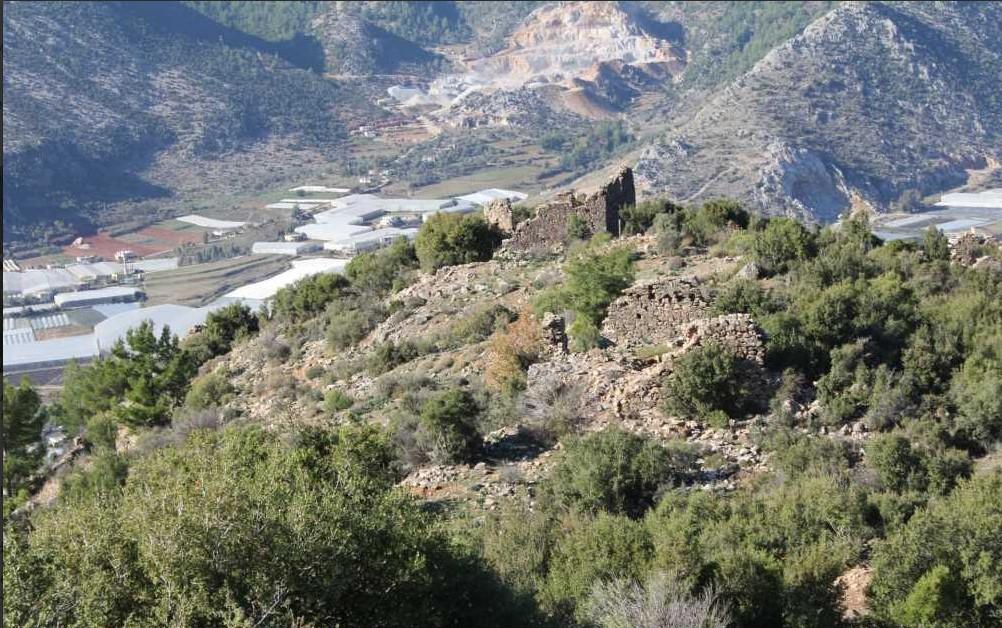
Titiopolis (T.C. Anamur Municipality)
The regular city walls of Titiopolis were constructed from roughly hewn stones of varying sizes and shapes. The settlement is believed to have included structures such as a bouleuterion, a nymphaeum, an odeon, and a theatre, but these are now buried beneath the modern village. At the entrance to the village, among gardens, a spiral column made of hard grey stone is considered to belong to one of the city’s major buildings. The gardens contain spaces with mosaic floors, although their exact functions have not yet been determined.

Titiopolis (T.C. Anamur Municipality)
As one ascends the hills, the first structure encountered is a bathhouse, which is thought to have been part of a gymnasion complex. To the west of the bathhouse stands a basilica with a three-aisled narthex. The basilica features syntrona steps, and on either side of the apse are diaconicon chambers. This arrangement indicates a multi-purpose basilica type with a vaulted rear area behind the apse.
To the north of the settlement, within the walled acropolis area, there are basilicas, a bathhouse, and necropolis zones. These areas reveal that the city was planned to meet its urban needs. The western and eastern basilicas within the acropolis are completely ruined, but their floors are decorated with mosaics in grey and white tones featuring geometric and vegetal motifs.

Titiopolis (
In the necropolis area located east of the religious structures, monumental tombs belonging to a few distinguished individuals have been identified. The tombs are two-story vaulted structures built of cut stone. On the facade of a sarcophagus on the eastern slope of the acropolis, relief carvings depict an eagle with outstretched wings, a bucranium bearing garlands, and Medusa heads. Nearby, a relief shows a male figure seated on a table, holding a staff.
At the northern end of the acropolis, there is a tylos-type bathhouse consisting of three separate vaulted chambers. The water supply for this bathhouse was provided by a nymphaeum located 20 metres away.
T.C.Anamur Belediyesi. "Titiopolis." Accessed June 20, 2025. https://anamur.bel.tr/titiopolis/.
Türkiye Kültür Portalı. "Titiopolis - Mersin." Accessed June 20, 2025. https://www.kulturportali.gov.tr/turkiye/mersin/gezilecekyer/titiopolis

Period(s) | Hellenistic-Roman-Byzantine | ||||||||
|---|---|---|---|---|---|---|---|---|---|
Structure(s) | Wall nymphaeum necropolis basilica bath | ||||||||
Feature(s) | Independent ancient site | ||||||||
Necropolis | Barrel-vaulted tomb, sarcophagus, eagle figure | ||||||||
Water Source | Nymphaeum | ||||||||
No Discussion Added Yet
Start discussion for "Ancient City of Titiopolis" article
Settlement and Architectural Structures
Public and Religious Structures
Necropolis Area
Bathhouse and Water Supply