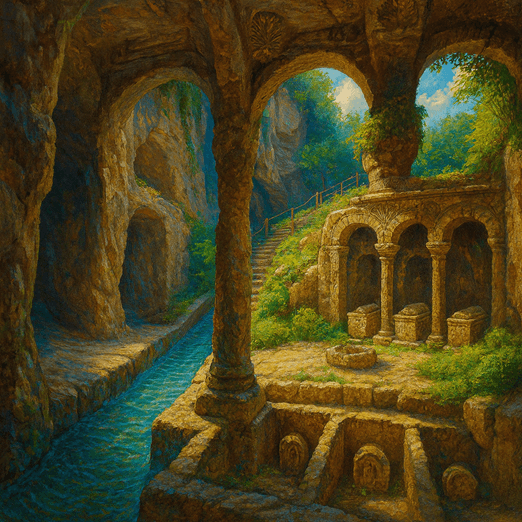




Titus Tunnel and Beşikli Cave
A Waterway Through the Mountains
The Titus Tunnel in the Samandağ district of Hatay is a monumental engineering feat from the Roman era. In the 1st century CE, Emperor Vespasian ordered its construction to protect the city and its harbor from flooding. Construction began in 69 CE and was completed in 81 CE by his son Titus.
The tunnel was entirely carved by hand into the mountainside. It is 1,380 meters long, 7 meters high and 6 meters wide. Thanks to this tunnel, floodwaters were diverted away from the city and safely channeled into the sea.

(Generated by Artificial Intelligence)
Beşikli Cave: Secrets Within the Rock
Approximately 100 meters from the sea entrance of the Titus Tunnel lie the rock-cut tombs known as Beşikli Cave. This site served as a necropolis during the Roman period. Twelve tombs carved into the rock are connected by stone columns and arches. Ceilings feature motifs of oysters and ivy.
It derives its name from two side-by-side stone sarcophagi. Despite the passage of centuries, these tombs remain well preserved and offer visitors a tangible sense of the past.

(Generated by Artificial Intelligence)
How to Get There
The Titus Tunnel and Beşikli Cave are located approximately 5 kilometers from the center of Samandağ. You can reach them by car by following the signs. Shuttle services departing from Samandağ also transport visitors to the site. Nearby historical sites include the ancient city of Seleucia Pieria, the Shrine of Hz. Hızır and the Temple of Dor.

(Generated by Artificial Intelligence)