

This article was automatically translated from the original Turkish version.
+2 More
Location | Türkiye Denizli Buldan | ||||||||
|---|---|---|---|---|---|---|---|---|---|
Establishment | 3rd century BCE | ||||||||
Feature(s) | Walled city necropolis areas theater agora | ||||||||
Antique City of Tripolis is a significant archaeological settlement dating back to the Hellenistic period, located within the boundaries of the Buldan district in Denizli province, Türkiye. Throughout history, the city came under the rule of various civilizations and became one of the regional centers of trade and culture due to its strategic location. Modern excavations and research continue to reveal the historical and cultural importance of Tripolis.
The city is situated in the valley of the Büyük Menderes River at an elevation of approximately 600 meters above sea level. Located east of the Buldan district center, Tripolis held strategic importance in antiquity as a crossroads of major trade routes. The region’s climate and terrain make it suitable for both settlement and agricultural activity.
The foundation of Tripolis dates to the 3rd century BCE, during the Hellenistic period. The city developed under the influence of Lydian, Persian and Hellenistic cultures and gained prominence as a commercial and cultural center during the Roman era. Public buildings, social spaces and marketplaces were constructed during the Roman Empire. In the Byzantine period, Tripolis experienced a decline in population and function, and was gradually abandoned.

Aerial View of the Antique City of Tripolis. (Ministry of Culture and Tourism of the Republic of Türkiye)
Excavations in Tripolis, conducted since the second half of the 20th century, have uncovered city walls, the agora, a theater, necropolis areas and other monumental structures. The mosaics and inscriptions discovered during these excavations provide important insights into the city’s social life and cultural structure. However, in recent years, a decline in excavation activities has limited the progress of archaeological research.
Tripolis exhibits characteristics of Hellenistic and Roman urban planning. The walled city featured the agora as the center of trade and social life. The theater structure draws attention as a venue for cultural activities, while the necropolis areas offer evidence of religious and cultural practices in the region. Architectural remains show similarities to other ancient cities in the area in terms of stonework and construction techniques.

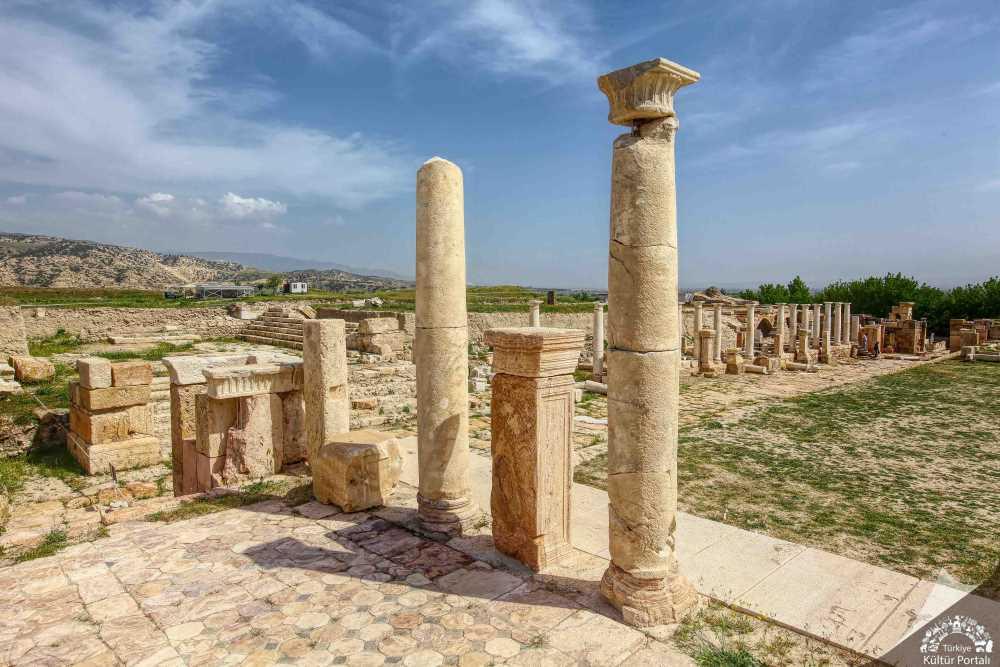
Image of the Columned Portico of the Antique City of Tripolis. (Ministry of Culture and Tourism of the Republic of Türkiye)
Due to its geographical position along major trade routes, Tripolis developed economically. During the Hellenistic and Roman periods, cultural diversity increased and the city became a center where different communities coexisted. Tripolis also played important roles in regional administration and religious life, which are key dimensions of its history.
The Antique City of Tripolis is currently open to visitors as an archaeological site under protection. However, structures remain at risk due to insufficient excavations and environmental factors. There is a need to increase scientific excavations, improve conservation efforts and promote tourism in a planned and sustainable manner.
The stagnation of archaeological work in Tripolis in recent years has prevented the full realization of the site’s potential. Reviving excavation and conservation activities and promoting the region on national and international platforms are essential. Sustainable conservation and scientific research will ensure the transmission of Tripolis’s historical and cultural values to future generations.
Video Explaining the Antique City of Tripolis. (HT History of Science Philosophy)
Tripolis Antique City is a significant center reflecting the processes of urbanization and cultural interaction in ancient Anatolia. Existing archaeological data provide fundamental sources for understanding the city’s historical development and regional role. However, deficiencies in conservation and excavation efforts continue to hinder its full potential from being realized.
Anadolu Ajansı. “Denizli’deki Tripolis Antik Kenti Kazılarında 10 Yıl Geride Kaldı.” Accessed June 30, 2025. https://www.aa.com.tr/tr/kultur/denizlideki-tripolis-antik-kenti-kazilarinda-10-yil-geride-kaldi/2761459.
Buldan Kaymakamlığı. "Tripolis Antik Kent." Accessed June 30, 2025. http://www.buldan.gov.tr/tripolis-antik-kent.
Denizli Valiliği İl Kültür ve Turizm Müdürlüğü. "Tripolis Antik Kenti." Accessed June 30, 2025. https://denizli.ktb.gov.tr/TR-211746/tripolis-antik-kenti.html.
HT Bilim Tarih Felsefe Youtube Kanalı. “Tripolis Antik Kenti’nin Sırları Neler? | Geçmişin İzinde.” Accessed June 30, 2025. https://youtu.be/HQ4LmOs_yNI?si=kQomoLnsAyaF-c6r.
T.C. Ministry of Culture and Tourism. "Tripolis Antik Kenti." *Kültür Portalı.* Accessed June 30, 2025. https://www.kulturportali.gov.tr/turkiye/denizli/gezilecekyer/tripolis-antik-kenti.

Location | Türkiye Denizli Buldan | ||||||||
|---|---|---|---|---|---|---|---|---|---|
Establishment | 3rd century BCE | ||||||||
Feature(s) | Walled city necropolis areas theater agora | ||||||||
No Discussion Added Yet
Start discussion for "Ancient City of Tripolis" article
Geographical Location and Physical Characteristics
Historical Development
Archaeological Excavations and Discoveries
Architecture and Urban Planning
Cultural and Economic Significance
Conservation and Tourism Status
Current Status and Future Perspectives