


This article was automatically translated from the original Turkish version.
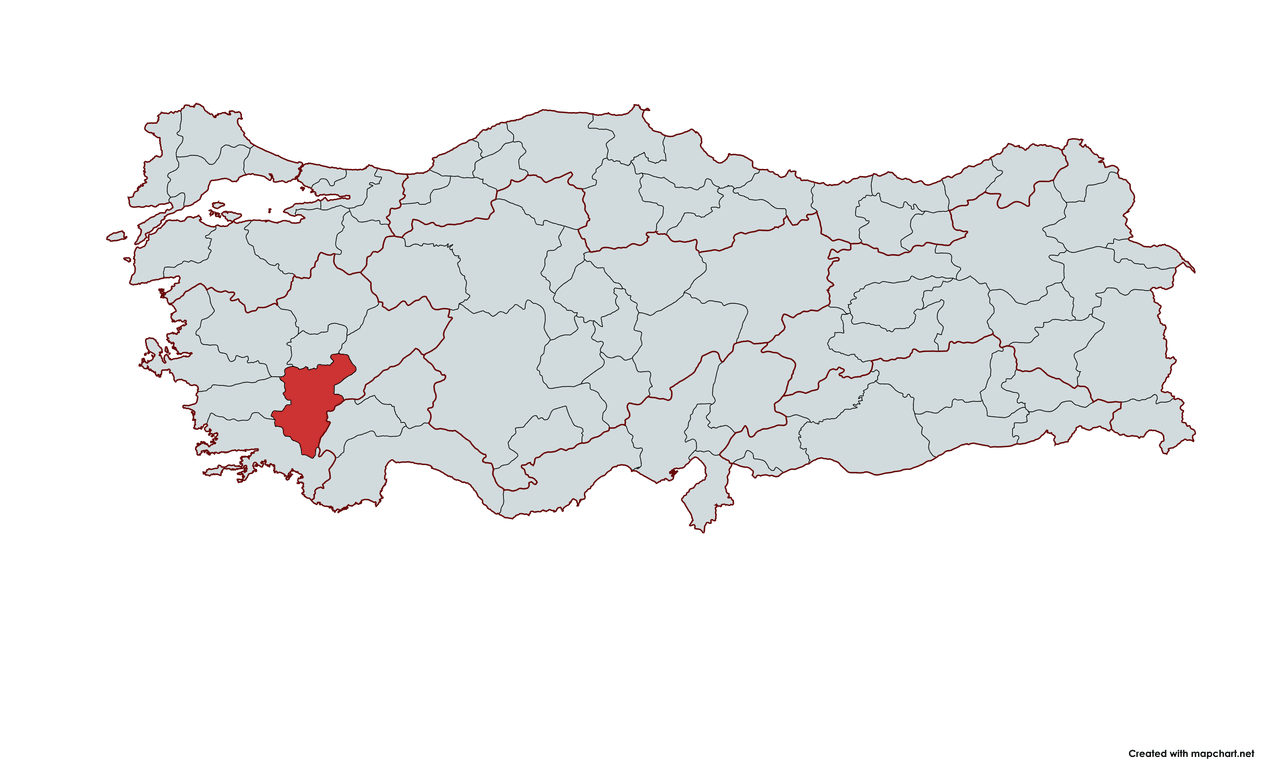
Denizli
Country | Türkiye | ||||||||
|---|---|---|---|---|---|---|---|---|---|
Region(s) | Aegean Region | ||||||||
Population | 1,059,082 | ||||||||
Area (km²) | 11,868 | ||||||||
Climate(s) | Mediterranean Climate - Continental Climate | ||||||||
Important Places | Pamukkale Travertines, Hierapolis Ancient City, Laodikeia Ancient City | ||||||||
License Plate Code | 20 | ||||||||
Governor(s) | Ömer Faruk Coşkun | ||||||||
Denizli is a city located in the southeastern part of Türkiye’s Aegean Region, having hosted numerous civilizations across place areas within historical and process. Its geographical position made it a transitional zone between the Phrygian and Carian civilizations, and during the Roman and Byzantine periods it became a significant center along trade trade routes. City is particularly notable for the Pamukkale Travertines and the ancient city of Hierapolis, both listed on UNESCO’s World Heritage List. In addition, Denizli possesses significant potential for health and nature tourism due to its thermal springs and natural landscape.

Economically, Denizli is one of Türkiye’s leading industrial and commercial centers, with its textile industry—particularly the production of towel and bathrobes—gaining national and international recognition. In agriculture, the city is prominent for grape, cherry and wheat such as products. Districts such as Buldan, Tavas and Çivril exhibit distinct agricultural and cultural characteristics. Furthermore, natural areas like Honaz Mountain National Park attract attention for their ecological diversity and potential for nature tourism. With its Modern city structure and industrial infrastructure, Denizli ranks among Türkiye’s developed cities in economic and cultural terms.
Denizli is a city with a deep historical legacy, having hosted many civilizations throughout history. The earliest settlement traces in the region date back to 4000 BCE. During the Hittite period, the area was an important settlement, later coming under the rule of the Phrygians, Lydians and Persians.
During the 3rd century BCE, following Alexander the Great’s campaigns, the region became exposed to Hellenistic culture and developed significantly with the founding of important cities such as Laodikeia and Hierapolis. Under the Roman Empire, Denizli became a center of intense trade and cultural exchange, with the thermal waters of Pamukkale attracting considerable interest for health tourism. Under Byzantine rule, Denizli came under Seljuk control from the 11th century onward following the arrival of Turks in Anatolia. During this period, the city was known as “Ladik” and served as an important hub along regional trade routes.
In the 13th century, Denizli passed under the control of the Germiyanids and later the Ottoman State, continuing its development in trade and industry during the Ottoman era. By the 19th century, the city had become known for textile production and rapidly adapted to the industrialization process during the Republican period, becoming one of Türkiye’s major industrial, tourism and commercial centers today.
Denizli is situated in the interior of Türkiye’s Aegean Region and shares geographical connections with both the Mediterranean and Central Anatolia regions. Covering an area of 11,868 km², the city borders Afyonkarahisar and Burdur to the east, Aydın and Manisa to the west, Uşak to the north, and Muğla to the south.
Located in the Büyük Menderes River basin, Denizli features a rugged land topography with wide valleys, plains and mountains. Honaz Mountain (2,571 m) is the city’s highest point and one of the highest peaks in the Aegean Region. The Çürüksu (Lykos) Plain is one of the city’s most important natural features and a major center for agricultural activity. The Pamukkale travertines represent the most significant geological formation enhancing the city’s tourism potential.

Denizli’s climate exhibits transitional characteristics. While the Mediterranean climate predominates overall, continental influences are also felt in higher inland areas due to elevation differences. Summer months are hot and dry, while winter months are mild and rainy. The annual average temperature is around 15–16°C. Summer temperatures can reach up to 40°C, while winter temperatures in higher elevations can drop below freezing.
Annual average rainfall in Denizli ranges between 550 and 700 mm, with precipitation concentrated primarily in autumn and winter months. These climatic conditions create a favorable environment for the cultivation of crops such as grapes, figs, olive and cotton.
As of 2023, Denizli’s total population is 1,059,082, comprising 526,717 males and 532,365 females. The population density is approximately 89 people per square kilometer. Pamukkale is the largest district with a population of 346,047, while Baklan, with a population of 5,457, is the smallest district.
Denizli’s economy is based on industry, agriculture and tourism. As one of Türkiye’s most important industrial cities, Denizli is particularly renowned for textile and apparel production. Cotton weaving, towels, bathrobes and household textiles play a significant role in the city’s economy. Additionally, cable and marble manufacturing are well-developed sectors. Denizli is among Türkiye’s largest cable producers and holds a significant share in the export of natural stone and marble.

In agriculture, Denizli produces grapes, cotton, wheat and poppy. Greenhouse farming and livestock activities also contribute to the economy. Denizli is also a major tourism center. The Pamukkale travertines, listed on UNESCO’s World Heritage List, along with ancient cities and thermal tourism potential, significantly boost the city’s tourism revenues. With its industry- and export-based economic structure, Denizli stands out as one of Türkiye’s strongest economic centers.
Denizli is a significant tourism destination due to its rich natural and historical heritage. Its most famous tourist site is the Pamukkale Travertines and the ancient city of Hierapolis, both on UNESCO’s World Heritage List. The thermal waters of Pamukkale hold major importance for health tourism. In addition, ancient cities such as Laodikeia, Tripolis and Tabea reflect the region’s historical legacy. Denizli is also an attractive destination for nature tourism, thanks to its highlands, caves and natural beauty.

Culturally, Denizli is known for its centuries-old people music, handicrafts and festivals. Famous folk poet Hayri Machine is a prominent representative of regional music. Denizli’s cuisine reflects influences from both Aegean and Central Anatolian kitchen cultures. Dishes such as Keşkek, tandır kebab, liver wraps and Denizli-style kavurma are among the standout local flavors. Additionally, regional specialties like leblebi and grape products reflect Denizli’s gastronomic diversity.
Tavas Baklava is a traditional Turkish dessert associated with the Tavas district of Denizli. It is made using 40 layers of thinly rolled phyllo, each brushed with walnut. After baking, the dessert is sweetened with syrup. Tavas Baklava is traditionally prepared for special occasions such as engagements, henna nights, wedding and holiday, using the imece communal method. Its unique flavor stems from the use of traditional ingredients and methods. The flours used include yellow hard baklava wheat, whole wheat flour and barley flour. Baking in a stone oven enhances the dessert’s taste.
Denizli Mosque Industry is recognized as the center of handmade glass products in Türkiye. Glass production, relocated from Istanbul to Denizli in the 1990s, is known especially for handmade glass household items and aesthetically value products. In glass production factories, a wide variety of modern and regional handmade products are offered, including fountain-i nightingale, amulets, crystal glass, glass rods and Beykoz-style items—25 distinct types in total.

The production process involves shaping molten glass using steel rods through a blowing technique. Each artisan’s unique methods and skills give the products their artistic and aesthetic qualities. Handmade glass items are sold in shops across Denizli and country regions. This traditional craftsmanship involves a labor intensive process, with each item shaped by the knowledge and skill of master artisans.
The Denizli Rooster has become the symbol of Denizli Province, a distinct breed of rooster. Recognized for its harmonious appearance, melodious crowing and aesthetic physical structure, this rooster is well known throughout the country. While some sources suggest it originated from the crossbreeding of long-crowing Berat roosters brought from Albania to Istanbul during the Ottoman period with local chickens, this theory remains debated. The prevailing view is that the Denizli Rooster emerged naturally from the region’s longstanding human interest in and careful breeding of long-crowing roosters.
The Denizli Rooster’s physical features are highly distinctive. Its eyes are black and glossy, its legs are dark gray or black in color, and its comb is axe shaped. Earlobes may be red or red with white spots. The overall body color is a mixture of black and dirty white, with occasional brown tones visible in the wing feathers. In red roosters, black and red color combinations are observed.
The live weight of the Denizli Rooster ranges from an average of 3 to 3.5 kg. Based on plumage color, body structure and comb type, it can be classified into six color varieties (Demirkır, Pamukkır, Kınalı, Al, Siyah, Kürklü) and three body types (High-necked, Sülün, Küpeli). Additionally, two comb types exist: wide comb and narrow comb.
Based on vocal tone, Denizli Roosters can be classified as having thin, deep or thick voices and may exhibit various vocal patterns such as clear, melancholic, sharp and wavering tones. Their crowing patterns, depending on body posture, are categorized into four types: Lion Crowing, Wolf Crowing, Yiğit Crowing and Pus Crowing. These characteristics make the Denizli Rooster distinctive both visually and acoustically.

The Governor of Denizli is Omar Faruk Coşkun, who assumed office on 10 August 2023. Born in Istanbul in 1970, Coşkun graduated from the Political Science Department of the Faculty of Political Sciences at Ankara University. He began his career in 1996 as a Kocaeli District governor Cadet and served as district governor in Akpınar (Kırşehir), Mazgirt (Tunceli) and Adilcevaz (Bitlis). In 2007, he was appointed as Faculty of Political Science Inspector and in 2009 as Chief Inspector of the Ministry of Interior. He assumed office as Governor of Osmaniye on 13 June 2017 and was appointed Governor of Kahramanmaraş on 9 June 2020. Most recently, he began his term as Governor of Denizli in 2023.
The Mayor of Denizli Metropolitan Municipality is Osman Zolan, who assumed office following the 2019 elections. Born in 1965, Zolan completed his education at the Faculty of Civil Engineering of Istanbul Technical University. He was also elected Mayor of Denizli Metropolitan Municipality in the local elections of 2009 and 2014.
Baykara, Tuncer. "Denizli," *TDV İslâm Ansiklopedisi,* Accessed February 13, 2025. https://islamansiklopedisi.org.tr/denizli
Culture Portal. "Genel Bilgiler." Accessed February 12, 2025. https://www.kulturportali.gov.tr/turkiye/denizli/genelbilgiler.
Denizli Valiliği. "Şehrimiz." Accessed February 12, 2025.
Turkey Statistical Institute. Accessed February 12, 2025. https://cip.tuik.gov.tr/.

Denizli
Country | Türkiye | ||||||||
|---|---|---|---|---|---|---|---|---|---|
Region(s) | Aegean Region | ||||||||
Population | 1,059,082 | ||||||||
Area (km²) | 11,868 | ||||||||
Climate(s) | Mediterranean Climate - Continental Climate | ||||||||
Important Places | Pamukkale Travertines, Hierapolis Ancient City, Laodikeia Ancient City | ||||||||
License Plate Code | 20 | ||||||||
Governor(s) | Ömer Faruk Coşkun | ||||||||
History
Geography and Climate
Population
Economy
Tourism, Culture and Cuisine
Tavas Baklava
Handmade Glass Products
Denizli Rooster
Administration
Governor
Metropolitan Mayor