


This article was automatically translated from the original Turkish version.
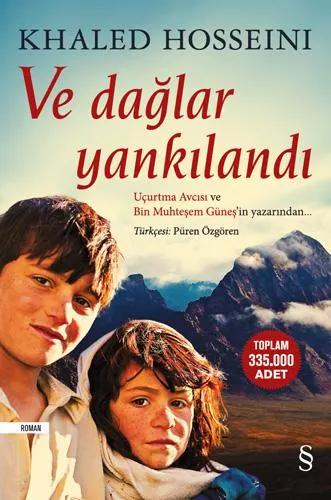
And the Mountains Echoed (Original title: And the Mountains Echoed) is the third novel by Afghan-American author Khaled Hosseini. First published in English in 2013, the work was translated into Turkish by Püren Özgören and published by Everest Yayınları the same year. Hosseini, whose earlier novels Kite Hunter and One Thousand Magnificent Suns achieved worldwide success, explores universal themes such as family bonds, love, sacrifice, betrayal, and loyalty in this novel. The story unfolds through multiple perspectives, weaving a layered narrative that begins in 1950s Afghanistan and spans from Kabul to Paris, San Francisco, and the island of Tinos.
And the Mountains Echoed opens with the story of two siblings, Abdullah and Peri, who have lost their mother. For ten-year-old Abdullah, his younger sister Peri is everything; for Peri, her elder brother serves as both a parent and a guardian. A journey their father takes to Kabul due to financial hardship forces the family to confront a heart-wrenching decision: Peri is given up for adoption to the wealthy Vahdeti family, where her step-uncle Nebi works. This separation creates a resonance that affects not only the siblings but also the fates of many others across generations. The novel interweaves multiple stories branching from this central narrative, exploring the complexities of love, loss, and human relationships.
Unlike his earlier novels, And the Mountains Echoed does not center on a single main narrative but instead tells the interconnected stories of multiple characters. Each chapter is written from the perspective of a different character and can be read as an independent tale, yet all are subtly linked by delicate threads. This structure gives the novel a richly layered texture, though some readers have criticized it for weak connections between stories or a fragmented narrative. Hosseini’s poetic and emotionally charged style powerfully conveys the inner worlds and emotional conflicts of his characters.
The novel opens with a quote from Mevlana: “There is a land beyond right and wrong, and I will wait for you there,” a philosophical perspective that frames the book’s central themes. The opening “tale of a giant,” presented as a folk parable, sets the tone of the narrative and symbolically introduces the theme of sacrifice.
Although And the Mountains Echoed encompasses many characters, several lie at the heart of the narrative and shape its emotional and thematic depth:
Abdullah, one of the novel’s central characters, is Peri’s elder brother. Having lost his mother, he assumes the roles of both sibling and parent to his younger sister. His bond with Peri forms the emotional backbone of the novel. Her adoption inflicts a deep wound on Abdullah, and this loss profoundly shapes his later life and memories.
Peri, Abdullah’s younger sister, is only three years old at the beginning of the story. Her adoption by a wealthy family marks a turning point that alters the lives of both siblings. Peri’s journey, through childhood and adulthood, reflects the complexities of familial bonds and the search for identity.
Nebi, the step-uncle of Abdullah and Peri, is a pivotal figure in the story. He works for the wealthy Vahdeti family in Kabul and plays a crucial role in facilitating Peri’s adoption. Nebi’s internal conflicts and moral dilemmas deepen the novel’s exploration of sacrifice and betrayal.
A member of Kabul’s affluent Vahdeti family, Nila is a poet and intellectual. As the woman who adopts Peri, she occupies a central place in the narrative. Nila’s own emotional emptiness and complex personality reinforce the novel’s themes of personal longing and loneliness.
A Greek physician, Markos emerges as a significant character in later sections of the novel. His story, told through his humanitarian work in Afghanistan and his past on the island of Tinos with Thalia, enriches the novel’s global and human dimensions.
Thalia, Markos’s childhood friend, lives with a physical deformity. Her story addresses themes of difference, acceptance, and humanity. Thalia’s resilience and depth form one of the most compelling subplots in the novel.
Cousins of Afghan origin, Idris and Timur appear in the San Francisco segment of the novel. After returning to postwar Afghanistan, they confront their pasts. Idris’s introspective and thoughtful nature contrasts with Timur’s extroverted and pragmatic personality, reflecting experiences of the diaspora and cultural identity conflicts.
And the Mountains Echoed was met with high anticipation following Hosseini’s earlier novels The Kite Runner and A Thousand Splendid Suns, but received mixed reviews. Readers and critics praised Hosseini’s emotionally compelling storytelling, yet some noted that the novel’s broad scope—spanning numerous characters and narratives—led to a lack of focus.
And the Mountains Echoed examines, from a psychological perspective, how individual choices and traumas echo across generations. The separation of Abdullah and Peri can be analyzed through the lens of attachment theory and the psychology of loss; their profound bond reflects the long-term impact of early attachment relationships. Socially, the novel addresses Afghanistan’s socioeconomic conditions before and after war, exploring themes of migration, poverty, and family dynamics. Hosseini weaves Afghanistan’s cultural fabric and diaspora experiences into universal human conditions, appealing to a broad global readership.
Book and Commentary. "Ve Dağlar Yankılandı Kitap İncelemesi." Accessed May 31, 2025. https://www.kitapveyorum.com/ve-daglar-yankilandi-khaled-hosseini/.
Hosseini, Khaled. *Ve Dağlar Yankılandı*. Translated by Püren Özgören. Istanbul: Everest Yayınları, 2013.

No Discussion Added Yet
Start discussion for "And the Mountains Echoed (Book)" article
Content and Themes
Structure and Style
Main Characters
Abdullah
Peri
Nebi
Nila Vahdeti
Markos Varvaris
Thalia
Idris and Timur
Criticism and Reception
Psychological and Social Context