


This article was automatically translated from the original Turkish version.
Anechoic chamber is a specially designed acoustic test room in which echoes or reflections are eliminated. The term “anechoic,” of Greek origin, means “non-reflective.” These chambers are primarily used to simulate free-field conditions for the propagation of sound and electromagnetic waves. Anechoic chambers serve as essential tools in various industrial tests, research and development processes, and measurements requiring compliance with international standards.
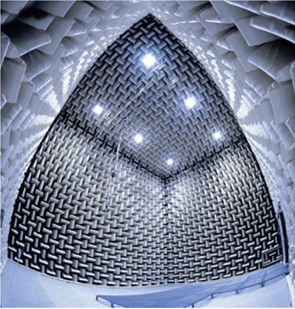
Image of an Anechoic Chamber – TÜBİTAK UME, GEBZE (TÜBİTAK UME)
Anechoic chambers are equipped with high-performance sound and wave absorption materials mounted on interior surfaces. These absorbers are typically wedge-shaped and installed on all six surfaces (walls, ceiling, and floor), effectively eliminating nearly all reflections from the chamber’s surfaces. The floor is often supported by a transparent platform made of tensioned wire mesh; however, semi-anechoic solutions with reflective hard floors are also preferred for practical reasons and to reduce measurement errors.
In the design of sound absorbers, material density and resistance to airflow are critical parameters. To achieve effective absorption at low frequencies, wedge structures may be made multi-layered or incorporate resonator-based designs. In electromagnetic applications, materials such as carbon-loaded foam or ferrite tiles are commonly used.
Anechoic chambers are used for measurements in both acoustic and electromagnetic fields. In acoustic chambers:
RF anechoic chambers used for EMC (Electromagnetic Compatibility) testing are designed to:
Measurements conducted in anechoic chambers are defined by international standards such as ISO 3745 and ANSI S12.35. These standards specify methods for measuring the room’s anechoic performance, microphone placement, sound source characteristics, and measurement procedures. The directivity of the sound sources used during chamber validation is critical to the reliability of measurement results.
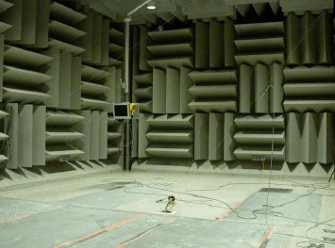
Image of an Anechoic Chamber – İ.T.Ü. OTAM ()
Fully anechoic environments are not always necessary and can be costly. Therefore, semi-anechoic chambers with reflective floors are widely used. Such chambers provide a more practical and suitable test environment, especially for measuring devices that interact with the ground, such as washing machines, compressors, and electric tools.
The history of anechoic chambers dates back to the mid-20th century, when radio waves and acoustic properties began to be studied scientifically. With the widespread adoption of EMC regulations in the 1980s, major corporations shifted toward constructing chambers as alternatives to open-area test sites. A key milestone was the installation in 1982 of the first 3-meter EMC anechoic chamber for IBM. From the 1990s onward, the use of ferrite tiles and hybrid absorber materials enabled smaller chamber sizes with improved performance.
Measurements in anechoic chambers vary depending on the method used and the size of the test object. The two primary measurement approaches defined in international acoustic standards are:
In both methods, sound power levels are calculated using A-weighted sound pressure levels, octave or 1/3-octave band analyses, and frequency components.
The performance of anechoic chambers depends on the properties of the absorber materials installed on interior surfaces. The primary purpose of these materials is to absorb sound or electromagnetic waves without reflection. In acoustic anechoic chambers, absorbers typically take the following forms:
Material selection is determined by the target frequency range, chamber size, and specific testing requirements.
Anechoic chamber design is determined by parameters such as the target frequency range, required measurement accuracy, and the size of the objects to be tested. Key design considerations include:
All these parameters ensure high-accuracy measurements in both acoustic and electromagnetic testing.
Anechoic chambers are used across various industries for product development, quality control, and regulatory compliance testing. Each sector may require different types of anechoic chamber solutions based on specific measurement needs. Major application areas include:
These application examples demonstrate that anechoic chambers are not merely academic tools but integral components of product development and certification processes.
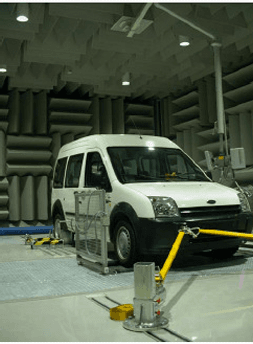
Image of a Vehicle Test in an Anechoic Chamber ()
In Türkiye, anechoic chamber infrastructure has developed to meet growing testing demands in industry and academic research centers. These chambers enable domestic products to meet the EMC and acoustic compliance requirements necessary for international market acceptance. Key institutional examples include:
In addition to these institutions, major domestic manufacturers such as Vestel, BSH, and Arçelik also maintain anechoic and semi-anechoic chambers to control the acoustic characteristics of their products. This infrastructure has become an indispensable part of product development, quality control, and compliance evaluation processes.
Accessed November 26, 2025.
Dilmen, Hakan. Akustik Ölçüm Odaları ve Endüstriyel Kullanımları. Sunum dosyası, TÜBİTAK UME Akustik Paydaşlar Toplantısı, Gebze, January 23, 2013. Accessed June 16, 2025.
Lawrence, Brian F. "Anechoic Chambers: Past and Present." Conformity Magazine, February 2005. Accessed June 13, 2025
Schøyen Nielsen, M. B. "Anechoic vs. Semi Anechoic Rooms." Brüel Acoustics, Venlighedsvej 6, 2970 Hørsholm, Denmark. Accessed June 13, 2025

Structural Features
Applications
Standards and Validation
Semi-Anechoic Chambers
Historical Development
Measurement Methods
Absorber Material Technologies
Anechoic Chamber Design Criteria
Industry Application Examples
Institutional Examples from Türkiye