This article was automatically translated from the original Turkish version.
+1 More
Location | Siem Reap / Cambodia | ||||||||
|---|---|---|---|---|---|---|---|---|---|
Construction Date(s) | 1116–1150 | ||||||||
Patron | Suryavarman II | ||||||||
Architectural Style(s) | Khmer temple-mountain architecture | ||||||||
Building Material | laterite greenish gray sandstone Yellowish brown sandstone | ||||||||
Area(s) | Approximately 400 km² (including the Angkor Archaeological Park) | ||||||||
UNESCO Status | Inscribed on the World Heritage List in 1992 | ||||||||
Angkor Vat is a monumental temple-city located in the Siem Reap region of present-day Cambodia, constructed in the 12th century by Khmer King Suryavarman II as a dedication to the Hindu deity Vishnu. An exemplary masterpiece of classical Khmer architecture, it symbolizes Mount Meru of Hindu cosmology through its central tower system, while the surrounding galleries and moats represent the layered structure of the universe.
Originally designed as a religious center and a funerary monument representing the king’s divine presence, Angkor Vat was later adapted for Buddhist use. Built upon an extensive settlement area characterized by low-density wooden structures, this temple-city stands as one of the most significant monuments reflecting the socio-political structure and cosmic worldview of the Khmer Empire, through both its architectural scale and symbolic content.

Angkor Vat (unsplash)
Angkor Vat was constructed between 1116 and 1150 during the Khmer Empire under the reign of King Suryavarman II. Designed to legitimize the king’s authority and demonstrate his devotion to the Hindu god Vishnu, the structure also served as a funerary temple intended to ensure the king’s rebirth in a divine realm after death. At this time, the Khmer Empire was one of the most powerful political and cultural entities in Southeast Asia, dominating a vast territory.
The temple was built according to the “temple-mountain” model, reflecting Hindu architectural and cosmological principles. However, from the 13th century onward, as Buddhism became widespread in the region, Angkor Vat was gradually converted for Buddhist worship and has retained this religious identity to the present day. While the Angkor region was gradually abandoned during the 15th century due to the rise of the Ayutthaya Kingdom, climatic changes, and infrastructure challenges, Angkor Vat retained its sacred status and continued to be used by local communities.
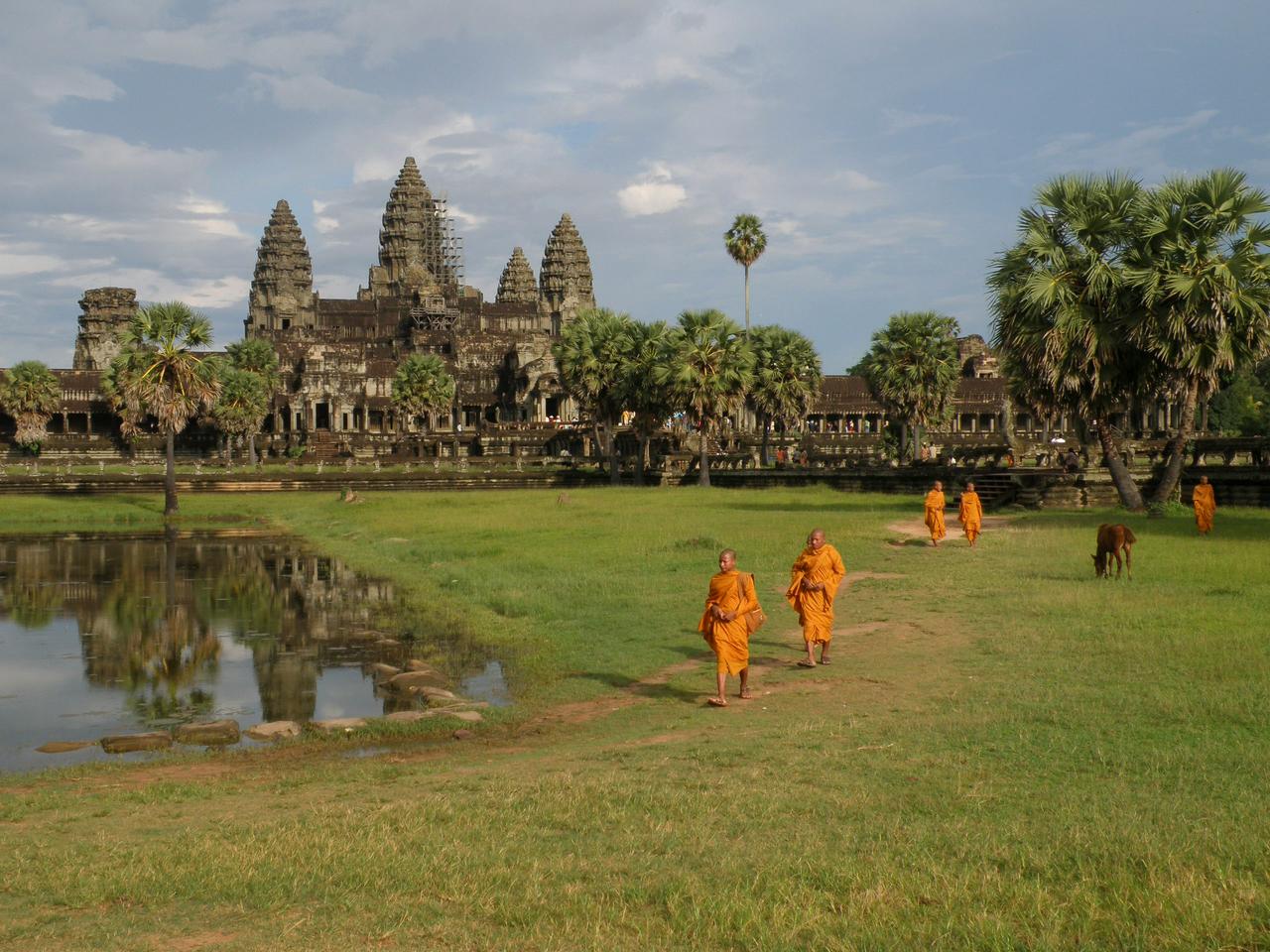
Angkor Vat (unsplash)
Angkor Vat is oriented along an east-west axis and surrounded by a vast moat. Its central structure consists of five towers, with the main tower rising on a raised platform alongside four smaller towers. The complex is enclosed by terraced platforms, long galleries, and multi-layered courtyards. The temple complex connects directly to a main entrance facing west. This entrance is linked to the central structure by a broad stone causeway crossing the moat. Two library buildings on either side of the main causeway complete the symmetrical layout of the temple.
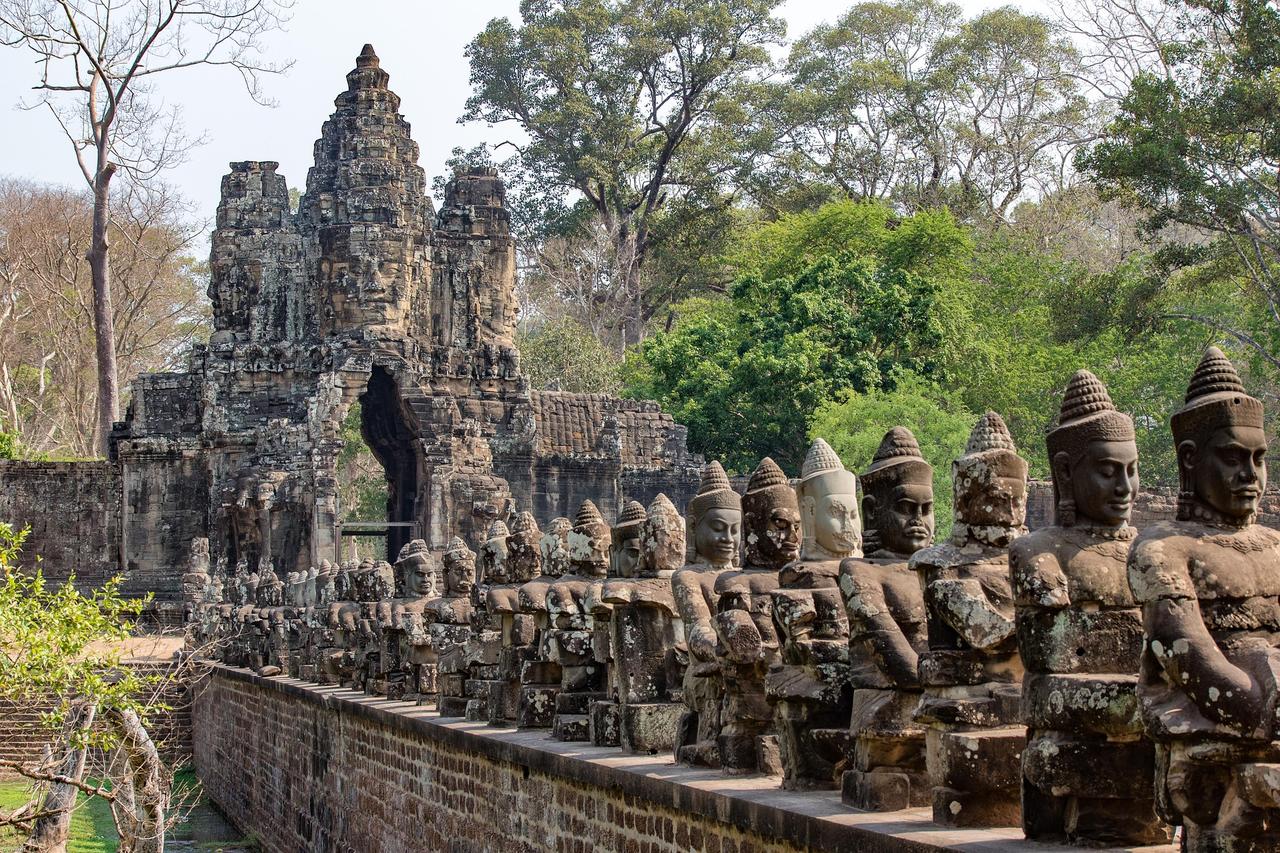
The temple was constructed using yellowish-brown and greenish-grey sandstone. The greenish-grey stone, being harder, was preferred for load-bearing elements, while the yellowish sandstone was used for reliefs and decorative details. Laterite stone is also found in certain sections of the structure. Wall surfaces are covered with bas-reliefs depicting scenes from Hindu mythology. Among these, the scene of the churning of the ocean of milk in the eastern gallery is particularly prominent.
The temple is surrounded by a low-density settlement fabric. Most structures in these areas were built of wood, but these have not survived to the present; only their foundations and ground traces remain. Grid-like road and canal systems, as well as orderly sequences of mounds and depressions, have been identified around the temple. Within certain corridors and chambers of the temple, varying degrees of deterioration have been observed, linked to the chemical properties of the building materials.
The conservation of Angkor Vat is maintained through multifaceted efforts at both national and international levels. The structure is legally protected under the 1994 Royal Decree and the authority of the APSARA National Authority, established in 1995. The ICC-Angkor (International Coordinating Committee), operating with UNESCO support, coordinates conservation and restoration projects according to scientific standards. Past restoration efforts have not compromised the overall authenticity of the site. However, increasing tourism, environmental degradation, and urban pressure necessitate continuous monitoring and careful balancing of preservation measures.
Angkor Vat suffers from physical and chemical erosion due to the tropical climate’s high humidity, heavy rainfall, and temperature fluctuations. Scaling, cracking, and layer loss in the sandstone are primarily caused by salt crystallization resulting from the evaporation of rainwater. Porous stone surfaces provide favorable conditions for microbial growth. Sulfur-oxidizing bacteria, cyanobacteria, algae, and lichens cause discoloration and surface degradation of the stone.
Bats inhabiting the temple also constitute a significant threat. Guano, rich in sulfate and phosphate, penetrates the stone and crystallizes, leading to cracking and disintegration. Additionally, deforestation disrupts the temple’s ecological balance, exposing stone surfaces to increased sunlight and rainfall.
Restoration activities were halted between 1975 and 1979 during the Khmer Rouge regime, resulting in structural damage and widespread looting of artworks. Some biocides used in past conservation interventions have been observed to induce new forms of deterioration in the stone. Consequently, conservation efforts now carefully evaluate biodiversity, environmental balance, and long-term impacts.
Bhagentsang, Dickyi. Caperchione, Kendall. Gusain, Ipsa. Hobart, Anna. Inayat, Zaira. MacDonald, Christina. Park, Jiyeon. Tam, Belinda. Wang, Jessie. Zhang, Si Cong (Sam). *Angkor Wat Exploring the Art, Science, and History Behind one of the World’s Greatest Religious Sites.* Golden Meteorite Press, 2021. Erişim Adresi
Hoskins, Dick. “people walking on park near trees and building during daytime JPG”. Pixabay. Accessed October 9, 2025. https://unsplash.com/photos/a-group-of-people-walking-across-a-lush-green-field-HD8b4cu33bI
Rod-ari, Melody. “Angkor Wat.” *Smarthistory.* Accessed October 9, 2025. https://smarthistory.org/angkor-wat/
UNESCO. “Angkor.” *World Heritage Convention.* Accessed October 9, 2025. https://whc.unesco.org/en/list/668/
allPhoto Bangkok. “people walking on park near trees and building during daytime JPG.” Pixabay. Accessed October 9, 2025. https://unsplash.com/photos/people-walking-on-park-near-trees-and-building-during-daytime-gt3gK_Wob2g
dMz. “Angkor thom, Angkor wat, Kamboçya görseli JPG”. Pixabay. Accessed October 9, 2025. https://pixabay.com/tr/photos/angkor-thom-angkor-wat-kambo%C3%A7ya-1349581/

Location | Siem Reap / Cambodia | ||||||||
|---|---|---|---|---|---|---|---|---|---|
Construction Date(s) | 1116–1150 | ||||||||
Patron | Suryavarman II | ||||||||
Architectural Style(s) | Khmer temple-mountain architecture | ||||||||
Building Material | laterite greenish gray sandstone Yellowish brown sandstone | ||||||||
Area(s) | Approximately 400 km² (including the Angkor Archaeological Park) | ||||||||
UNESCO Status | Inscribed on the World Heritage List in 1992 | ||||||||
Historical Background
Architectural Features
Conservation Status
Environmental Threats and Conservation Challenges