This article was automatically translated from the original Turkish version.
Type of Geographical İndication | Mahreç Sign | ||||||||
|---|---|---|---|---|---|---|---|---|---|
Application Date | 30.09.2014 | ||||||||
Registration Number | 233 | ||||||||
Registration Date | 05.12.2017 | ||||||||
Product / Product Group(s) | Meals and soups | ||||||||
Province(s) | Ankara | ||||||||
Applicant/Registrant(s) | Ankara Chamber of Commerce | ||||||||
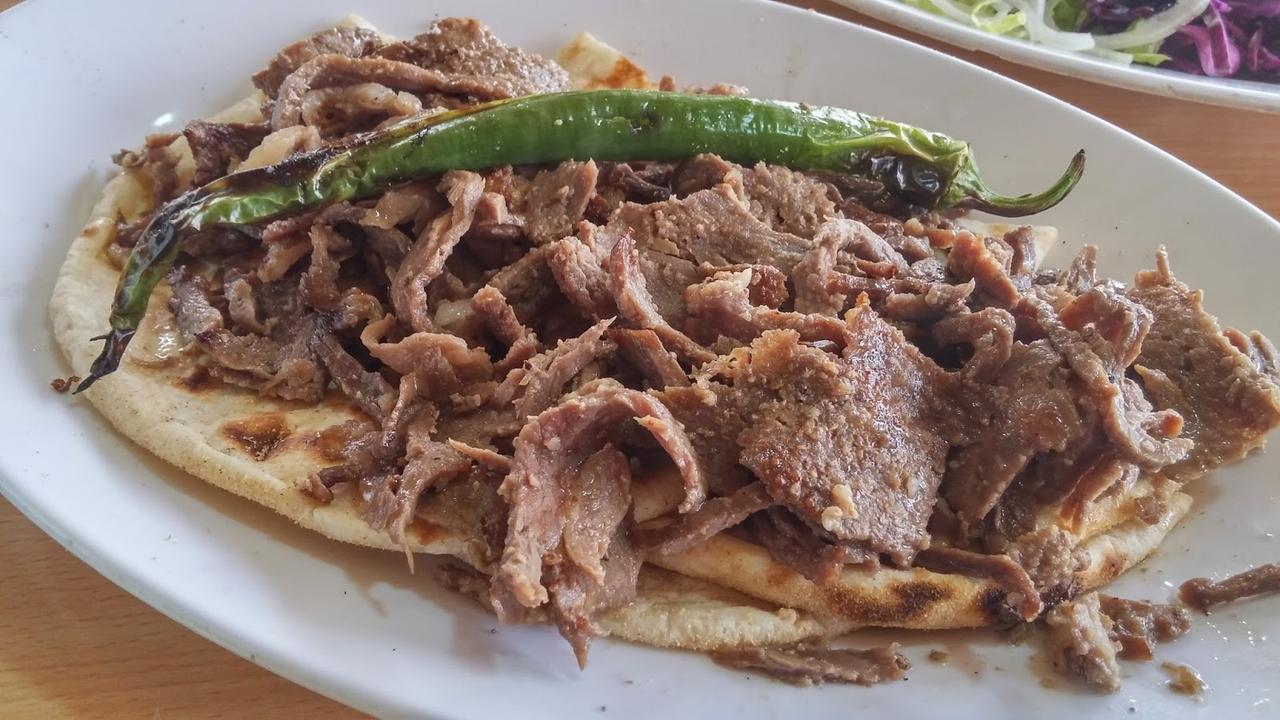
Ankara Döneri is a traditional meat dish closely associated with Ankara, the capital of Türkiye. Registered as a geographical indication by the Turkish Patent and Trademark Office on 5 December 2017 under Industrial Property Law No. 6769, it has been protected since 30 September 2014. The registered holder is the Ankara Chamber of Commerce.
Ankara Döneri is produced exclusively from the MLD (Musculus longissimus dorsi – loin muscle) of male lambs weighing 40 kg or more, raised in the districts of Çubuk, Beypazarı, Kalecik, Polatlı and Haymana within the boundaries of Ankara Province. These districts are renowned for sheep farming due to their unique flora.
No minced meat is used.
No additives such as internal fat, kidney fat or shirt fat are added; only thinly sliced tail fat is incorporated.
The meat is sliced in leaf-like pieces.
Cooking is carried out exclusively over slow-burning oak wood charcoal, in a controlled and gradual manner.
These characteristics are the fundamental features that distinguish Ankara Döneri from other types of döner.
The meat is obtained from slaughterhouses in the aforementioned districts with proper documentation. After slaughter, the meat is rested at 4°C for 2 to 4 days.
The rested meat is sliced to a thickness of 1 mm using a sharp stainless steel döner knife measuring 50–70 cm in length.
For every 10 kg of meat, 1 kg of onion juice, or 1 kg of tomato purée, or 1 kg of a mixture of onion juice and tomato purée is used. The marination process lasts approximately 14 to 16 hours at 7–12°C in a refrigerator. After this period, the meat is mounted on the döner spit and the liquid is allowed to drain off.
To prevent the meat from drying out, thinly sliced tail fat is added every 4 to 5 layers during wrapping. One kilogram of tail fat is used for every 15 kg of meat. A “cap” of tail fat is placed on the top of the döner; this ensures the outer surface remains tender and enhances flavor.
Oak wood is burned separately in a separate grill until it becomes charcoal, then transferred to the döner oven. The döner is cooked at a distance of approximately 20–25 cm from the heat source, at a temperature of 200–220°C. Cooking is done slowly: the meat is first shaved off, then rotated for even cooking. The slicing is performed from top to bottom at a slight incline, in leaf-shaped pieces.
The monitoring of Ankara Döneri production and the use of its geographical indication is coordinated by the Ankara Chamber of Commerce. The monitoring commission includes representatives from the following institutions:
Ankara Provincial Directorate of Food, Agriculture and Livestock
Ankara University Faculty of Agriculture
Ankara University Institute of Food Safety
Ankara Chamber of Commerce
Inspections are conducted at least once annually, and may also be carried out at any time upon request or complaint. The origin of the meat is verified through delivery documents. The commission conducts on-site inspections to ensure compliance with the production method and distinguishing characteristics, and may engage public or private experts as needed.
Ankara Chamber of Commerce. "Ankara Döneri." Coğrafi İşaretler Portalı, TÜRKPATENT. Accessed August 16, 2025. https://ci.turkpatent.gov.tr/cografi-isaretler/detay/38140.
Ankara Ticaret Odası. "Ankara Döneri." Coğrafi İşaretler Portalı, TÜRKPATENT. Accessed August 16, 2025. PDF file. https://ci.turkpatent.gov.tr/Files/GeographicalSigns/54df0027-306f-4799-9ebf-4f6d661e922e.pdf.

Type of Geographical İndication | Mahreç Sign | ||||||||
|---|---|---|---|---|---|---|---|---|---|
Application Date | 30.09.2014 | ||||||||
Registration Number | 233 | ||||||||
Registration Date | 05.12.2017 | ||||||||
Product / Product Group(s) | Meals and soups | ||||||||
Province(s) | Ankara | ||||||||
Applicant/Registrant(s) | Ankara Chamber of Commerce | ||||||||
Definition and Distinguishing Characteristics
Ingredients
Production Method
Sourcing and Resting of Meat
Slicing the Meat
Marination Process
Fat Layers
Cooking
Monitoring Process