This article was automatically translated from the original Turkish version.
Type of Geographical İndication | Place of Origin | ||||||||
|---|---|---|---|---|---|---|---|---|---|
Application Date | 17.03.2017 | ||||||||
Registration Number | 408 | ||||||||
Registration Date | 08.01.2019 | ||||||||
Product / Product Group(s) | Processed and unprocessed meat products | ||||||||
Province(s) | Ankara | ||||||||
Applicant/Registrant(s) | Ankara Chamber of Commerce | ||||||||
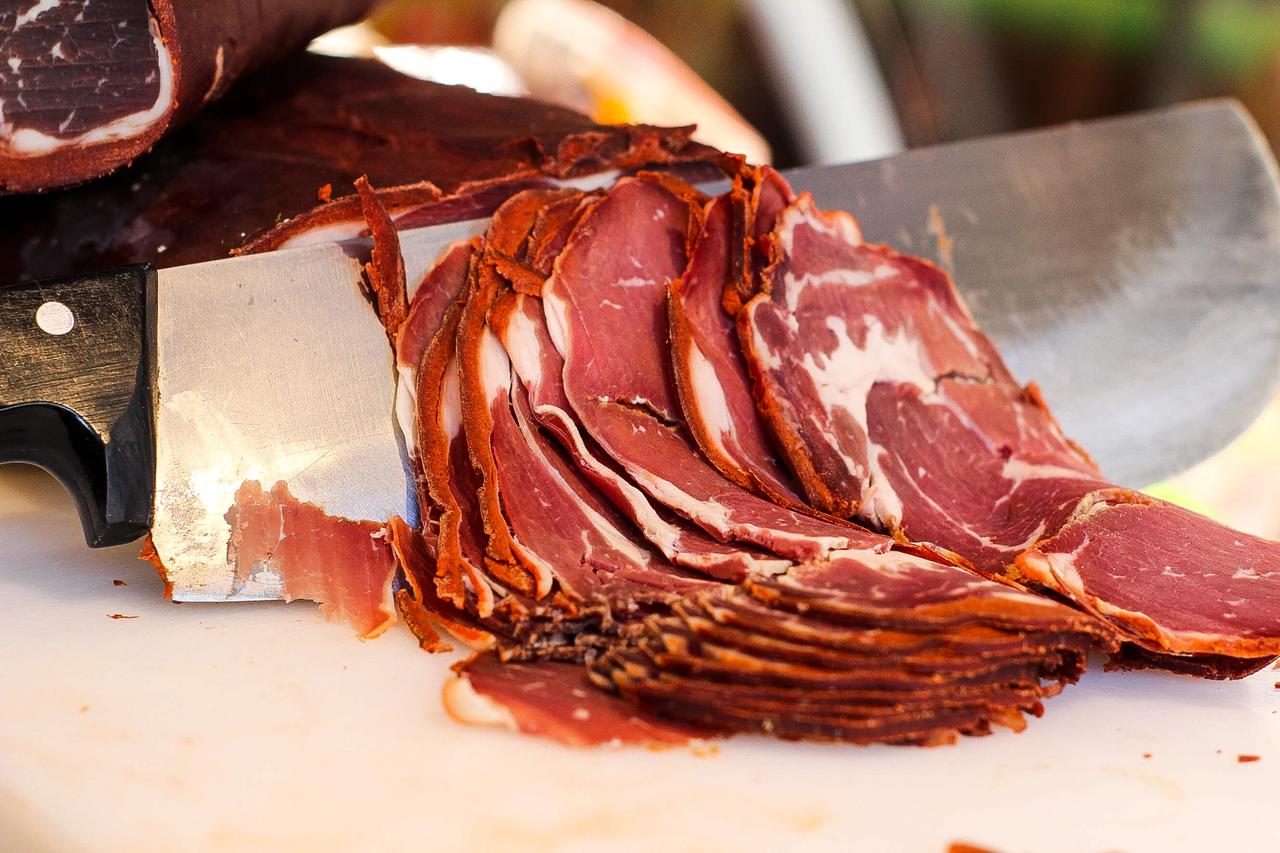
Ankara Erkeç Pastırması is a traditional type of pastırma, unique to Ankara Province, produced exclusively from male Ankara goats using traditional methods and officially registered with a geographical indication. The product acquires its distinctive taste, aroma, and texture through the combination of the region’s climatic conditions, rich vegetation, and local production techniques.
Ankara Erkeç Pastırması can only be produced within the boundaries of Ankara Province and is registered under its place of origin. The product was granted geographical indication protection in 2019 by the Ankara Chamber of Commerce and is sourced from Ankara goats raised in 21 districts of Ankara. The district of Ayaş and its surrounding areas are among the regions where production is most concentrated.
Pastırma is produced exclusively from male Ankara goats that are at least four years old and castrated after one year of age. Castration prevents the transfer of the buck odor to the meat. The Ankara goat (Capra hircus angorensis) grazes on pastures and shrublands within the region’s rich flora, which comprises 231 plant species. This natural diet imparts a unique flavor and aroma to the meat.
The origins of Ankara Erkeç Pastırması date back centuries. The mention of Ankara goat pastırma in Evliya Çelebi’s Seyahatname highlights the product’s historical significance and cultural roots. 【1】
Çemen is preferably obtained from the seeds of çemen herb grown in Ayaş and neighboring districts. This regional source imparts a distinctive aroma to the pastırma.
Pastırma is served in thin slices. It is stored in climate-controlled refrigerators at 2–4 °C. During transportation, it is preserved under vacuum in polyvinyl packaging.
Inspection is carried out by a supervisory body composed of representatives from Ankara University, the Provincial Directorate of Agriculture, and the Livestock Breeder Association for Sheep and Goats, coordinated by the Ankara Chamber of Commerce. Inspections occur at least once annually and additionally upon complaint. Compliance is verified through physical, microbiological, and chemical analyses. The origin and breed of the meat are confirmed through documentation provided at the time of delivery.
Ankara Ticaret Odası. *Ankara Erkeç Pastırması*. Coğrafi işaret tescili belgesi pdf. Accessed August 16, 2025. https://ci.turkpatent.gov.tr/Files/GeographicalSigns/906ff713-1af6-4218-b173-bbb19a33c2a9.pdf.
Ankara Ticaret Odası. *Ankara Erkeç Pastırması*. Coğrafi işaret tescili belgesi. Accessed August 16, 2025. https://ci.turkpatent.gov.tr/cografi-isaretler/detay/38257.
[1]
Ankara Ticaret Odası, Ankara Erkeç Pastırması, Coğrafi İşaret Tescili Belgesi, PDF, 2. sayfa, erişim 16 Ağustos 2025, https://ci.turkpatent.gov.tr/Files/GeographicalSigns/906ff713-1af6-4218-b173-bbb19a33c2a9.pdf.

Type of Geographical İndication | Place of Origin | ||||||||
|---|---|---|---|---|---|---|---|---|---|
Application Date | 17.03.2017 | ||||||||
Registration Number | 408 | ||||||||
Registration Date | 08.01.2019 | ||||||||
Product / Product Group(s) | Processed and unprocessed meat products | ||||||||
Province(s) | Ankara | ||||||||
Applicant/Registrant(s) | Ankara Chamber of Commerce | ||||||||
No Discussion Added Yet
Start discussion for "Ankara Erkeç Pastırma" article
Origin and Geographical Boundaries
Animal Breed and Feeding
Historical Background
Production Process
Physical and Chemical Properties
Service and Storage
Inspection Process