

This article was automatically translated from the original Turkish version.
Geographical Indication Type(s) | Mahreç Sign | ||||||||
|---|---|---|---|---|---|---|---|---|---|
Registration Date | 5 December 2017 | ||||||||
Registration Number | 235 | ||||||||
Registering Institution | Ankara Chamber of Commerce | ||||||||
Product / Product Group(s) | Desserts Dough products Bakery and confectionery products | ||||||||
Ankara Simidi is a flour-based product unique to Ankara, the capital of Türkiye, and was officially registered as a geographical indication in 2017. This geographical indication was secured by the Ankara Chamber of Commerce under Law No. 6769 on Industrial Property, effective from 22 August 2014, and the registration process was completed on 5 December 2017. The geographical boundary of the product is limited to the province of Ankara.
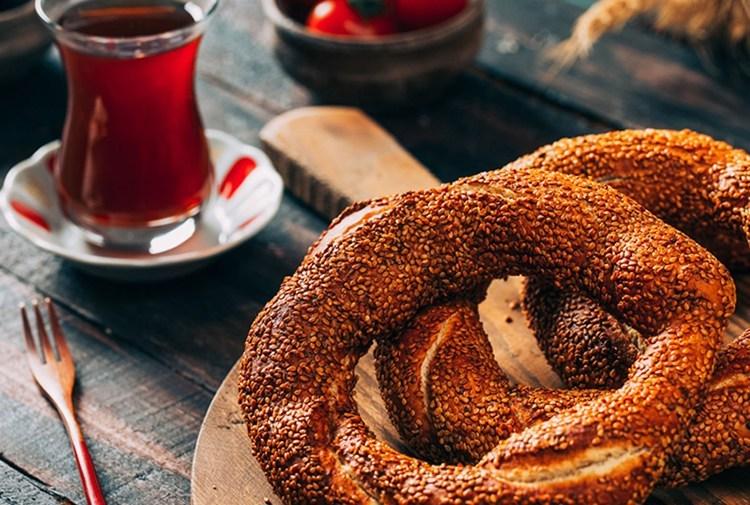
Ankara Simidi differs significantly from simits produced in other regions of Türkiye. Physically, this type of simit is thinner and smaller in size, and is particularly notable for its intensive use of grape molasses and its dark color. The depth of color does not result from burning but from a distinctive molasses treatment technique that produces a rich brown hue. Ankara Simidi is predominantly consumed while warm.
Its crisp texture results from baking in a stone oven over wood fire at a temperature of approximately 250–270°C with a moisture content of 50–52%. Sesame seeds are used in large quantities and are technically roasted beforehand at 175–200°C until they achieve a light brown color.
The dough of Ankara Simidi contains no fat. The firm dough has a water content of 50–52%. Color analyses of the dough, molasses, and sesame are standardized using Hunter Color Analysis.
The primary ingredients used in the production of Ankara Simidi are wheat flour, drinking water, yeast, salt, grape molasses, and roasted sesame. The dough is kneaded mechanically for approximately 12 minutes and then divided into portions of 100–120 grams. These dough pieces are rolled into cylindrical shapes and shaped into simits, after which they are dipped several times into a grape molasses solution diluted to 50–60 Bx and heated to 45–50°C. They are then coated with roasted sesame and baked in a stone oven.
The baking process lasts an average of 10–12 minutes. After the first five minutes, the simits are turned and moved closer to the wood fire. This method ensures a crisp exterior while preventing the interior from drying out. The final product has an average weight of 60 grams, with a weight tolerance of up to 3% accepted.
Ankara Simidi may be sold unpackaged, but if distributed outside the geographical boundary, it must be packaged in paper packaging compliant with the Turkish Food Codex. Sending frozen dough to other locations is not permitted, as it compromises the product’s distinctive characteristics.
The molasses used in Ankara Simidi is produced exclusively from grapes grown within the boundaries of Ankara province. This molasses, derived from local grape varieties such as Emir, Dimrit, Narince, and Kalecik Karası, is rich in minerals including zinc, calcium, iron, and magnesium. The soluble dry matter content of the grapes ranges between 12–20%, and through boiling, it is concentrated into a dense molasses reaching a 70–72 Bx value. During production, this concentrated molasses is diluted to 50–60% before use. This high-quality molasses directly influences the distinctive color and flavor profile of Ankara Simidi.
To ensure that the production processes of Ankara Simidi comply with the geographical indication requirements, monitoring activities are carried out under the coordination of the Ankara Chamber of Commerce. The monitoring commission consists of representatives from the Ankara Provincial Directorate of Food, Agriculture and Livestock, Ankara University Institute of Food Safety, Ankara Chamber of Commerce, and the Association of Pide, Simit and Pastry Makers. The commission conducts at least one inspection per year. Additional inspections may be carried out upon complaint or need.
During inspections, the accuracy of the production method and the origin of the molasses are verified through official documentation. The commission may, when necessary, obtain expert services from public or private institutions and has the authority to initiate legal proceedings.
Turk Patent and Trademark Office. "Ankara Simidi." Accessed June 29, 2025. https://ci.turkpatent.gov.tr/cografi-isaretler/detay/38133
Turk Patent and Trademark Office. *Ankara Simidi Geographical Indication Registration Certificate*. Ankara: TÜRKPATENT, December 5, 2017. Accessed June 29, 2025. https://ci.turkpatent.gov.tr/Files/GeographicalSigns/8236c79c-b642-4a53-9d8d-cf76dc22db8a.pdf

Geographical Indication Type(s) | Mahreç Sign | ||||||||
|---|---|---|---|---|---|---|---|---|---|
Registration Date | 5 December 2017 | ||||||||
Registration Number | 235 | ||||||||
Registering Institution | Ankara Chamber of Commerce | ||||||||
Product / Product Group(s) | Desserts Dough products Bakery and confectionery products | ||||||||
Distinctive Characteristics
Production Method
Geographical Link and Molasses Quality
Monitoring and Control