This article was automatically translated from the original Turkish version.
+1 More
Registration Number | 1646 | ||||||||
|---|---|---|---|---|---|---|---|---|---|
Registration Date | 03.10.2024 | ||||||||
Type of Geographical Indication | Mahreç İşareti | ||||||||
Geographical Boundary | Hatay Türkiye | ||||||||
Applicant/Registrant(s) | Hatay Valiliği | ||||||||
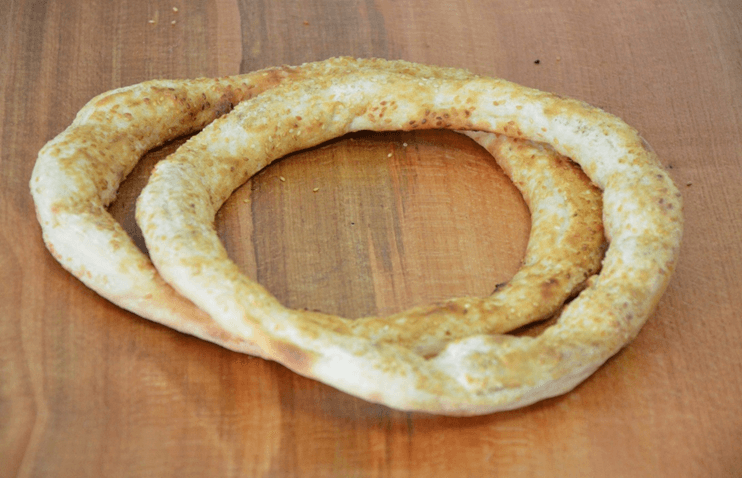
Antakya simit is a bakery product unique to the Hatay province. Made from a firm dough of flour, fresh yeast, carbonate, and water, the product is dipped in sesame and baked in a stone oven, distinguishing it from other types of simit by both its shape and baking method. Antakya simit holds an important place in Hatay’s culinary culture and is characteristically consumed in the morning accompanied by ayran. This product, officially registered with a geographical indication, is shaped into rings known locally as “bukle” and adheres to specific dimensional standards.
Antakya simit is a traditional simit made from bread wheat flour, fresh yeast, carbonate, and water, shaped into a thin wheel and coated with sesame. It has a diameter of approximately 20 ± 2 cm and a thickness of 1.5–2 cm. Before baking, the product weighs an average of 130 g; after baking, it weighs 110 ± 5 g. The sesame seeds are soaked in water one day before production to ensure better adhesion to the surface. The simit is baked in a stone oven at high temperature (approximately 300 °C) using wood fire and is typically consumed hot after being dipped in a mixture of salt and cumin.
The following ingredients are used in the production of Antakya simit (based on a batch of 120 units):
For topping:
Flour, fresh yeast, and carbonate are mixed, after which water is gradually added. The dough is kneaded for 9–10 minutes until it achieves a firm and homogeneous texture. It is then left to ferment for 30 minutes. From the rested dough, pieces of approximately 130 g are taken and hand-rolled into rope-like strands of about 40 cm in length. The ends of each strand are joined to form a ring. These rings are locally called “bukle” and have a diameter of approximately 9–10 cm.
Only the front surface of each bukle is dipped in wet sesame and arranged on wooden boards. They are then shaped to their final diameter of 20 ± 2 cm by rotating them with both hands. The simits are transferred into the stone oven using a wooden peel and baked at approximately 300 °C for 4–5 minutes. They are turned occasionally during baking to ensure even color and texture. Traditionally, they are dipped in a mixture of salt and cumin before consumption.
Antakya simit is a product with a long history in Hatay province. A distinctive local consumption pattern has developed, particularly in the morning, when street vendors sell it accompanied by ayran. Due to its strong cultural connection with the geographical area, all stages of production are carried out exclusively within the boundaries of Hatay province.
The production of Antakya simit is monitored by a three-member expert oversight body established under the coordination of the Hatay Governorate. The body consists of representatives from the Hatay Governorate and the Hatay Provincial Directorate of Agriculture and Forestry. Inspections are conducted at least once a year but may be carried out at any time upon request or complaint.
The inspection criteria are as follows:
In necessary cases, experts from public or private sectors may be assigned. As the registering authority, the Hatay Governorate is also responsible for the legal protection of the product.
Hatay Kültür and Tourism Directorate. "Yöresel Yemek ve Tatlı Çeşitlerimiz." Hatay Valiliği Kültür Turizm Müdürlüğü. Accessed July 15, 2025. https://hatay.ktb.gov.tr/TR-201512/yoresel-yemek-ve-tatli-cesitlerimiz.html.
Hatay Valiliği. *Antakya Simidi Mahreç İşareti Tescil Belgesi*. Türk Patent ve Marka Kurumu. Accessed July 15, 2025. https://ci.turkpatent.gov.tr/Files/GeographicalSigns/9c6dcc89-d44f-4e3f-a8cb-9ba810cae3ce.pdf

Registration Number | 1646 | ||||||||
|---|---|---|---|---|---|---|---|---|---|
Registration Date | 03.10.2024 | ||||||||
Type of Geographical Indication | Mahreç İşareti | ||||||||
Geographical Boundary | Hatay Türkiye | ||||||||
Applicant/Registrant(s) | Hatay Valiliği | ||||||||
Distinctive Characteristics
Production Method
Geographical Boundary and Production Linkage
Control Mechanism