
This article was automatically translated from the original Turkish version.
+1 More
Antenna The Antennae Galaxies hold a prominent place in the astronomical community among colliding galaxies important as a place key example. Located approximately 45 million light years from World, in the Crow Corvus constellation, this system system reveals the ongoing merger of two spiral galaxies. Galaxy Mergers are critical to the structural evolution of the universe, contributing to the formation of large-scale structures on cosmic scales by increasing the rate of star formation.

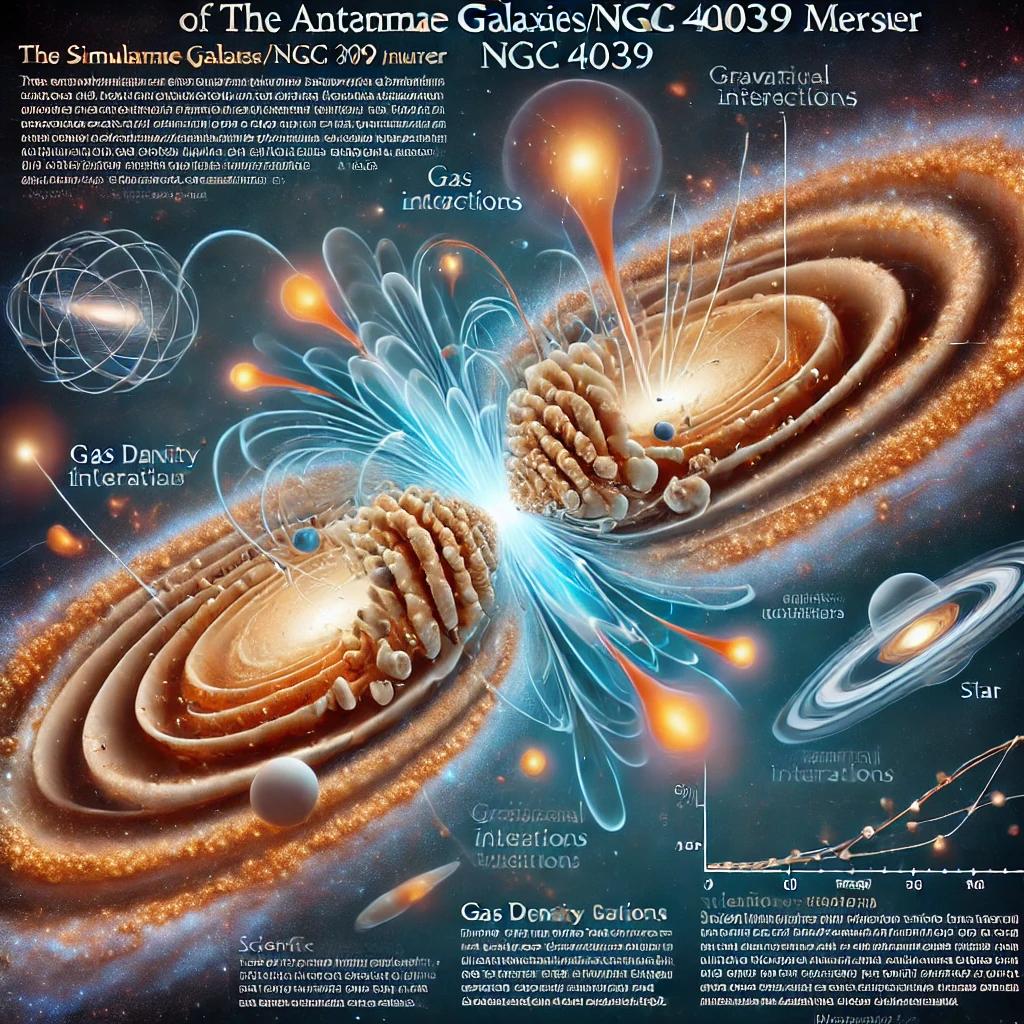
Artificial intelligence-generated visualization of the Antennae Galaxies
The Antennae Galaxies consist of two galaxies that are interlocked and surrounded by tidal star streams. Observations from the Hubble Space Telescope show that this system hosts an intense region of star formation during its collision phase. The impact of the collision compresses gas and dust dust clouds, triggering new star formation and producing strong ultraviolet and infrared radiation in the process.
Simulation studies indicate that the merger process of the Antennae Galaxies began several hundred million years ago and will take several hundred million more years to complete. Analysis of the collision dynamics reveals that gravitational interactions between the two galaxies have led to dense gas compressions and the formation of super star clusters.
The collision process has triggered the emergence of intense star-forming regions within the Antennae Galaxies. Observations by the Hubble Space Telescope and the Chandra X-ray Observatory have confirmed the presence of young and hot star clusters in the Antennae Galaxies. These star clusters will gradually coalesce into larger structures and accumulate toward central dense cores as the merger progresses.

Artificial intelligence-generated representation of a galaxy merger
Galaxy mergers also provide the conditions necessary for the eventual merging of supermassive land black holes. It is hypothesized that active galactic nuclei may form in the center central regions of the Antennae Galaxies. This process process can accelerate the flow of gas and dust, enhancing the growth of black holes.
The Antennae Galaxies offer a critical to understand observational observation laboratory for understanding the evolutionary processes of galaxy mergers. Intense star formation, black hole growth, and large-scale structural changes underscore the significance of such mergers in cosmic evolution. Future observations and simulations will further enhance our detailed understanding of galaxy mergers.

Physical Characteristics and Evolution
Star Formation and Effects of the Collision