This article was automatically translated from the original Turkish version.
+1 More
Type of Geographical İndication | Mahreç Sign | ||||||||
|---|---|---|---|---|---|---|---|---|---|
Registration Number | 1067 | ||||||||
Registration Date | 07.04.2022 | ||||||||
Product / Product Group(s) | Processed and unprocessed fruits and mushrooms vegetables | ||||||||
Province(s) | Gaziantep | ||||||||
Applicant/Registrant(s) | Gaziantep Chamber of Commerce | ||||||||
Antep haylan kabağı kurusu is a winter vegetable product unique to the province of Gaziantep. It is obtained by drying the haylan squash, whose Latin name is Lagenaria siceraria L.. It was officially registered as a geographical indication on 7 April 2022 and is protected under Law No. 6769 on Industrial Property. The registration process was carried out by the Gaziantep Chamber of Commerce.
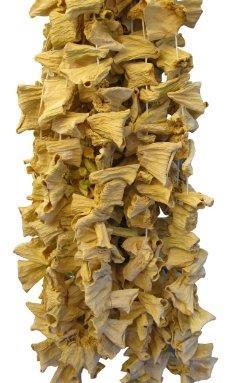
This product is produced from the haylan squash, which has a monoecious flower structure and large white flowers. In its dried form, it is hard, brittle and fragile. Its outer surface is light greenish-yellow and free from spots, cracks and sunburn. The interior is lighter in color, with seeds and inner contents completely removed and uniformly dried. Its shape is elliptical, curved and twisted. The average length is 6–7 cm, thickness 1–2 mm and width 4–5 cm. The dry matter content is approximately 5–6%.
Haylan squash is cultivated in Gaziantep province in organic-rich, permeable soils with high water retention capacity. Seedlings are planted with a row spacing of 60–80 cm and an in-row distance of 50–60 cm. Harvesting takes place in the morning and evening hours from August to the first half of September. Fruits are harvested by cutting them from the stem and immediately subjected to the drying process.
The squashes are washed, their stems are removed, their skins are peeled, and they are cut lengthwise into two or three pieces, after which the interiors are scooped out. Each piece is strung on cotton thread with the open side facing downward. A typical string consists of approximately 50 squashes. These strings are hung on three-legged wooden racks positioned to receive maximum sunlight. The drying process occurs during August and September at temperatures of 30–35 °C and with wind speeds of 19–28 km/h. Drying continues until the moisture content reaches 5%. The drying period varies between 4 and 7 days depending on weather conditions.
The dried strings are tied at their ends and stored in cool, dry environments. Under conditions of 50–55% relative humidity and a temperature of 15–18 °C, they can be stored for up to one year.
The production of Antep haylan kabağı kurusu is permitted only within the boundaries of Gaziantep province. The product holds a deeply rooted place in the regional culinary culture. This cultural connection forms the fundamental basis for its registration as a geographical indication.
The production and use of the indication are monitored under the coordination of the Gaziantep Chamber of Commerce. The monitoring body consists of expert representatives from the Gaziantep Chamber of Commerce, the Gaziantep Gastronomy and Tourism Association, and the Department of Gastronomy and Culinary Arts at the Faculty of Fine Arts, Gaziantep University. Monitoring may be conducted at least once annually, or at any time as needed or upon complaint.
Monitoring criteria include verification of documentation confirming that the haylan squash was cultivated within the geographical boundary, conformity of product characteristics, adherence to the production method, and correct use of the geographical indication.
Turk Patent and Trademark Office. "Antep Haylan Kabağı Kurusu / Gaziantep Haylan Kabağı Kurusu." *Geographical Indications Portal.* Accessed October 21, 2025. https://ci.turkpatent.gov.tr/cografi-isaretler/detay/38444.
Turkish Patent and Trademark Office. "Antep Haylan Kabağı Kurusu / Gaziantep Haylan Kabağı Kurusu Coğrafi İşaret Sicil Belgesi." *Geographical Indications Portal.* Accessed October 21, 2025. https://ci.turkpatent.gov.tr/Files/GeographicalSigns/7d46a3c3-a16f-4b0b-b5a4-8c53e4885791.pdf.

Type of Geographical İndication | Mahreç Sign | ||||||||
|---|---|---|---|---|---|---|---|---|---|
Registration Number | 1067 | ||||||||
Registration Date | 07.04.2022 | ||||||||
Product / Product Group(s) | Processed and unprocessed fruits and mushrooms vegetables | ||||||||
Province(s) | Gaziantep | ||||||||
Applicant/Registrant(s) | Gaziantep Chamber of Commerce | ||||||||
No Discussion Added Yet
Start discussion for "Antep Haylan Pumpkin Dried / Gaziantep Haylan Pumpkin Dried" article
Definition and Distinguishing Characteristics
Production Method
Geographical Boundary and Cultural Connection
Monitoring Process