


This article was automatically translated from the original Turkish version.
+2 More
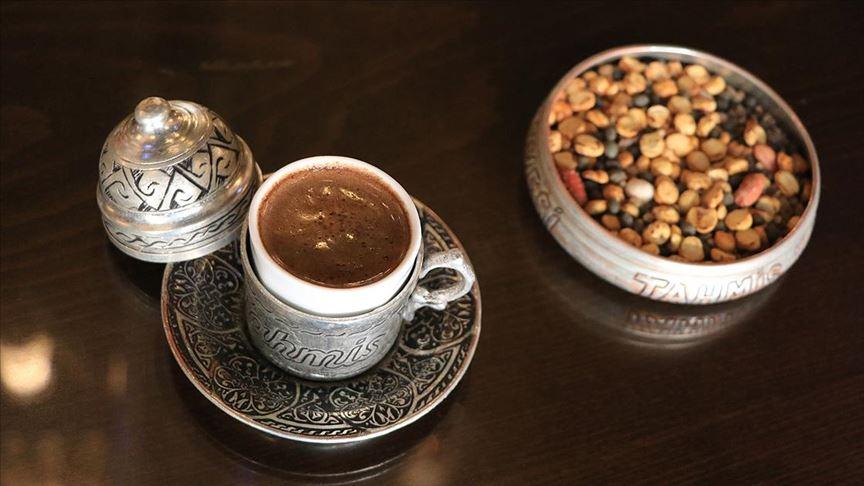
Antep Menengiç Coffee
Product / Product Group(s) | Other products | ||||||||
|---|---|---|---|---|---|---|---|---|---|
Applicant/Registrant(s) | Gaziantep Metropolitan Municipality | ||||||||
Registration Date | 16.12.2020 | ||||||||
File Number | C2017/122 | ||||||||
Registration Number | 627 | ||||||||
Antep Menengiç Kahvesi is a plant-based beverage unique to the city of Gaziantep in Türkiye’s Southeastern Anatolia Region. This beverage is produced by processing the fruits of the wild almond tree known as Pistacia terebinthus (menengiç or melengiç). After harvesting, the menengiç fruits are dried, roasted, and ground into a fine, high-oil-content powder. This product distinguishes itself from traditional coffee varieties primarily due to its lack of caffeine, offering an alternative beverage option for certain consumer groups.

Antep Menengiç Kahvesi (AA)
Protected under the geographical indication status granted by the Turkish Patent and Trademark Office, Antep Menengiç Kahvesi is prepared using traditional knowledge and methods directly linked to its place of origin. Geographical indication registration confirms that the product is produced exclusively within a specific geographic area using local techniques, thereby preserving its standardization. Antep Menengiç Kahvesi is one of the traditional beverages consumed locally and is regarded as an example reflecting the diversity of regional food products.
Antep Menengiç Kahvesi is a plant-based beverage derived from the fruits of the Pistacia terebinthus L. tree, which grows naturally in the mountainous areas of Gaziantep province. Once ripe, the fruits are collected, roasted, and ground into a dark, thick paste. The final product is typically prepared by mixing with milk instead of water and heating it until hot, then consumed warm. Known for its lack of caffeine, the product is also high in fat content, a characteristic that determines both its texture and preparation method.
Due to its natural oils, Antep Menengiç Kahvesi has a different texture and cooking technique compared to traditional coffee varieties. After grinding, it reaches a paste-like consistency and is therefore suitable for heating before consumption. Although classified as a beverage, it differs significantly in production method and composition. Historical records indicate that this product has been used by the people of Gaziantep since the 17th century, demonstrating its long-standing association with the region’s traditional food culture.
1. Harvesting: Menengiç fruits are harvested in October–November when they turn green-blue in color.
2. Cleaning and Drying: The harvested fruits are washed and dried in the sun.
3. Roasting: The dried fruits are roasted until they turn brown.
4. Grinding: The roasted fruits are pounded or processed in a stone mill until they achieve a paste-like consistency.
5. Packaging: The resulting paste is stored in glass jars. Due to its high oil content, a layer of oil may form on the surface.
6. Consumption: Before use, the paste is stirred to achieve homogeneity. It is then cooked slowly over low heat with milk until boiling. Traditionally, it is served in a covered copper cup.

Antep Menengiç Kahvesi (generated by Artificial Intelligence)
The production of Antep Menengiç Kahvesi is permitted only within the administrative boundaries of Gaziantep province. This geographical limitation is mandatory due to its registered geographical indication status, as the product’s distinctive characteristics are recognized as being uniquely attributable to the environmental conditions, local knowledge, and production techniques of this specific region. Consequently, products made using similar methods from the same plant species in other geographic areas cannot be marketed as “Antep Menengiç Kahvesi.”
The production process must be carried out in accordance with the geographical indication registration document issued by the Turkish Patent and Trademark Office and must be regularly monitored by authorized inspection authorities. Inspection activities are conducted based on criteria such as product composition, production techniques, and whether the product was genuinely produced within the designated origin area. Local administrations, chambers of agriculture, relevant professional organizations, and, when necessary, universities provide support to enhance inspection effectiveness. This oversight mechanism ensures that the geographical indication product is produced and commercialized in compliance with established standards.
Anadolu Ajansı. “Gaziantep'in yemekleri kadar ünlü kahvesi: Menengiç.” Accessed May 25, 2025. https://www.aa.com.tr/tr/kultur-sanat/gaziantepin-yemekleri-kadar-unlu-kahvesi-menengic/1680674
Gaziantep Büyükşehir Municipality. "Antep Menengiç Kahvesi." Accessed May 25, 2025. https://ci.gaziantep.bel.tr/Urunler/antep-menengic-kahvesi-gaziantep-menengic-kahvesi-antep-melengic-kahvesi-gaziantep-melengic-kahvesi-28
TRT Haber. “Gaziantep'in tescilli lezzeti: Menengiç kahvesi.” Accessed May 25, 2025. https://www.trthaber.com/foto-galeri/gaziantepin-tescilli-lezzeti-menengic-kahvesi/32814.html

Antep Menengiç Coffee
Product / Product Group(s) | Other products | ||||||||
|---|---|---|---|---|---|---|---|---|---|
Applicant/Registrant(s) | Gaziantep Metropolitan Municipality | ||||||||
Registration Date | 16.12.2020 | ||||||||
File Number | C2017/122 | ||||||||
Registration Number | 627 | ||||||||
No Discussion Added Yet
Start discussion for "Antep Menengiç Coffee" article
Product Definition and Distinctive Characteristics
Production Method
Geographical Boundaries and Oversight