This article was automatically translated from the original Turkish version.
+2 More
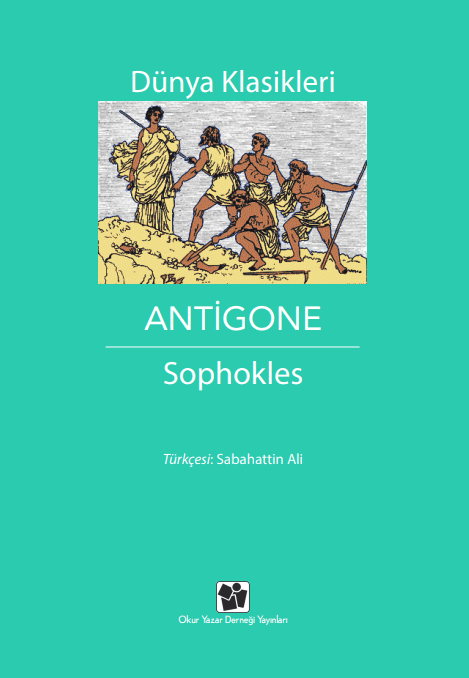
Antigone
Author(s) | Sophocles | ||||||||
|---|---|---|---|---|---|---|---|---|---|
Turkish | Sabahattin Ali | ||||||||
Publisher(s) | Okur Yazar Derneği Yayınları | ||||||||
Publication Editor | H. Emre Bağce | ||||||||
Publication Date | 20 October 2021, Istanbul | ||||||||
Antigone is one of the plays written by the ancient Greek tragedian Sophocles in the 5th century BCE. It continues the myth of Oedipus and completes the tragedy of the House of Thebes alongside Sophocles’ works Oedipus the King and Oedipus at Colonus. At its center lies the conflict between individual conviction and state authority. The tragedy is regarded as one of the most powerful and enduring examples of ancient Greek theater, both for its universal themes and its depth of character.
Antigone defies King Creon’s decree forbidding the burial of her brother Polyneices and buries him anyway. Her act represents the fusion of individual conscience with moral obligations rooted in divine law. Creon, prioritizing the preservation of state order, punishes Antigone with death for violating his edict. This decision triggers a chain of disasters within his family: Antigone commits suicide, her fiancé Haemon kills himself in turn, and Creon’s wife cannot bear the loss of her son and takes her own life. The tragedy reveals the social consequences of individual resistance paid for at great personal cost and the blindness of authority.
The central tension of the play is highlighted by the distinction between human-made state laws (nomoi) and divine, unchanging, universal laws (thesmoi). Antigone acts on religious and ethical duty, appealing to the unwritten but universally accepted laws of the gods. Creon, in the name of public order, declares this act illegal. Antigone says: “Zeus did not issue such a law.” This statement reflects not only a religious but also a philosophical position: what is just is not always lawful. Within this framework, Antigone opens a debate on the moral grounds for individual action when law and justice diverge.
Antigone’s resolve is not merely stubbornness but a mode of thought. Despite being a woman, she directly opposes the state’s command, transgressing traditional gender roles. In contrast, the figure of Creon embodies the authoritarian will that suppresses individual rights in the name of law and order. Creon’s thinking places the interests of the state above individual values. This opposition is presented in the play not only as a conflict between individuals but as a clash between systems of thought.
Antigone draws attention as a woman who defies the law during a period in ancient Greece when women’s political and social roles were severely limited. While her sister Ismene conforms to traditional expectations, Antigone violates these norms. In this regard, the play can also be seen as an early narrative that questions the boundaries of social gender.
The tragedy is linked to the myth of Oedipus in Greek mythology. Oedipus’ curse continues to affect his children. Antigone has not only shared in her father’s blind fate but also sacrificed her own life for the truths she believed in. In ancient Greek culture, burial of the dead was considered a divine right; its violation was seen not merely as a breach of law but as an assault on sacred order. Therefore, Antigone’s act is not simply a personal choice but an expression of her desire to act in harmony with the gods.
The character of Antigone has become a symbol of resistance against totalitarian regimes in contemporary interpretations. Jean Anouilh transposed his adaptation of Antigone to the context of Nazi-occupied France, while Bertolt Brecht treated the tragedy as a warning against fascism. In Kemal Demirel’s version, Antigone represents individual resistance against injustice in the modern world. These adaptations portray Antigone not as a figure of the past but as a timeless symbol of defiance.
Antigone explores philosophically the conflicts between individual and state, law and justice, woman and power, belief and command. Although the events unfold in an ancient world, the questions it raises remain relevant: Should the state’s law prevail, or should universal moral principles? Should the individual suppress their conscience for the sake of order, or should they resist—even at the cost of their life?
For this reason, the work is regarded not merely as a philological or literary text but also as an intellectual resource in the fields of law, politics, ethics, and social theory.
The play follows the classical Greek tragedy structure, advancing through dialogue and choral odes. The choral sections provide moral and philosophical commentary. The Turkish translation by Sabahattin Ali retains the linguistic and stylistic features of its time and is not simplified.
Sophokles. Antigone. Türkçesi: Sabahattin Ali. İstanbul: Okur Yazar Derneği Yayınları, 2021.
Zerenler, Dilek. “Antigone’nin İki Farklı Yorumu.” *Türkiyat Araştırmaları Dergisi*, no. 13 (2011): 263–267. Accessed June 21, 2025. https://dergipark.org.tr/tr/pub/sutad/issue/26305/277246
Çankaya, Aylin. “Yasa Üzerine İki Farklı Perspektif: Antigone ve Sokrates.” *FLSF (Felsefe ve Sosyal Bilimler Dergisi)*, no. 19 (2015): 237–248. Accessed June 21, 2025. https://dergipark.org.tr/tr/pub/flsf/issue/48624/617794

Antigone
Author(s) | Sophocles | ||||||||
|---|---|---|---|---|---|---|---|---|---|
Turkish | Sabahattin Ali | ||||||||
Publisher(s) | Okur Yazar Derneği Yayınları | ||||||||
Publication Editor | H. Emre Bağce | ||||||||
Publication Date | 20 October 2021, Istanbul | ||||||||
Plot
Characters
Conflict Between Laws: Nomos and Thesmos
Intellectual Representation Through Characters
Social Gender and the Female Figure
Mythological and Cultural Context
Modern Adaptations and Influence
Universal Themes and Enduring Legacy
Form and Language