

This article was automatically translated from the original Turkish version.
+1 More
Range (With 18 Ton Payload) | 1.000 km | ||||||||
|---|---|---|---|---|---|---|---|---|---|
Length(s) | 32.23 m | ||||||||
Engine(s) | 2×Progress D-436-148FM Turbofan | ||||||||
Manufacturer(s) | Antonov (Ukraine) | ||||||||
Height(s) | 9.65 m | ||||||||
First Flight(s) | 7 May 2015 | ||||||||
Type(s) | medium-scale military transport aircraft Short-range | ||||||||
Required Runway Length | 2.500 m (for full load takeoff) | ||||||||
Maximum Payload Capacity | 18.000 kg (18 tons) | ||||||||
Service Ceiling | 12.200 m (40.000 ft) | ||||||||
Wingspan | 30.57 m | ||||||||
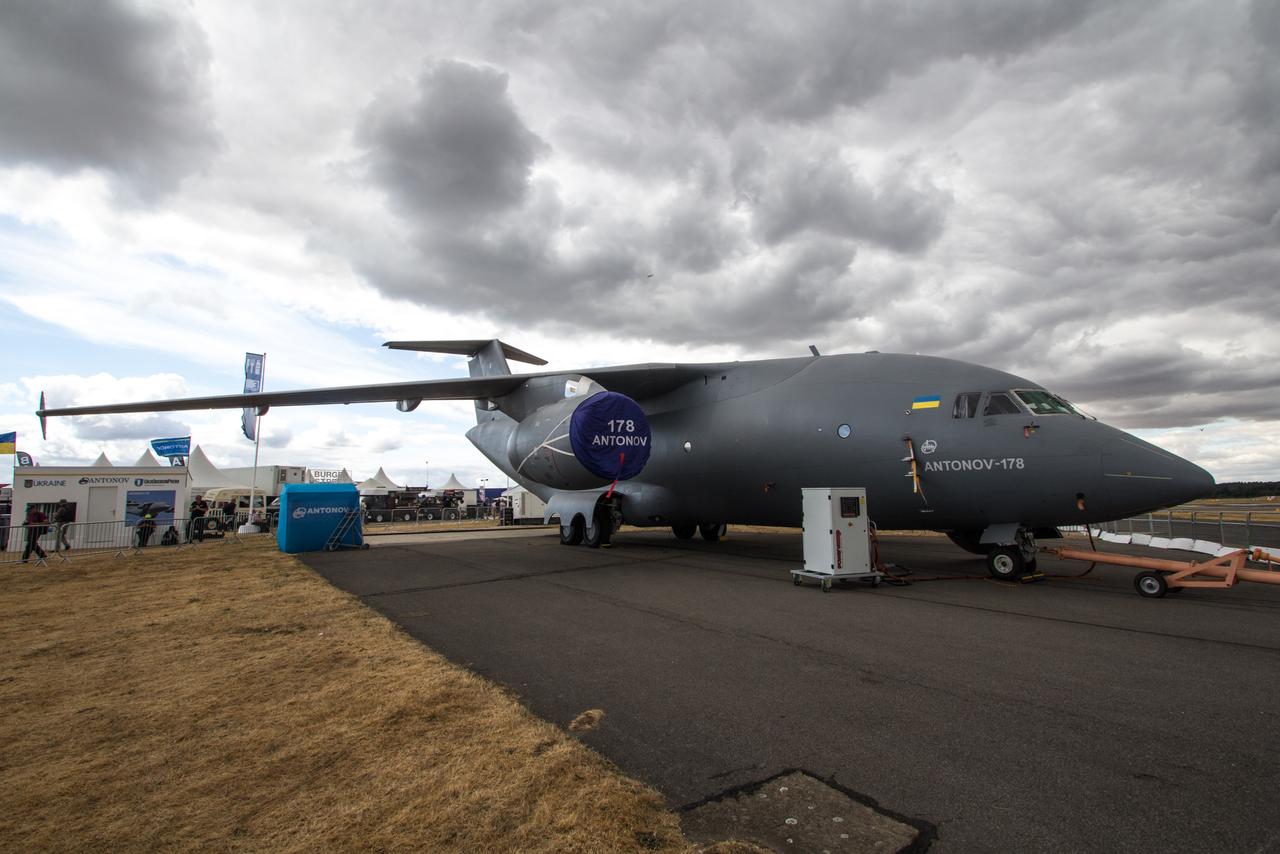
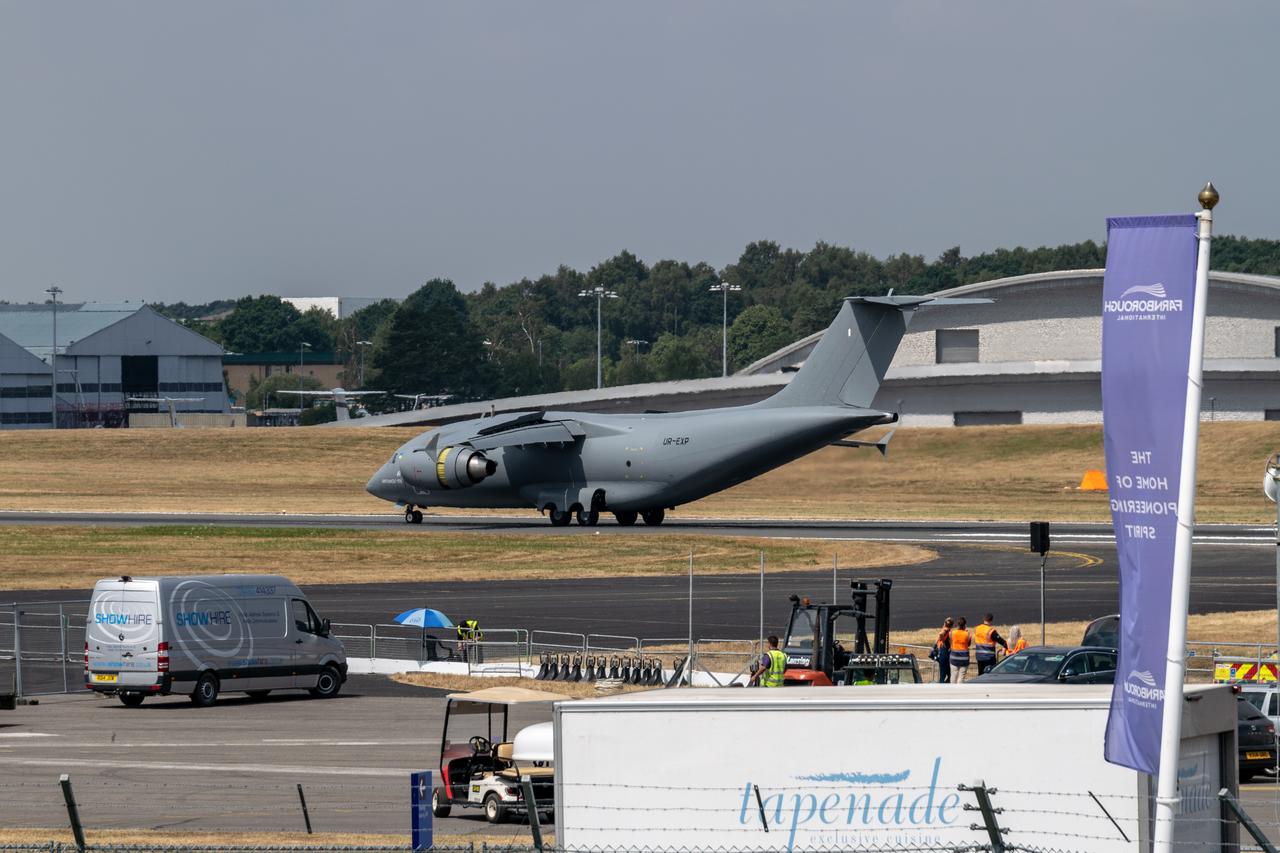
Antonov An-178 is a short-range medium-lift military transport aircraft developed by the Ukrainian aerospace company Antonov. First announced in 2010, the model was modernized to replace Soviet-era An-12, An-26, and An-32 aircraft, based on the design of the Antonov An-158 regional passenger aircraft. The fuselage structure was modified to include a rear loading ramp to facilitate logistics operations, and its high-wing configuration enhances operational capability.
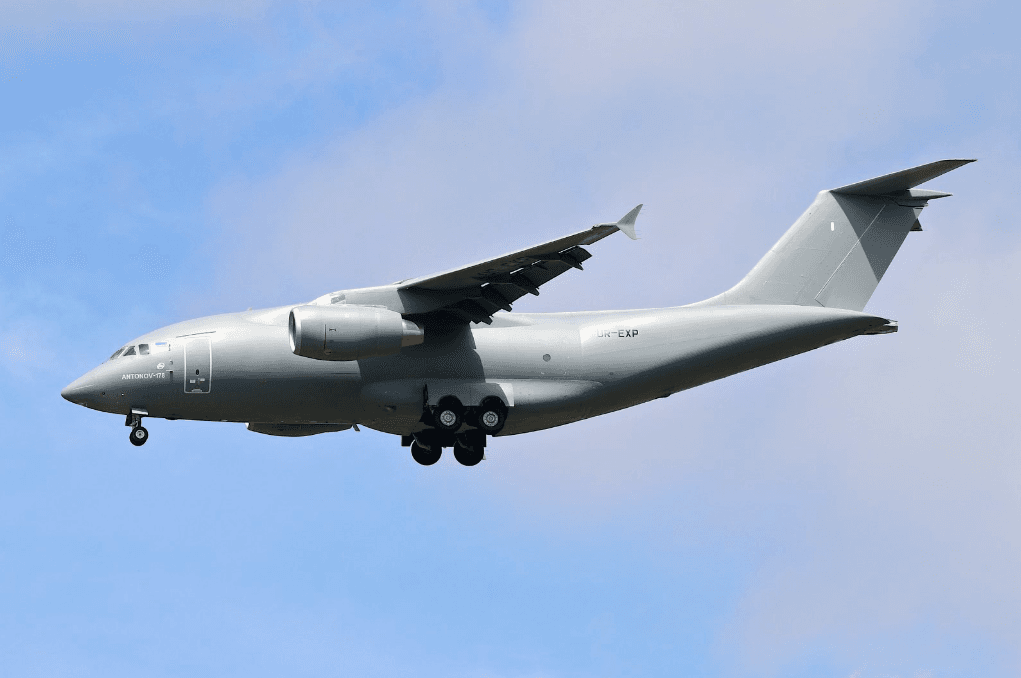
Antonov An-178 (Colin Cooke)
The design process of the Antonov An-178 began in 2010 using an engineering approach derived from the Antonov An-148 and An-158 regional passenger aircraft family. The core design philosophy was to retain the aerodynamic advantages of the existing platform while increasing the fuselage diameter and integrating a rear cargo ramp to meet military logistics requirements. This modification increased the fuselage width from 2.74 meters to 3.90 meters, enabling the transport of heavy loads and standard sea containers. With 70 percent of its components shared with the An-158, the design reduced production costs and standardized maintenance procedures.【1】
One of the most critical milestones in the development phase was the modernization of the aircraft’s propulsion system and avionics architecture. The aircraft is equipped with D-436-148FM turbofan engines developed by Ivchenko-Progress, optimized to minimize performance loss under hot and high-altitude conditions. During development, a digital fly-by-wire (FBW) flight control system and an advanced glass cockpit featuring five multifunction displays were adopted. This technological infrastructure significantly improved the aircraft’s ability to perform precise takeoffs and landings in challenging terrain and low-visibility conditions.【2】
In the industrial development of the project, Ukraine’s policy to reduce dependence on foreign components in its defense industry played a decisive role. Particularly after 2014, Antonov engineers replaced Russian-origin components in the design with Ukrainian domestic systems and Western suppliers such as Honeywell, Liebherr, and Pratt & Whitney Canada. Under this “Import Substitution” program, the aircraft’s landing gear, hydraulic systems, and auxiliary power unit (APU) were fully modernized to meet Western standards. This transition directly influenced the aircraft’s certification processes for international aviation.
The first prototype of the An-178 (serial number 001) was rolled out from the hangar at the Antonov factory in Kyiv on 16 April 2015 and successfully completed its maiden flight on 7 May 2015. During the test program, stability measurements at various center-of-gravity positions, cargo drop trials, and operational limits under diverse climatic conditions were evaluated. The development process evolved beyond military transport to include variants for aerial refueling tankers and fire-fighting roles, transforming the platform into a multi-mission system. Digital 3D design methods used in the production line contribute to improved assembly precision and structural lifespan.【3】
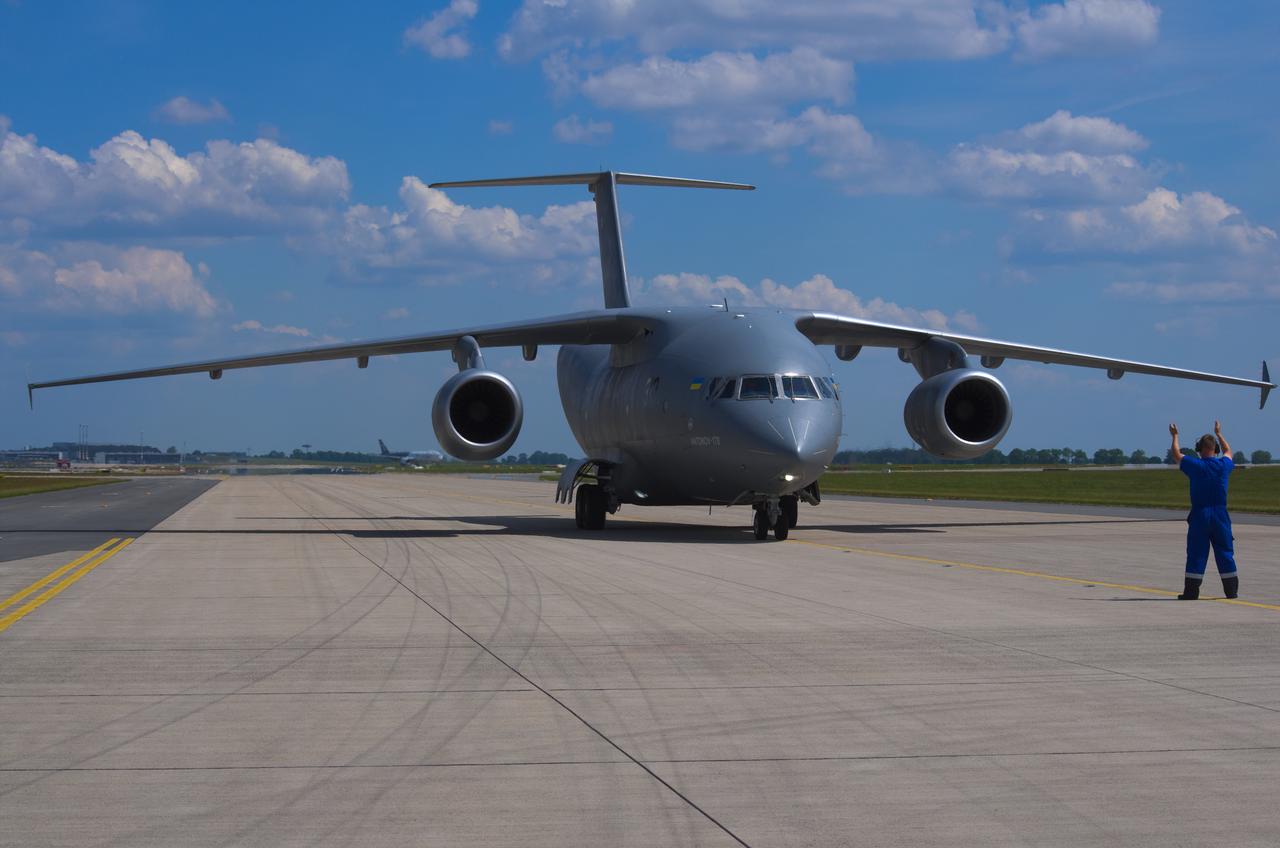
An-178 (Jan M)
The Antonov An-178 is a high-wing, T-tail military transport aircraft powered by two turbofan engines. The aircraft has a fuselage length of 32.23 meters, a wingspan of 30.57 meters, and a height of 9.65 meters. The cargo compartment, including the ramp, measures 16.65 meters in length, 2.74 meters in width, and 2.75 meters in height, enabling the transport of standard sea containers and IATA pallets. With a maximum takeoff weight of 52,250 kg, the aircraft has a payload capacity of up to 18 tons depending on operational requirements.【4】
Performance data shows that the An-178 has a maximum cruise speed of 825 kilometers per hour (445 knots). The aircraft can reach a service ceiling of 12,200 meters (40,000 feet). Its range varies with payload: approximately 3,680 kilometers with a 10-ton load and about 1,000 kilometers with a full 18-ton load. For takeoff with maximum payload, it requires a minimum runway length of 2,500 meters.【5】
The propulsion system consists of two Progress D-436-148FM turbofan engines, each producing over 15,000 lbf of thrust at sea level. These engines have been modernized to improve fuel efficiency and reduce noise emissions to comply with international civil aviation standards (ICAO Chapter 4). The avionics suite features a dual-duplex fly-by-wire flight control system and an advanced digital cockpit with modern navigation equipment. These systems enable precise aircraft control under all weather conditions and during both day and night operations.【6】
The An-178’s cargo compartment can be reconfigured for various operational needs. In military transport missions, it can carry 90 fully equipped troops or 70 paratroopers. In medical evacuation scenarios, it can accommodate 40 stretchers and 30 ambulatory patients. The rear loading ramp is designed with sufficient strength to enable rapid loading and unloading of vehicles and heavy equipment. The aircraft also features a reinforced landing gear system with low-pressure tires, allowing operations on unprepared or dirt runways.
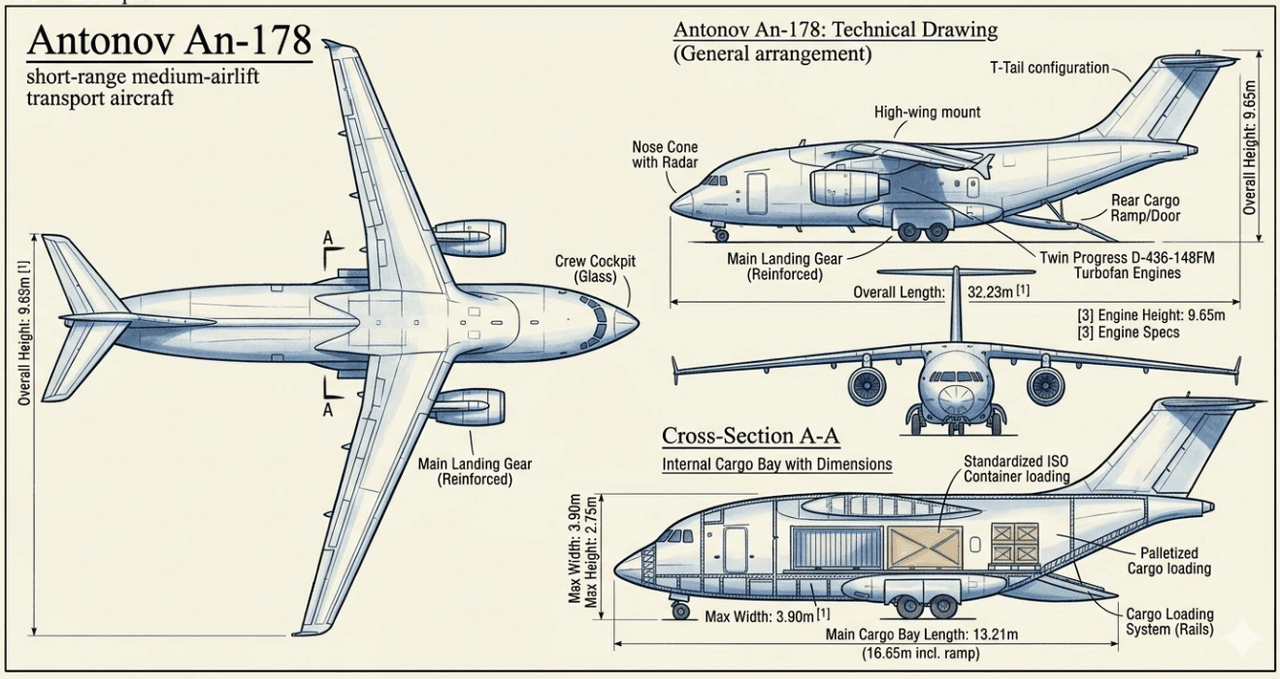
Antonov An-178 Drawing (Generated by AI)
Thanks to its modular fuselage structure, the Antonov An-178 has been designed in multiple variants to meet diverse operational requirements. The baseline model, the An-178-100, is optimized for standard military transport missions and designed to carry personnel, vehicles, and standard cargo containers. This variant features an automated rail system and a rear loading ramp for rapid loading and unloading. The civilian version is configured with ICAO-compliant avionics for commercial cargo operators.
An-178-100R is the most up-to-date military variant developed under Ukraine’s import substitution program. In this model, Russian-origin components have been replaced with Ukrainian-made and Western-supplied systems, particularly in flight control and navigation equipment, which have been upgraded to NATO standards. Produced for the Ukrainian Air Force, this variant is capable of airdropping personnel and munitions and is equipped with infrared and advanced radar systems for night operations.
Among the aircraft’s multi-role scenarios is the An-178 MEDEVAC configuration, specifically adapted for medical evacuation missions. In this variant, the cargo compartment can be converted into a flying hospital capable of carrying 40 stretchers and 30 ambulatory patients. Communication and logistics support units necessary for delivering humanitarian aid to disaster zones and deploying search and rescue (SAR) teams in difficult terrain are standard in this configuration.【7】
The An-178P variant, developed for fire-fighting missions, is equipped with integrated high-capacity water tanks and discharge mechanisms. This model leverages the aircraft’s stable low-speed flight characteristics to deliver precise interventions in fire zones. Additionally, projections for converting the aircraft into an aerial refueling tanker were evaluated during the design phase. All these variants share the same fuselage and engine architecture, providing operators with logistical commonality and simplified maintenance.
Antonov An-178 (Antonov Company)
The Antonov An-178 competes directly with specific platforms in the medium-lift military transport market due to its operational capacity and jet-powered configuration. The following analysis evaluates the An-178’s technical and doctrinal position relative to its counterparts.
Both aircraft are modern jet transport platforms utilizing turbofan technology, but they serve different payload classes.
While the C-295 uses a turboprop system, the An-178 offers a jet-powered alternative focused on speed and altitude performance.
C-130J is globally recognized as a four-engine turboprop standard, while the An-178 is positioned as a simpler, higher-speed jet alternative.
The Y-9 is a four-engine turboprop platform based on the An-12, while the An-178 offers a technological generational leap through modern avionics and jet engine integration.
Antonov An-178 (Dan Dunn)
The Antonov An-178 represents a symbolic platform for Ukraine’s aerospace industry, embodying its engineering capabilities and industrial transformation in the post-Soviet era. Its development is the product of Antonov Design Bureau’s (OKB-153) decades of transport aircraft expertise merged with modern digital design and manufacturing techniques. By leveraging the technical foundation of the An-148/158 regional passenger aircraft family, the An-178 established a significant precedent in integrating commercial aviation technologies into military logistics needs (dual-use). This approach reduced production costs, increased component commonality, and simplified maintenance procedures.
The most critical element of the aircraft’s industrial legacy is its role as a tangible outcome of Ukraine’s strategy to reduce dependency on Russia in its aerospace sector. After 2014, Russian-origin systems on the aircraft—including avionics, hydraulics, and landing gear—were systematically replaced with Ukrainian-made and Western-supplied components from the United States and Europe. This transition restructured Ukraine’s aerospace supply chain according to Western standards and built technical expertise in NATO compliance.
As Ukraine’s first domestically produced transport aircraft ordered by its armed forces after independence, the An-178 holds symbolic importance for the national defense industry. Its production line has been one of the foundational projects supporting the technological modernization of the Antonov factory under the state enterprise Ukroboronprom and preserving Ukraine’s skilled workforce. This industrial continuity has enabled Ukraine to remain a “producer” in the global transport aircraft market and has continued the legacy of massive aircraft such as the An-124 and An-225 within a smaller segment.
Antonov Company. "An-178 Transport Aircraft: Design Features and Layout." Accessed March 17, 2026. https://www.antonov.com/en/aircraft/an-178.
Antonov Company. "Антонов АН-178." YouTube. Accessed March 18, 2026. https://www.youtube.com/watch?v=h0jR9klmM00.
Colin Cooke Photo. "UR-EXP Antonov AN-178 Antonov Design Bureau Farnborough 7.7.16." Flickr. Accessed July 7, 2016. https://www.flickr.com/photos/cooke1/28049459232/.
Dunn, Dan. "Prototype Antonov AN178." Flickr. Accessed July 13, 2018. https://www.flickr.com/photos/d0mokun/42485792555/.
GlobalSecurity. "Antonov AN-178 / Regional Transport Aircraft." Accessed March 17, 2026. https://www.globalsecurity.org/military/world/ukraine/an-178.htm.
GlobalSecurity. "C-295 Transport Aircraft." Accessed March 18, 2026. https://www.globalsecurity.org/military/world/europe/cn-295.htm.
GlobalSecurity. "C-390 Millennium Multi-mission Aircraft." Accessed March 18, 2026. https://www.globalsecurity.org/military/world/brazil/c-390.htm.
GlobalSecurity. "Y-9 Medium Transport Aircraft." Accessed March 18, 2026. https://www.globalsecurity.org/military/world/china/y-9.htm.
Lockheed Martin. "C-130J Super Hercules Specifications." Accessed March 18, 2026. https://www.lockheedmartin.com/en-us/products/c130.html.
Lynes, Steve. "EGLF - Antonov AN-178 - UR-EXP." Flickr. Accessed July 17, 2018. https://www.flickr.com/photos/lynothehammer/43522107771/.
M, Jan. "An-178 UR-EXP." Flickr. Accessed June 3, 2016. https://www.flickr.com/photos/134135469@N02/27747506805/.
McParlin, Stephen. "Antonov An-178." Flickr. Accessed July 16, 2018. https://www.flickr.com/photos/stephen_dedalus/29579885318/.
Military Factory. "Antonov An-178 (Short-Range Medium-Airlift Military Transport Aircraft)." Accessed March 18, 2026. https://www.militaryfactory.com/aircraft/detail.php?aircraft_id=1638.
Shmyrov, Volodymyr, Vyacheslav Merkulov, and Vasyl Loginov. “Principle of Modernization of the Aircraft An-148, An-158, and An-178 for Improving Their Fuel Efficiency and Increasing Competitiveness”. *Eastern-European Journal of Enterprise Technologies* 3, no. 1 (105): 6–16. https://doi.org/10.15587/1729-4061.2020.204780
[1]
Antonov Company."An-178 Transport Aircraft: Design Features and Layout."Antonov Company. Access Date: 17 March 2026.https://www.antonov.com/en/aircraft/an-178.
[2]
GlobalSecurity."Antonov AN-178 / Regional Transport Aircraft."GlobalSecurity. Access Date: 17 March 2026.https://www.globalsecurity.org/military/world/ukraine/an-178.htm.
[3]
Antonov Company."An-178 Transport Aircraft: Design Features and Layout."Antonov Company. Access Date: 17 March 2026.https://www.antonov.com/en/aircraft/an-178.
[4]
GlobalSecurity."Antonov AN-178 / Regional Transport Aircraft."GlobalSecurity. Access Date: 17 March 2026.https://www.globalsecurity.org/military/world/ukraine/an-178.htm.
[5]
GlobalSecurity."Antonov AN-178 / Regional Transport Aircraft."GlobalSecurity. Access Date: 17 March 2026.https://www.globalsecurity.org/military/world/ukraine/an-178.htm.
[6]
Military Factory. Military Factory, "Antonov An-178 (Short-Range Medium-Airlift Military Transport Aircraft)." Access Date: 18 March 2026.https://www.militaryfactory.com/aircraft/detail.php?aircraft_id=1638.
[7]
Antonov Company."An-178 Transport Aircraft: Design Features and Layout."Antonov Company. Access Date: 17 March 2026.https://www.antonov.com/en/aircraft/an-178.
[8]
GlobalSecurity. "C-390 Millennium Multi-mission Aircraft." GlobalSecurity. Access Date: 18 March 2026. https://www.globalsecurity.org/military/world/brazil/c-390.htm.
[9]
GlobalSecurity. "C-295 Transport Aircraft."GlobalSecurity Access Date: 18 March 2026.https://www.globalsecurity.org/military/world/europe/cn-295.htm.
[10]
Lockheed Martin."C-130J Super Hercules Specifications." Lockheed Martin. Access Date: 18 March 2026. https://www.lockheedmartin.com/en-us/products/c130.html.
[11]
GlobalSecurity."Y-9 Medium Transport Aircraft."GlobalSecurity. Access Date: 18 March 2026.https://www.globalsecurity.org/military/world/china/y-9.htm.


Range (With 18 Ton Payload) | 1.000 km | ||||||||
|---|---|---|---|---|---|---|---|---|---|
Length(s) | 32.23 m | ||||||||
Engine(s) | 2×Progress D-436-148FM Turbofan | ||||||||
Manufacturer(s) | Antonov (Ukraine) | ||||||||
Height(s) | 9.65 m | ||||||||
First Flight(s) | 7 May 2015 | ||||||||
Type(s) | medium-scale military transport aircraft Short-range | ||||||||
Required Runway Length | 2.500 m (for full load takeoff) | ||||||||
Maximum Payload Capacity | 18.000 kg (18 tons) | ||||||||
Service Ceiling | 12.200 m (40.000 ft) | ||||||||
Wingspan | 30.57 m | ||||||||
Design and Development
Technical Specifications
Variants and Configurations
International Comparison
An-178 and Embraer C-390 Millennium (Brazil)
An-178 and Airbus C-295 (European Union)
An-178 and Lockheed Martin C-130J Super Hercules (United States)
An-178 and Shaanxi Y-9 (People’s Republic of China)
Industrial Legacy