

This article was automatically translated from the original Turkish version.
+1 More
Length(s) | 57.84 m | ||||||||
|---|---|---|---|---|---|---|---|---|---|
Height(s) | 12.54 m | ||||||||
Wingspan | 64.40 m | ||||||||
Wing Area | 345 m | ||||||||
Cruising Speed | 580 km/h | ||||||||
Range (Operational) | 5.225 km | ||||||||
Maximum Operational Altitude | 9.100 m | ||||||||
Antonov An-22 (Antei) is a heavy cargo aircraft developed during the Soviet era, featuring four turboprop engines and a high-wing configuration, designed for both military and civilian use. Designated “Cock” by NATO, the aircraft is recognized as the world’s largest turboprop-powered aircraft and entered service in 1965.
The Antonov An-22 was designed as an enlarged successor to the An-12 military transport aircraft. Its development was driven by the Soviet Armed Forces’ need for a platform capable of transporting a 36-ton T-54 tank along with its crew and supplies, as well as large-volume cargo such as ballistic missiles. The Soviet Airborne Forces also required the ability to airlift BMD-1 series armored combat vehicles, and the An-22 was specifically designed to carry four of these vehicles in a single sortie; for comparison, its predecessor, the An-12, could carry only one BMD-1.
The An-22 program was officially launched in 1960 following a decision by the Soviet authorities. Construction of the prototype was completed in January 1964. The first prototype, designated “01-01” (USSR-46191), was delivered for flight testing on 18 August 1964.
The An-22’s first flight took place on 27 February 1965. The flight was commanded by test pilot Yurii Kurlin. Within three months of its first flight, the aircraft was publicly unveiled for the first time internationally at the 1965 Paris Air Show (Le Bourget).
On 10 June 1965, a decree by the Soviet Ministry of the Aviation Industry decided that series production of the An-22 would begin at the Chkalov Aviation Production Association in Tashkent. The first production aircraft rolled off the assembly line on 16 November 1965, and its maiden flight was conducted on 27 January 1966 by the same crew under the command of Yurii Kurlin. The An-22 entered service beginning in 1965.
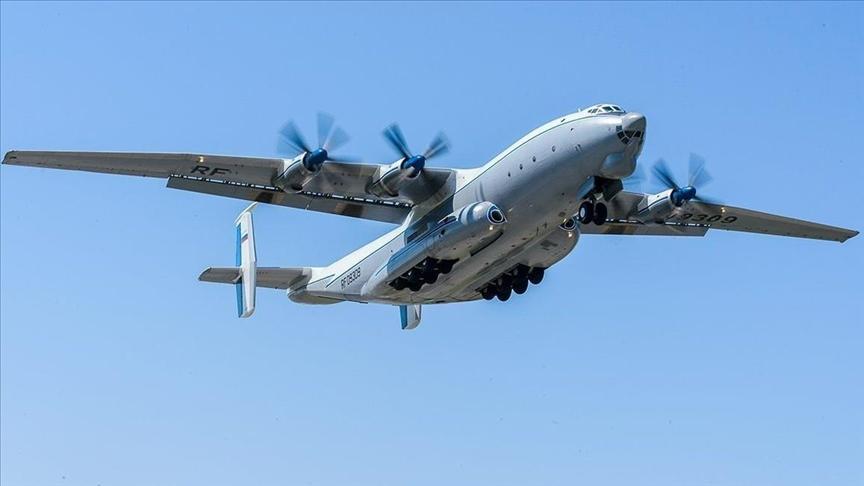
Takeoff of the An-22 Aircraft (Antonov Company)
The An-22 is a high-wing aircraft with an “H”-type tail configuration. Its fuselage has a circular/tubular cross-section, with landing gear bays located on both sides of the fuselage where the main landing gear is housed.
The wingspan is 64.40 meters and the wing area is 345 square meters. The aircraft’s length is 57.84 meters and its height is 12.54 meters. The wide internal volume of the fuselage provides a cargo compartment suitable for transporting heavy vehicles and bulky cargo.
The An-22’s high flight performance and ability to operate from unpaved runways enabled its use in transporting large-scale cargo and equipment to remote and inaccessible regions. It played a vital role in transporting machinery, industrial equipment, tractors, and similar heavy materials.
The aircraft is powered by four turboprop engines, each driving a pair of contra-rotating propellers. The An-22 is equipped with NK-12MA turboprop engines. This propulsion system provides thrust levels compatible with the aircraft’s large fuselage and high payload capacity. Due to these features, the An-22 is recognized as the world’s largest turboprop aircraft and the world’s largest propeller-driven aircraft.
The An-22’s cruise speed is 580 km/h. Its operational range is 5,225 km and its service ceiling is 9,100 meters. Its maximum true airspeed is approximately 400 knots, or about 0.68 Mach. It can carry a payload of approximately 80 tons over a distance of 5,000 km at an altitude of 29,000 feet.
Following the dissolution of the Soviet Union in 1991, Antonov became a Ukrainian-based aviation organization, but commercial and industrial ties with Russia continued. The Russian-Ukrainian war, which began in February 2022, and the subsequent Western sanctions rendered existing aviation cooperation between the two countries unworkable. This situation has significantly hampered maintenance and repair activities for Antonov aircraft in both Russian civil and military fleets.
The aircraft was specifically developed for transporting heavy loads over long distances in remote areas with unprepared runways, such as Siberia. A total of 67 An-22 aircraft were produced, some of which remained in Ukraine, while approximately 60 were integrated into the inventory of the Russian Military Transport Aviation. However, most of the aircraft in the fleet have been retired, five are stored, only four remain active, and six have been lost in various accidents.
Throughout its service life, the An-22 has been involved in seven major accidents, resulting in the loss of nine aircraft and the deaths of 102 people. The Russian Air Force has planned to withdraw these aircraft from military transport operations by summer 2024. The most recent accident involving an An-22 occurred in December 2025 in the Ivanovo region northeast of Moscow.
Aerospace Global News. "Russian Antonov An-22 crashes into a reservoir: All 7 crew feared dead." Accessed December 9, 2025. https://aerospaceglobalnews.com/news/russia-antonov-an-22-crash/
Antonov Company. "AN-22 Military Transport Airplane." Accessed December 9, 2025. https://www.antonov.com/en/history/an-22
Antonov Company. "An-22 Aircraft is Take Off." YouTube, 00:53. Accessed December 9, 2025. https://www.youtube.com/watch?v=RA3XONGRD2c
GDH. "Rusya, Dünyanın En Büyük Turboprop Uçağı Antonov An-22 Antei Filosunu Emekliye Ayırıyor." Accessed December 9, 2025. https://gdh.digital/haber/rusya-dunyanin-en-buyuk-turboprop-ucagi-antonov-an-22-antei-filosunu-emekliye-ayiriyor-ruc81dooef
Satam, Parth. "Russia to Retire its Fleet of the World’s Largest Turboprop Aircraft, the Antonov An-22 Antei" The Aviationist. Accessed December 9, 2025. https://theaviationist.com/2024/06/06/russia-to-retire-the-an-22/
Skybrary. "ANTONOV An-22 Antheus." Skybrary. Accessed December 9, 2025.

Length(s) | 57.84 m | ||||||||
|---|---|---|---|---|---|---|---|---|---|
Height(s) | 12.54 m | ||||||||
Wingspan | 64.40 m | ||||||||
Wing Area | 345 m | ||||||||
Cruising Speed | 580 km/h | ||||||||
Range (Operational) | 5.225 km | ||||||||
Maximum Operational Altitude | 9.100 m | ||||||||
General Characteristics
Development Process
First Flight
Transition to Series Production
Technical Specifications
Fuselage, Wing, and Landing Gear Configuration
Engines and Propulsion System
Performance
Operational Use