


This article was automatically translated from the original Turkish version.
+2 More
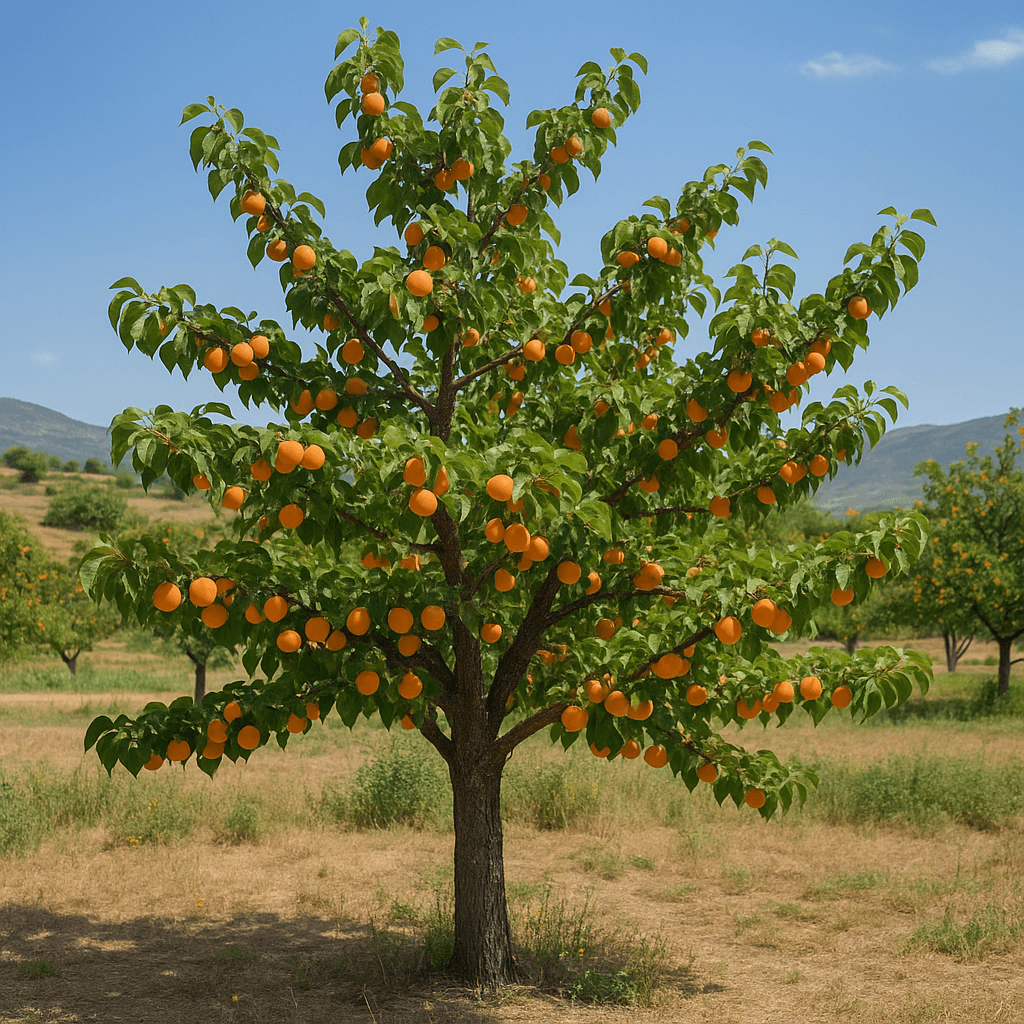
(Generated by artificial intelligence.)
Apricot Tree
World | Plantae | ||||||||
|---|---|---|---|---|---|---|---|---|---|
Class | Magnoliopsida | ||||||||
Team(s) | Rosales | ||||||||
Family | Rosaceae | ||||||||
Genus | Prunus | ||||||||
Specie(s) | Prunus armeniaca L. | ||||||||
Native Country | Northeastern China, Central Asia, Iran region | ||||||||
Morphological Characteristics | fruit yellow and orange blooms in early spring flowers white and pink deciduous tree Medium-sized | ||||||||
Apricot tree, scientifically known as Prunus armeniaca, is a deciduous, woody-stemmed fruit tree belonging to the Rosaceae family. This tree typically reaches a height of 4–10 metres and can be cultivated not only in tropical and subtropical climates but also in temperate climate zones. The apricot fruit holds significant economic and cultural importance especially in Central Asian and Anatolian regions such as Türkiye, Iran, and Uzbekistan.
The exact origin of the apricot is not definitively known, but its natural range includes the northwestern part of Central Asia and western China. Its name derives from the ancient region of Armenia, and throughout history it spread to Mesopotamia and Anatolia. Today, major producers include Türkiye, Iran, Spain, and Italy.

Image of Apricot Tree Flower.(Pıxabay)
The apricot is a sun-loving plant requiring ample sunlight for optimal growth. It has a chilling requirement of 300–900 hours, meaning it must experience a prolonged period of cold temperatures between 0–7 °C during winter to initiate flowering. Early frost events can damage flowers and young fruits.

Image of Apricot Fruit.(Pıxabay)
Agricultural Practices
The apricot is valuable both for fresh consumption and in the dried fruit industry. Türkiye holds a significant share of global dried apricot production. Due to its content of vitamins (A, C, and E), minerals, and dietary fiber, the apricot also holds nutritional importance.
Anadolu Ajansı. “Malatya’da 2 Milyon Kayısı Ağacının Kesildiği İddiaları Asılsız.” AA, April 26, 2017. Accessed June 23, 2025. https://www.aa.com.tr/tr/turkiye/malatyada-2-milyon-kayisi-agacinin-kesildigi-iddialari-asilsiz/961152
Doğru Çokran, Berna. “Kayısılarda Soğuklama İhtiyacı, Çiçeklenme ve Meyve Tutumu İlişkileri.” *Iğdır Üniversitesi Fen Bilimleri Dergisi*. Accessed June 23, 2025. https://eskisite.igdir.edu.tr/Addons/Resmi/uploads/files/kayisilarda-sog%CC%86uklama-i%CC%87hti%CC%87yaci-c%CC%A7i%CC%87c%CC%A7eklenme-ve-meyve-tutumu-i%CC%87li%CC%87s%CC%A7ki%CC%87leri%CC%87-berna-dog%CC%86ru-c%CC%A7okran.pdf.
Malatya İli Kayısı Bahçelerinde Saptanan Zararlılar ile Avcı Türler. *Entomoloji Dergisi*. Accessed June 23, 2025. https://dergipark.org.tr/tr/download/article-file/41527.
Meyve Gelişimi Döneminde Kayısıda Bazı Fiziksel ve Kimyasal Değişimler. Tarım Bilimleri Dergisi. Accessed June 23, 2025. https://dergipark.org.tr/en/download/article-file/1784119
Pixabay. "Kayısı Hasat Meyve Ağaç." Accessed June 23, 2025. https://pixabay.com/tr/photos/kay%C4%B1s%C4%B1-hasat-meyve-a%C4%9Fa%C3%A7-871493/.
Pixabay. "Kayısı Çiçekler Bahar Meyve Ağacı." Accessed June 23, 2025. https://pixabay.com/tr/photos/kay%C4%B1s%C4%B1-%C3%A7i%C3%A7ekler-bahar-meyve-a%C4%9Fac%C4%B1-4101055/.
Pixabay. "Wachau Kayısı Meyveler Çiftlik." Accessed June 23, 2025. https://pixabay.com/tr/photos/wachau-kay%C4%B1s%C4%B1-meyveler-%C3%A7iftlik-3545995/.
Tarım ve Orman Bakanlığı. *Kayısı Entegre Mücadele Teknik Talimatı*. Ankara: Tarım ve Orman Bakanlığı, 2017. Accessed June 23, 2025. https://www.tarimorman.gov.tr/TAGEM/Belgeler/yayin/Kay%C4%B1s%C4%B1%20Entegre-30.08.2017.pdf.
Tarım ve Orman Bakanlığı. *Kayısı Yetiştiriciliği El Kitabı*. Ankara: Tarım ve Orman Bakanlığı Yayınları, 2020. Accessed June 23, 2025. https://www.tarimorman.gov.tr/GKGM/Belgeler/Uretici_Bilgi_Kosesi/Dokumanlar/kayisi.pdf.
Yalova Bahçe Research Institute. *Organic Apricot Cultivation*. Yalova: Yalova Garden Research Institute. Accessed June 23, 2025. https://arastirma.tarimorman.gov.tr/yalovabahce/Belgeler/Yayinlar/106-organik.kay%C4%B1s%C4%B1.pdf.

(Generated by artificial intelligence.)
Apricot Tree
World | Plantae | ||||||||
|---|---|---|---|---|---|---|---|---|---|
Class | Magnoliopsida | ||||||||
Team(s) | Rosales | ||||||||
Family | Rosaceae | ||||||||
Genus | Prunus | ||||||||
Specie(s) | Prunus armeniaca L. | ||||||||
Native Country | Northeastern China, Central Asia, Iran region | ||||||||
Morphological Characteristics | fruit yellow and orange blooms in early spring flowers white and pink deciduous tree Medium-sized | ||||||||
Origin and Distribution
Morphological Characteristics
Biological Characteristics
Ecological Requirements and Cultivation Conditions
Economic and Cultural Significance