
This article was automatically translated from the original Turkish version.
Date | 27 April 2007 | ||||||||
|---|---|---|---|---|---|---|---|---|---|
Institution That Published the Report | General Staff Presidency | ||||||||
Results of the Report | Abdullah Gül was elected president A decision was made for early elections It was evaluated as a military intervention attempt | ||||||||
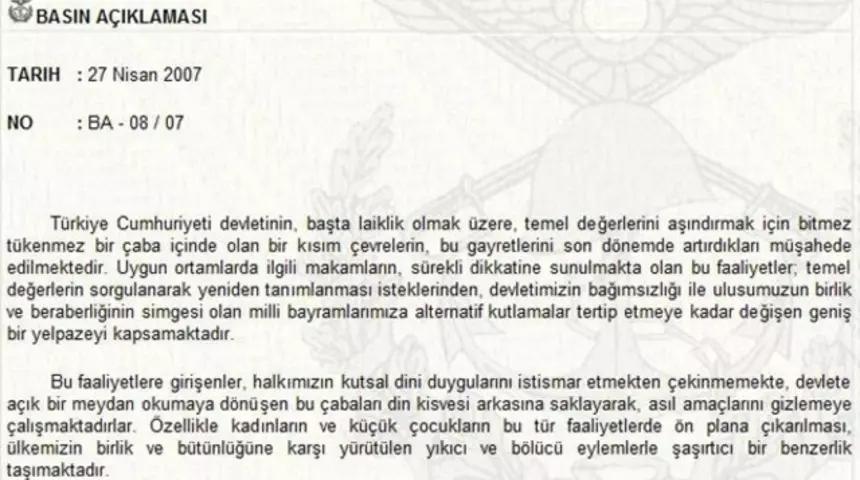
27 April E-Memorandum is a press statement issued on the official website of the Turkish General Staff at around 23:30 on the night of 27 April 2007, and it carried the character of a military intervention directed at Türkiye’s 11th presidential election process.【1】 This text, historically referred to as the “first e-memorandum,” differs from previous military interventions by being publicly announced directly through a digital platform. The statement emphasized the principle of secularism and highlighted the Turkish Armed Forces’ sensitivity on this issue.
The statement was published at a time when political tensions surrounding the presidential election had intensified, visibly exposing a clear divergence of views between the executive branch and the military bureaucracy. Immediately after its publication, the government issued a statement emphasizing that the General Staff was subordinate to the Prime Minister’s Office and clearly affirmed the supremacy of civilian authority within the framework of a democratic rule of law. This response has been regarded as a critical threshold in the transformation of civil-military relations in Türkiye.
The 27 April e-memorandum did not merely influence the political developments of its time; it also opened the way for long-term debates in Türkiye regarding democratization, civilian oversight, and the boundaries of military intervention.【2】
The e-memorandum process of 2007 was shaped by the political transformation that began with the Justice and Development Party’s (AKP) single-party rise to power in 2002 and the resistance it encountered from state bureaucracy.
The 3 November 2002 elections marked a turning point in Turkish political history, resulting in the AKP assuming power alone. From the earliest years of AKP governance, debates over the headscarf, secularism, and the public sphere generated tensions at the highest levels of the state.【3】
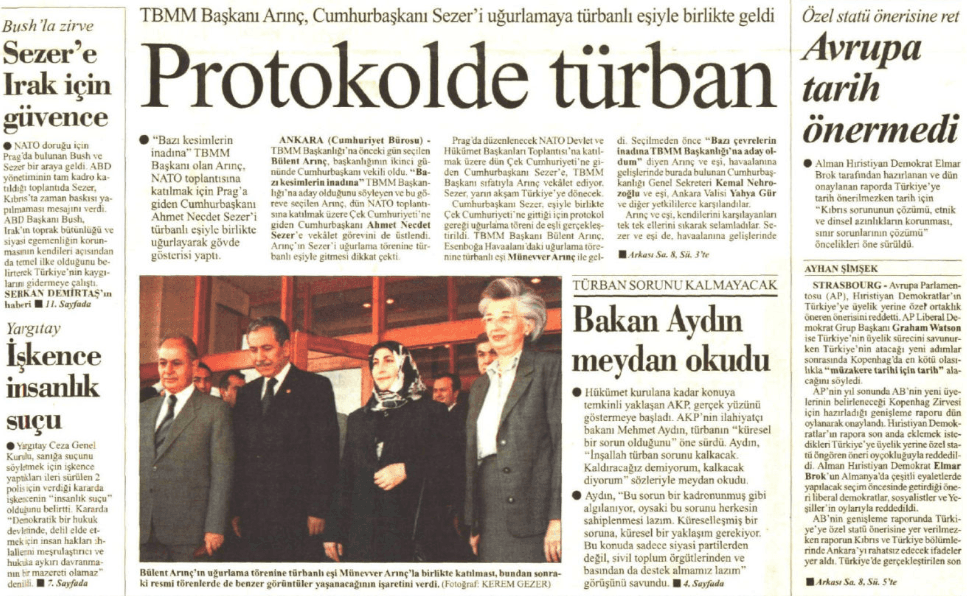
22 Kasım 2022 Cumhuriyet Gazetesi Birinci Sayfa Haberi (Gaste Arşivi)
During this period, the participation of Münevver Arınç, wife of the Speaker of the Grand National Assembly Bülent Arınç, in a farewell ceremony wearing a headscarf was labeled by then-President Ahmet Necdet Sezer as a “violation of the public sphere” and met with strong criticism.【4】 These symbolic events made military oversight more visible; indeed, the 2.5-minute duration of the courtesy visit paid by General Hilmi Özkök, Chief of the General Staff, and the service commanders to Bülent Arınç on 29 November 2002 was interpreted as a military protest against the inclusion of headscarves in protocol.【5】
Institutional rifts continued in subsequent phases, particularly when the 23 April 2003 reception was made “spousal” and allowed the participation of spouses wearing headscarves, prompting President Sezer, along with the Turkish Armed Forces command and senior judiciary officials, to boycott the reception.【6】
Between 2002 and 2007, Türkiye underwent a reform period in which civil-military relations were redefined in line with its European Union aspirations. Accelerated by the Helsinki Summit, this period saw the implementation of “harmonization packages” aimed at reducing the military’s institutional influence over politics.【7】 The most critical of these packages, the Seventh Harmonization Package, fundamentally restructured the National Security Council (NSC), transforming its secretariat into a civilian structure and emphasizing that the council’s powers were purely advisory. Although the Turkish Armed Forces did not directly resist these democratization steps motivated by Türkiye’s modernization goals, they repeatedly voiced institutional concerns about civilian oversight mechanisms interfering in military internal affairs.
The path leading to the 27 April e-memorandum was paved with a series of violent incidents and mass protests that struck at the nerves of society. The 2006 attack on the Council of State marked the first major rupture that brought secularism debates into the streets; events such as the 2007 assassination of Hrant Dink and the raid on Zirve Publishing House deepened perceptions of social chaos.【8】 In the climate of insecurity created by these events, “Republic Rallies” organized by civil society organizations transformed into a collective demonstration against the AKP’s nomination of a presidential candidate. In particular, the attacker’s justification of his actions at the Council of State as a “headscarf decision” inflamed regime debates and shifted the military’s sensitivity on secularism into a potential interventionist ground.【9】 Additionally, during this period, rumors of coup plots such as “Sarıkız” and news reports with headlines like “Young Officers Are Disturbed” increased pressure on civilian politics.【10】
From the beginning of 2007, political tension in Türkiye centered on the presidential election.【11】 One of the central issues in the debate was the candidate’s adherence to secularist principles and the possibility that his spouse wore a headscarf.【12】
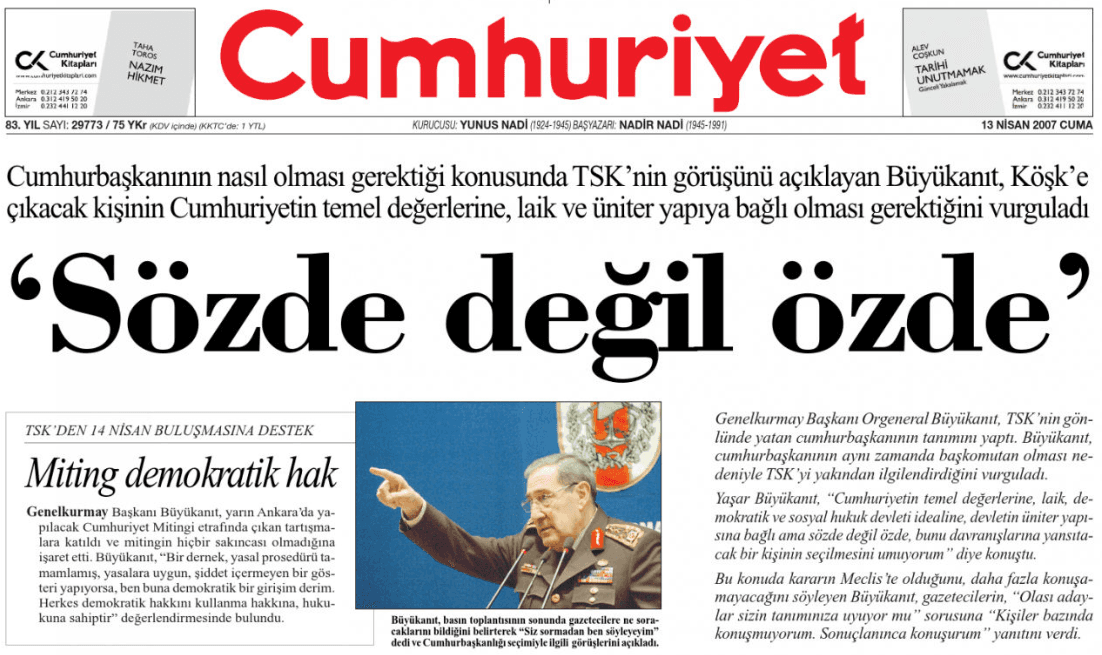
13 Nisan 2007 Tarihli Cumhuriyet Gazetesi Manşeti (Gaste Arşivi)
As the presidential election approached, “Republic Rallies” organized by civil society organizations such as the Atatürkist Thought Association (ADD) and the Association of Democratic Youth (ÇYDD) transformed political tension into a mass public demonstration. These rallies, attended by hundreds of thousands in major cities such as Ankara, Istanbul, and Izmir, emphasized secularism and opposed the government’s authority to determine the presidential candidate.【13】
On 12 April 2007, then-Chief of the General Staff General Yaşar Büyükanıt, during a press conference with service commanders, expressed the military’s expectations by stating: “The President must be loyal to the Republic not in name but in substance.”【14】 This statement triggered extensive debate in political circles and the public.【15】
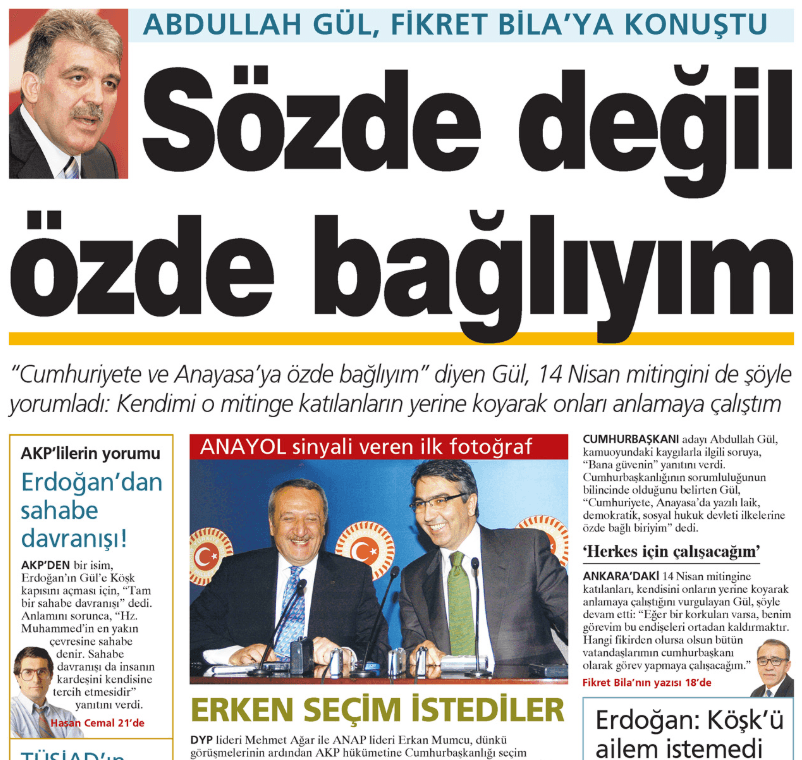
26 Nisan 2007 Tarihli Milliyet Gazetesi Manşeti (Gaste Arşivi)
Meanwhile, then-President Ahmet Necdet Sezer, in a speech at the War Academies Conference on 13 April 2007, warned: “Since the founding of the Republic, Turkey has never faced such a threat to its political regime as it does today. The fundamental values of the secular Republic are being openly debated for the first time.”【16】
Abdullah Gül, the candidate under discussion, defended his personal rights and emphasized the democratic process. In one statement, he affirmed his loyalty to the Republic “not in name but in substance,” and regarding the headscarf debate, he declared “The headscarf is my wife’s individual right”, expressing his opposition.【17】
As the 2007 presidential election approached, Sabih Kanadoğlu, the Honorary Chief Public Prosecutor of the Court of Cassation, proposed a novel interpretation. According to Kanadoğlu, the constitutional provision requiring a “two-thirds majority of total members” (367 MPs) referred not merely to a decision quorum but also to a meeting quorum necessary for voting to begin.【18】
Under this interpretation, if fewer than 367 MPs were physically present during the vote, the election process could not legally commence. Previously, in all presidential elections (including those of Özal, Demirel, and Sezer), the standard quorum of 184 MPs (one-third of total membership) had been considered sufficient; this new interpretation created a deadlock.
The main opposition party, the CHP, adopted this interpretation as a strategic tool. CHP leader Deniz Baykal opposed the AKP’s decision to nominate its own candidate (Abdullah Gül) without seeking consensus and declared that if 367 MPs were not present in the General Assembly, the election would be referred to the Constitutional Court.【19】
On 27 April 2007, during the first round of the presidential election, the AKP’s candidate Abdullah Gül received 357 votes, but since only 361 MPs were present, the required threshold of 367 was not reached.【20】 Alongside the CHP, other opposition parties of the time—the Motherland Party and the True Path Party—also boycotted the vote, thereby freezing the parliamentary arithmetic and transforming a legal dispute into a political crisis.
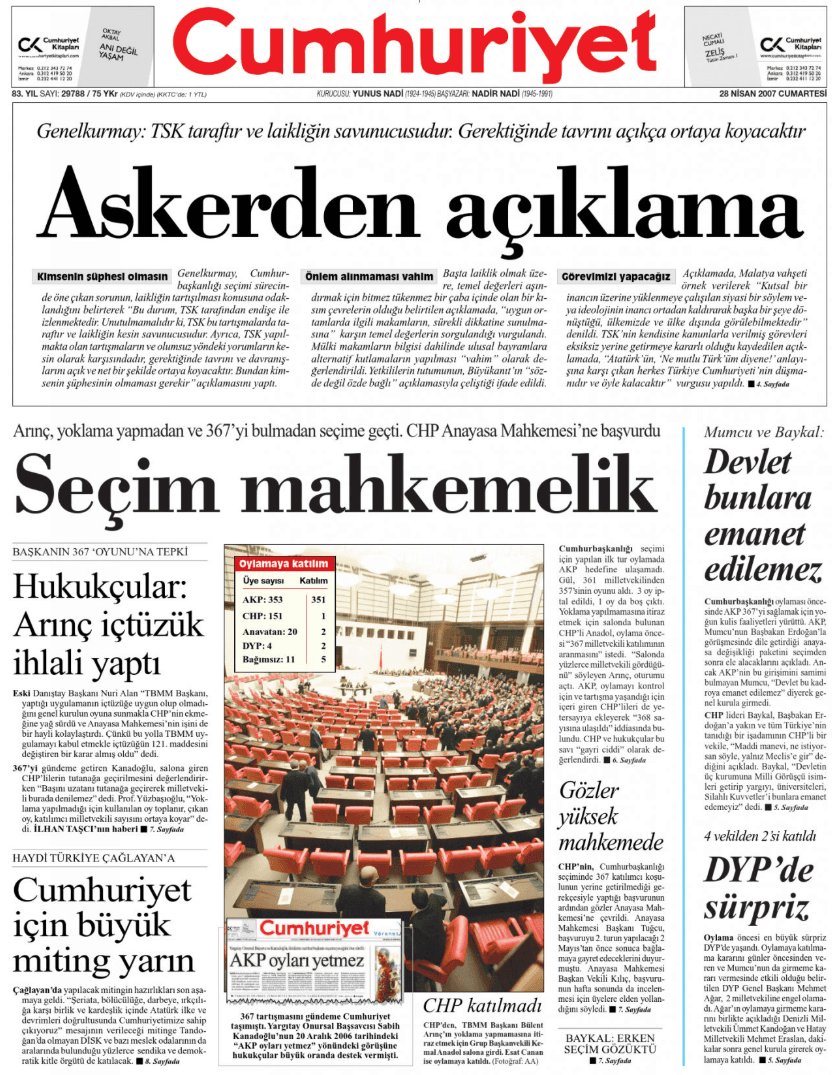
28 Nisan 2007 Tarihli Cumhuriyet Gazete Manşeti (Gaste Arşivi)
On the same night, between 23:17 and 23:30, a statement was posted on the General Staff’s website. The statement included the following points:【21】
Significant developments occurred in Türkiye’s civil-military relations following the 27 April e-memorandum. The government rejected the statement, emphasizing that the General Staff was subordinate to the Prime Minister’s Office and clearly asserting the supremacy of civilian authority. While political parties adopted varying stances, the Constitutional Court’s ruling on the 367 quorum issue pushed the situation toward early elections.
After the 22 July 2007 general elections, the decision by MHP leader Devlet Bahçeli to participate in parliament opened the way for the presidential election. In the newly constituted parliament, Abdullah Gül was elected president; subsequently, a constitutional amendment was adopted to allow the president to be elected directly by the people.
On 28 April 2007 at 15:00, Government Spokesperson Cemil Çiçek delivered a statement emphasizing that the General Staff was subordinate to the Prime Minister, stating:【22】
27 Nisan E Muhtırasına Hükümetten Gelen Tepki (TRT Avaz)
This response has been characterized as the first direct and institutional counter to military intervention in Turkish history.
Several days after the e-memorandum, following contacts between then-Minister of National Education Hüseyin Çelik and the General Staff, a meeting was held between Prime Minister Recep Tayyip Erdoğan and General Staff Chief Yaşar Büyükanıt at Dolmabahçe Palace. The content of this meeting was never fully disclosed to the public. However, it was observed that after this meeting, the General Staff softened its stance and an immediate military intervention was averted.【31】
The Constitutional Court, reviewing the application regarding the requirement of 367 MPs’ presence for the first round of the presidential election, annulled the vote on 1 May 2007. When subsequent attempts to hold a vote on 6 May also failed to reach the 367 threshold, Abdullah Gül withdrew his candidacy, and the option of early elections gained prominence. On 3 May 2007, the Grand National Assembly, by unanimous vote, approved the AKP’s proposal to advance the general elections, setting the election date as 22 July 2007.【32】
To prevent recurrence of the crisis, the AKP submitted a package of constitutional amendments to parliament aimed at fundamentally changing the presidential election system. Adopted on 10 May 2007, the amendment included the following provisions:【33】
Despite the veto of then-President Ahmet Necdet Sezer, the package was submitted to a referendum. On 21 October 2007, 68.95% of valid votes were cast in favor, approving the systemic change.
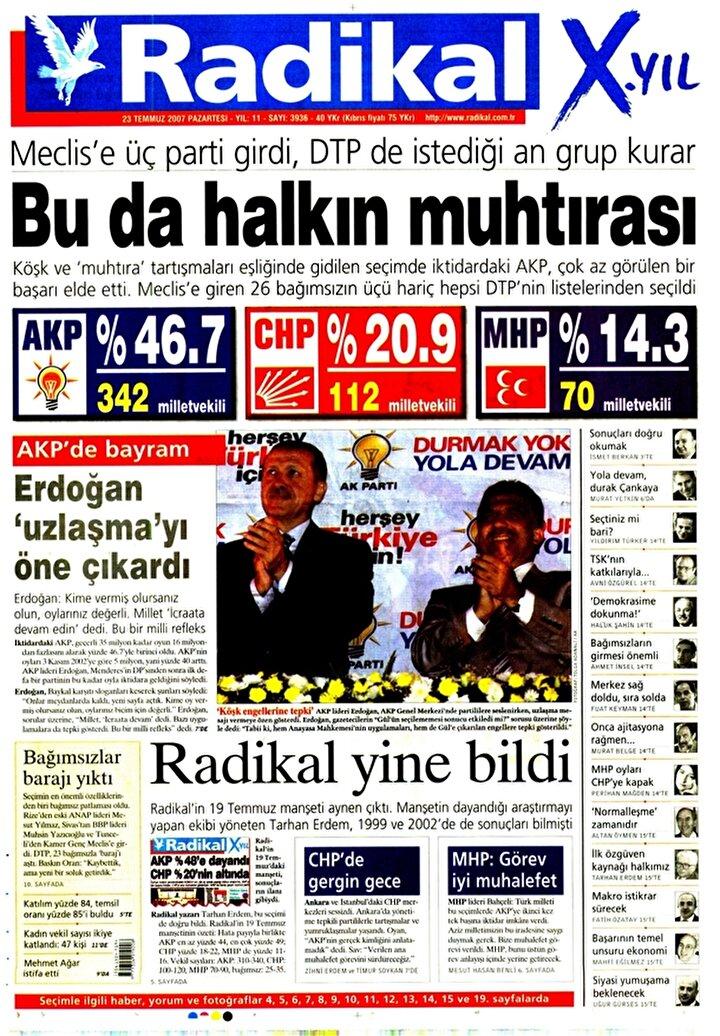
23 Temmuz 2007 Tarihli Radikal Gazetesi Manşeti (Yeni Şafak)
The 22 July elections, perceived as a referendum on civil politics versus military oversight, saw an exceptionally high voter turnout of 84.25%. The results were as follows:【34】
The first order of business in the newly constituted parliament was the election of the 11th president. The AKP again nominated Abdullah Gül; the pivotal role was assumed by MHP Chairman Devlet Bahçeli, who declared his party’s participation in the vote, thereby preventing the legal recurrence of the 367 quorum crisis.
Following the election, CHP leader Deniz Baykal confirmed the end of the tense period that began in April by affirming the legitimacy of the outcome and pledging respect for it.【35】
As political tensions subsided, the statement was removed from the General Staff’s website. Years later, after Yaşar Büyükanıt publicly acknowledged authorship of the memorandum, an investigation was launched in 2012 in response to related complaints. However, the investigation was closed in subsequent years following Büyükanıt’s death in 2019.【36】
Demir, Anıl. "28 Şubat’tan, 27 Nisan’a Ordu-Siyaset İlişkisi: Hürriyet Gazetesi İncelemesi." Master's thesis,Marmara Üniversitesi, 2010. https://tez.yok.gov.tr/UlusalTezMerkezi/tezDetay.jsp?id=lHZGnWCGulP3wT8a4231yA&no=kbZKJqpQZn5vy6_F9yKOqQ
Gündoğan, Barış. "Türk Demokrasisinin Askeri Müdahalelere Karşı Duruşunda Kırılma Noktası: 27 Nisan E-muhtırası." Anadolu Ajansı, April 27, 2021. Accessed April 27, 2026. https://www.aa.com.tr/tr/turkiye/turk-demokrasisinin-askeri-mudahalelere-karsi-durusunda-kirilma-noktasi-27-nisan-e-muhtirasi/2221945
Gürsoy, Özge Elif. "Türkiye’nin Avrupa Birliği Üyelik Sürecine Askeri Darbelerin Etkileri: 27 Nisan 2007 E-Muhtırası." Master's thesis, İstanbul Üniversitesi, 2014. Accessed [insert date if available]. https://tez.yok.gov.tr/UlusalTezMerkezi/tezDetay.jsp?id=CJ0PS8GZvd7XRHf4-Tu87g&no=P_ap8kgxG18zlDSqkxqt7g
Habertürk. "Bir E-muhtıranın Anatomisi." April 27, 2012. Accessed April 27, 2026. https://www.haberturk.com/gundem/haber/737683-bir-e-muhtiranin-anatomisi?page=3
Milliyet. "‘Kamusal Alanda Başörtüsü Olmaz’." Accessed April 27, 2026. https://www.milliyet.com.tr/gundem/kamusal-alanda-basortusu-olmaz-5197132
Mynet Haber. "27 Nisan E-muhtırası Tam Metni." April 27, 2012. Accessed April 27, 2026. https://haber.mynet.com/27-nisan-e-muhtirasi-tam-metni-110102212559
NTV. "E-muhtıranın Kronolojisi." April 27, 2017. Accessed April 27, 2026. https://www.ntv.com.tr/galeri/turkiye/e-muhtiranin-kronolojisi,0Sl6nw7mM0iKqufp3XMd6w.
Sayın, Ayşe. "23 Nisan: Ulusal Egemenlik ve Çocuk Bayramı Nasıl Ortaya Çıktı?" BBC News Türkçe, November 20, 2019. Accessed April 27, 2026. https://www.bbc.com/turkce/haberler-turkiye-50494175.
Turkish Grand National Assembly. *Meclis Komisyon Araştırma Raporu*. Ankara: TBMM, December 26, 2012. Accessed April 27, 2026. https://acikerisim.tbmm.gov.tr/items/db9ea564-1ae2-4575-b138-aed0f955b2de.
Yeni Şafak. "Halk Sandığı Patlattı: 2007 Genel Seçimi." Accessed April 27, 2026. https://www.yenisafak.com/secim-2007
Çelik, Muhammed Mazlum. "Türk Demokrasisinde Kara Bir Gün: 27 Nisan E-muhtırası." Independent Türkçe, April 27, 2020. Accessed April 27, 2026. https://www.indyturk.com/node/169886/siyaset/türk-demokrasisinde-kara-bir-gün-27-nisan-e-muhtırası
Şahin, Sefa. "Cemil Çiçek 27 Nisan E-muhtırasına Karşı Demokrasiye Sahip Çıkılan Günü Anlattı." Anadolu Ajansı, April 26, 2022. Accessed April 27, 2026. https://www.aa.com.tr/tr/politika/cemil-cicek-27-nisan-e-muhtirasina-karsi-demokrasiye-sahip-cikilan-gunu-anlatti/2573074
[1]
Barış Gündoğan, "Türk demokrasisinin askeri müdahalelere karşı duruşunda kırılma noktası: 27 Nisan e-muhtırası," Anadolu Ajansı, 27 Nisan 2021,https://www.aa.com.tr/tr/turkiye/turk-demokrasisinin-askeri-mudahalelere-karsi-durusunda-kirilma-noktasi-27-nisan-e-muhtirasi/2221945
[2]
Sefa Şahin, "Cemil Çiçek 27 Nisan e-muhtırasına karşı demokrasiye sahip çıkılan günü anlattı," Anadolu Ajansı, 26 Nisan 2022,https://www.aa.com.tr/tr/politika/cemil-cicek-27-nisan-e-muhtirasina-karsi-demokrasiye-sahip-cikilan-gunu-anlatti/2573074
[3]
TBMM, Meclis Komisyon Araştırma Raporu (Ankara: TBMM, 26 Aralık 2012), Sayfa: 1243 https://acikerisim.tbmm.gov.tr/items/db9ea564-1ae2-4575-b138-aed0f955b2de
[4]
Milliyet, "Kamusal alanda başörtüsü olmaz" 25 Kasım 2002, https://www.milliyet.com.tr/gundem/kamusal-alanda-basortusu-olmaz-5197132
[5]
Milliyet, "Çok şey anlattılar," 30 Kasım 2002,https://www.milliyet.com.tr/siyaset/cok-sey-anlattilar-5196628
[6]
TBMM, Meclis Komisyon Araştırma Raporu (Ankara: TBMM, 26 Aralık 2012), Sayfa: 1244
https://acikerisim.tbmm.gov.tr/items/db9ea564-1ae2-4575-b138-aed0f955b2de
[7]
Özge Elif Gürsoy, "Türkiye’nin Avrupa Birliği Üyelik Sürecine Askeri Darbelerin Etkileri: 27 Nisan 2007 E-Muhtırası" (Yüksek lisans tezi, İstanbul Üniversitesi, 2014), Sayfa: 70
[8]
Anıl Demir, "28 Şubat’tan, 27 Nisan’a Ordu-Siyaset İlişkisi: Hürriyet Gazetesi İncelemesi" (Yüksek lisans tezi, Marmara Üniversitesi, 2010), Sayfa: 132 https://tez.yok.gov.tr/UlusalTezMerkezi/tezDetay.jsp?id=lHZGnWCGulP3wT8a4231yA&no=kbZKJqpQZn5vy6_F9yKOqQ
[9]
TBMM, Meclis Komisyon Araştırma Raporu. S. 1251 - 1252
[10]
TBMM, Meclis Komisyon Araştırma Raporu. Sayfa.1250
[11]
Habertürk. "Bir e-muhtıranın anatomisi," 27 Nisan 2012,https://www.haberturk.com/gundem/haber/737683-bir-e-muhtiranin-anatomisi?page=3
[12]
Şahin, "Cemil Çiçek 27 Nisan e-muhtırasına karşı."
[13]
"Türk demokrasisinde kara bir gün: 27 Nisan e-muhtırası," Independent Türkçe, 27 Nisan 2020,https://www.indyturk.com/node/169886/siyaset/türk-demokrasisinde-kara-bir-gün-27-nisan-e-muhtırası
[14]
Gündoğan, "Türk demokrasisinin askeri müdahalelere karşı duruşunda."
[15]
Habertürk. "Bir e-muhtıranın anatomisi."
[16]
TBMM, Meclis Komisyon Araştırma Raporu. Sayfa 1253
[17]
NTV. "E-muhtıranın kronolojisi."
[18]
Gündoğan, "Türk demokrasisinin askeri müdahalelere karşı duruşunda."
[19]
NTV. "E-muhtıranın kronolojisi."
[20]
Gündoğan, "Türk demokrasisinin askeri müdahalelere karşı duruşunda."
[21]
TBMM, Meclis Komisyon Araştırma Raporu. Sayfa: 1257 - 1258
[22]
Şahin, "Cemil Çiçek 27 Nisan e-muhtırasına karşı."
[23]
Çelik, "Türk demokrasisinde kara bir gün."
[24]
NTV. "E-muhtıranın kronolojisi."
[25]
Çelik, "Türk demokrasisinde kara bir gün."
[26]
NTV. "E-muhtıranın kronolojisi."
[27]
Şahin, "Cemil Çiçek 27 Nisan e-muhtırasına karşı."
[28]
Gündoğan, "Türk demokrasisinin askeri müdahalelere karşı duruşunda."
[29]
NTV. "E-muhtıranın kronolojisi."
[30]
NTV. "E-muhtıranın kronolojisi."
[31]
Ayşe Sayın, "Yaşar Büyükanıt: 'E-muhtıra', Dolmabahçe görüşmesi ve Şemdinli olayıyla tartışılan eski genelkurmay başkanı," BBC News Türkçe, 21 Kasım 2019,https://www.bbc.com/turkce/haberler-turkiye-50499427
[32]
Gündoğan, "Türk demokrasisinin askeri müdahalelere karşı duruşunda."
[33]
TBMM, Meclis Komisyon Araştırma Raporu. Sayfa 1261
[34]
Yeni Şafak, "Halk sandığı patlattı: 2007 genel seçimi," erişim 27 Nisan 2026,https://www.yenisafak.com/secim-2007
[35]
NTV. "E-muhtıranın kronolojisi."
[36]
Gündoğan, "Türk demokrasisinin askeri müdahalelere karşı duruşunda."

Date | 27 April 2007 | ||||||||
|---|---|---|---|---|---|---|---|---|---|
Institution That Published the Report | General Staff Presidency | ||||||||
Results of the Report | Abdullah Gül was elected president A decision was made for early elections It was evaluated as a military intervention attempt | ||||||||
No Discussion Added Yet
Start discussion for "April 27 E-Memorandum" article
Political and Social Context Before 27 April (2002–2007)
The AKP’s Rise to Power and Initial Tensions
EU Accession Process and Military Reforms
Social Tensions and Atmosphere of Chaos Before 27 April
The 2007 Presidential Election Process
Republic Rallies and Regime Debates
The 367 Quorum Requirement
The 27 April Vote and the E-Memorandum
Content and Publication of the Statement
Events Following the E-Memorandum
Statements
Government’s Official Response
Statements by Political Party Leaders
Statements from the Military Sector
The Dolmabahçe Meeting
Decision for Early Elections
Constitutional Amendment
22 July 2007 General Elections and Presidential Election
Subsequent Developments