


This article was automatically translated from the original Turkish version.
The Archimedes screw is a mechanical device developed by the ancient Greek mathematician and engineer Archimedes. Its primary function is to transport water from one point to another. The screw enables the upward movement of liquid along a pipe through rotational motion, offering significant efficiency in both irrigation and drainage applications. Unlike classical bucket and lever systems, this mechanism provides a continuous and steady flow of water.
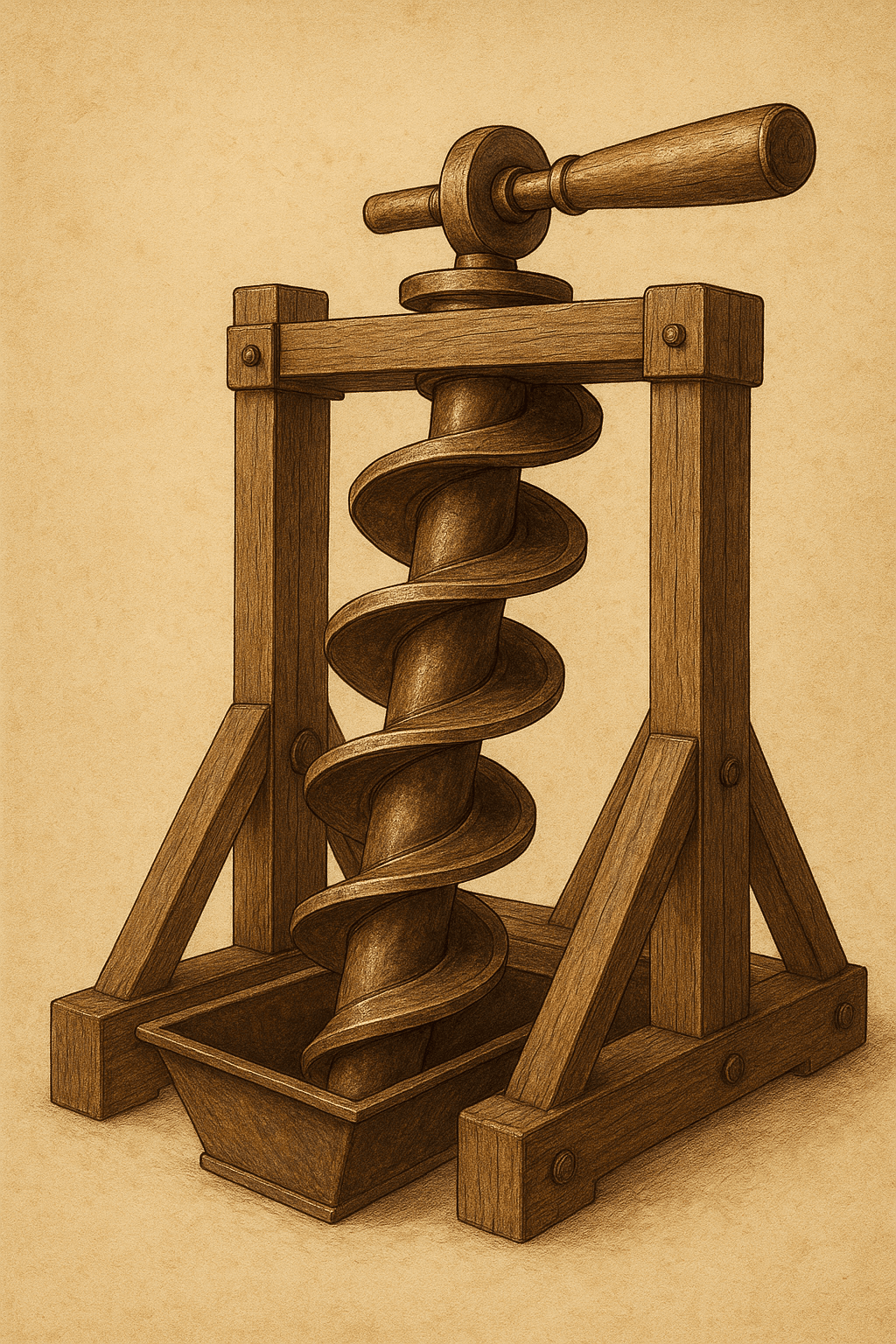
Representative Image of the Archimedes Screw (Image Generated by Artificial Intelligence.)
The Archimedes screw was designed in the 3rd century BCE. The device was developed specifically to address the challenge of transferring water from lower to higher elevations. Sources indicate that it was used in both ancient Greece and the Roman period for irrigation channels and urban infrastructure. Archimedes himself is believed to have designed the device to control water levels in the Nile River and support irrigation systems. Some research suggests that principles similar to those of the Archimedes screw may have been applied in earlier ancient irrigation systems such as the Hanging Gardens of Babylon.
The device consists of a helical screw enclosed within a cylindrical pipe. The screw is positioned at an incline from the water source toward a higher elevation. As the screw rotates, water is carried along its channels and delivered to the outlet. This process involves the conversion of the liquid’s potential energy into kinetic energy. The helical structure prevents backflow and ensures continuous upward movement. This simple yet effective design is regarded as a significant example of mechanical thinking in ancient engineering.
The Archimedes screw continued to be used in Europe from the medieval period onward in the fields of irrigation and water management. It was particularly favored in agricultural regions for lifting water from low-lying sources to irrigate fields. In modern times, the device is applied in wastewater treatment plants, fish hatcheries, and hydroelectric power stations for energy generation.
The Archimedes screw is recognized as one of the pivotal milestones in the history of engineering. It represents an early example of the application of mechanical design and physical principles. The screw, with its enduring influence from ancient civilizations to contemporary engineering, has been adopted across diverse regions and eras due to its simple structure and efficient function. It continues to be studied as a model in education and engineering research.
Turan, Ali, and Ali İslam. “Tombul Fındık Çeşidinde Yağ Oksidasyonunu Azaltacak Kurutma Yönteminin Belirlenmesi.” *GIDA* 44, no. 4 (2019): 563–575. Accessed October 23, 2025. Erişim: https://dergipark.org.tr/en/download/article-file/751736
Uysal, Fatih, and Zebo Akparalieva. “Dış Çeperli Arşimet Pompanın Montaj Eğimine Göre Kova Hacmi Performansının İncelenmesi.” *Uluslararası 3D Yazıcı Teknolojileri ve Dijital Endüstri Dergisi* 8, no. 2 (2024): 225–236. Accessed October 23, 2025. Erişim: https://dergipark.org.tr/en/download/article-file/3869131
Yıldırım, Ercüment. “Eski Mısır’da Tarımsal Üretim ve Vergilendirme Sistemi (MÖ 3100 – 672).” *Gaziantep University Journal of Social Sciences* 21, no. 4 (2022): 2456–2468. Accessed October 23, 2025. Erişim: https://dergipark.org.tr/tr/download/article-file/2431257

Historical Background and Ancient Use
Structural Features and Working Principle
Use in the Medieval and Modern Periods
Cultural and Engineering Significance