

This article was automatically translated from the original Turkish version.
+2 More
Context | The tradition of the 'Seven Wonders of the Ancient World' | ||||||||
|---|---|---|---|---|---|---|---|---|---|
Vegetation | Various trees and plants, deep topsoil, shading and microclimate effects | ||||||||
Period(s) | Neo-Babylonian period | ||||||||
Settlement | The city of Babylon in Mesopotamia | ||||||||
Written Sources | Josephus Pliny Curtius Diodorus Strabo Berossus | ||||||||
The Hanging Gardens of Babylon is a monumental structure described in ancient sources as a terraced palace-garden complex associated with royal residence and listed among the Seven Wonders of the Ancient World. Accounts state that the structure consisted of stepped terraces, beneath which enclosed spaces supported the upper levels; water was lifted from lower elevations and circulated among the terraces.
According to tradition, the gardens were constructed by Nebuchadnezzar II of the Neo-Babylonian Empire; the Babylonian priest Berossus linked their construction to the king’s desire to alleviate the homesickness of his queen, Amytis. Berossus’s original account has not survived directly but was transmitted indirectly by later writers such as Josephus.

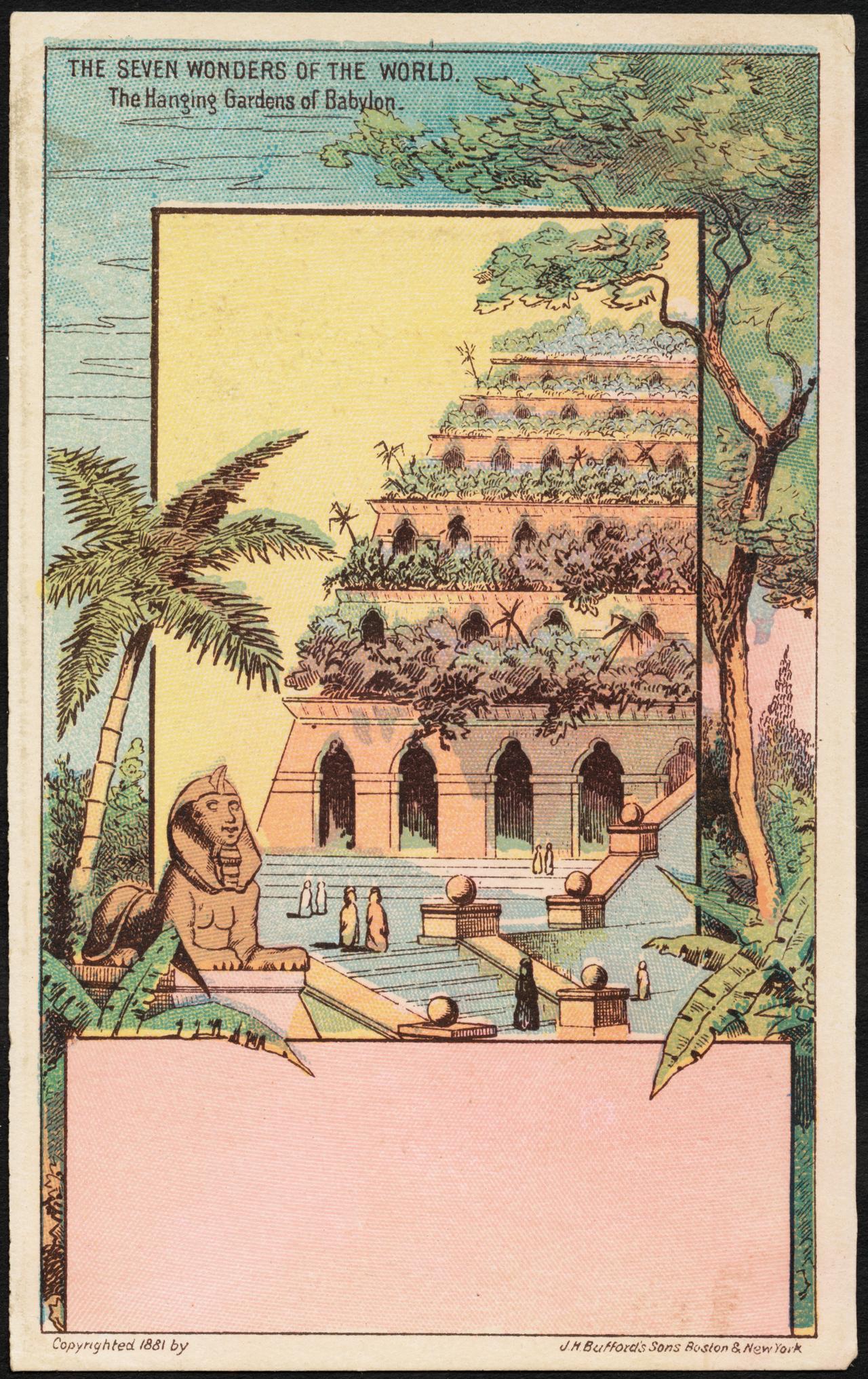
Depiction of the Hanging Gardens of Babylon, one of the Seven Wonders of the Ancient World (Hangende tuinen van Babylon, Rijks Museum)
Berossus speaks of an elevated garden arrangement with dense vegetation, emphasizing its royal context. Later Greco-Roman authors (e.g., in geographical and historical writings) describe the gardens in terms of functional elements such as the palace surroundings, access to upper levels, and the mechanism for lifting and distributing water. Since the textual tradition was compiled centuries after Nebuchadnezzar, the transmission is indirect. Nevertheless, neither Diodorus nor Strabo saw the gardens themselves; their accounts rely on hearsay and literary sources.
According to Berossus, Nebuchadnezzar commissioned a terraced structure resembling a mountain to compensate for Amytis’s homeland landscape; large trees and flowers were cultivated on these terraces. Hellenistic and Roman texts imply that the gardens were still regarded as existing in the 4th century BCE; however, all these texts were written centuries after Nebuchadnezzar’s reign.
Although ancient texts provide various details regarding the plan and materials, modern assessments emphasize that these details are secondary and derived from multiple transmissions. The common framework consists of multiple terraces rising above a regular layout, supporting substructures beneath the terraces, a soil layer suitable for plant growth, and a system for circulation and irrigation. A cautious tone is maintained regarding the precise plan, measurements, and construction materials. Some sources suggest the structure measured approximately four plethra (about 120 x 120 meters); however, these dimensions have not been confirmed by archaeological evidence.【1】
Beneath the terraces lies a system of arched vaults arranged in a grid pattern. Diodorus describes the flooring sequence as follows: a layer of reeds followed by bitumen; above this, two layers of baked brick; then a lead covering; and finally, a layer of soil thick enough to accommodate large tree roots. Strabo also notes the use of asphalt-like materials for waterproofing. This layered construction forms the root zone for the vegetation above while protecting the underlying structure from moisture.
Sources agree that water was drawn from the Euphrates River. Strabo describes a screw-like mechanism operating parallel to a staircase that lifted water to higher levels and distributed it across the terraces. Diodorus writes that the water-lifting machines operated in such a way that they were imperceptible from outside. Vertical lifting and horizontal distribution-drainage systems functioned in tandem.
According to Strabo, the Euphrates flows through the center of the city with a width of one stadium; the gardens are located along the riverbank. Access to upper levels is via staircases, and the water supply follows the same route. This positioning allows for continuous operation of the lifting and distribution system through direct contact with the river.
Plant composition and substrate: Ancient accounts indicate that a variety of trees and plants were cultivated, requiring a deep soil profile on the upper levels. This profile is functionally suited for root development, moisture retention, and nutrient cycling; the underlying insulation system limits water seepage into structural layers. The stepped surfaces create a favorable microclimate by balancing shading and evaporation.
Stepping, irrigation, and maintenance regime: Water is controlled as it flows from upper to lower levels; surface drainage and reuse (percolation to lower terraces) establish a rhythm for landscape maintenance. The terraces’ imitation of a mountain landscape suggests that vertical and horizontal planting was designed as a visual and hydrological composition. Thus, aesthetic representation is combined with functional irrigation and ease of maintenance.

Color engraving of the Hanging Gardens of Babylon (Wellcome Collection)
In Assyrian tradition, palace-adjacent pleasure gardens (kirimâlnu) and hunting parks outside the capital are mentioned together; elevated garden designs containing small pavilions or summer residences (bitānu) are depicted from the reigns of Sargon II and Sennacherib onward. Reliefs from Nineveh depict trees, irrigation canals, and water channels surrounding the royal residence. In Urartian territory, vineyards and gardens were established along canals dug by kings and on artificial terraces; vineyards near the Minua Canal have been documented.
Classical texts locate the gardens in Babylon along the Euphrates River. Modern scholarship suggests that due to the abundance of textual and iconographic evidence, the gardens of Nineveh associated with Sennacherib may have been conflated with the Hanging Gardens narrative; Nineveh was sometimes referred to as “ancient Babylon” in certain contexts. Nevertheless, the possibility of gardens existing in Babylon itself has not been entirely dismissed.
During Koldewey’s excavations from 1899 to 1917, a “vault structure” was uncovered northeast of the Southern Palace and south of the Ishtar Gate and was at one time associated with the Hanging Gardens: a north-south corridor with seven rooms on each side, narrow surrounding corridors, and a cell containing hydraulic machinery. It was proposed that the stone mass could support the weight of moist soil and trees; however, this attribution has been challenged due to factors such as distance from the ziggurat, scale inconsistencies, and distance from the river; an alternative interpretation identifies the structure as a storage facility.
In the region’s legal tradition, the protection of trees and gardens, along with provisions for damage compensation, maintenance obligations, and revenue systems, are explicitly regulated. This framework elucidates the institutional foundation for palace gardens such as the Hanging Gardens, which required sustained irrigation, pruning, and continuity. Permanent tree planting and landscape maintenance were not merely technical matters but required administrative and legal organization.
Cartwright, Mark. “Babil’in Asma Bahçeleri.” Trans. Emine Beyza Rüzgar. *World History Encyclopedia*. Accessed October 26, 2025. https://www.worldhistory.org/trans/tr/1-17206/babilin-asma-bahceleri/
Digital Commonwealth. "The Seven Wonders of the World: The Hanging Gardens of Babylon." Accessed October 26, 2025. https://www.digitalcommonwealth.org/search/commonwealth:3f462n50q?view=commonwealth%3A3f462n528
Konyar, Erhan. “Babil'in Asma Bahçeleri.” *Toplumsal Tarih* 96, no. 16 (2001): 46–53. Accessed October 26, 2025. https://www.academia.edu/8854452/Babilin_Asma_Bah%C3%A7eleri?source=swp_share
Reade, Julian. “Alexander the Great and the Hanging Gardens of Babylon.” *Iraq* 62 (2000): 195–217. Accessed October 26, 2025. https://www.academia.edu/30244757/2000_Alexander_the_Great_and_the_Hanging_Gardens_of_Babylon
Rijksmuseum. "Hangende tuinen van Babylon." Rijksmuseum. Accessed October 26, 2025. https://www.rijksmuseum.nl/en/collection/object/Hangende-tuinen-van-Babylon--016546d8dc9b65e4ed3c7a6a92f10f28
Wellcome Collection. "Babylon: the city (above); the hanging gardens of Babylon (below). Coloured engraving, ca. 1804-1811." Wellcome Collection. Accessed November 12, 2025. https://wellcomecollection.org/works/gu64p3rr/images?id=kdph5a5b
Şahin, Hasan Ali, and Şerife Koçyiğit. “Eski Ön Asya Hukukunda Ağaçlara Verilen Önem.” *OANNES - International Journal of Ancient History* 3, no. 2 (2021): 439-456. Accessed October 26, 2025. https://doi.org/10.33469/oannes.976411
[1]
Erhan Konyar, “Babil'in Asma Bahçeleri,” Toplumsal Tarih 96, no.16 (2001): syf 51, https://www.academia.edu/8854452/Babilin_Asma_Bah%C3%A7eleri?source=swp_share


Context | The tradition of the 'Seven Wonders of the Ancient World' | ||||||||
|---|---|---|---|---|---|---|---|---|---|
Vegetation | Various trees and plants, deep topsoil, shading and microclimate effects | ||||||||
Period(s) | Neo-Babylonian period | ||||||||
Settlement | The city of Babylon in Mesopotamia | ||||||||
Written Sources | Josephus Pliny Curtius Diodorus Strabo Berossus | ||||||||
No Discussion Added Yet
Start discussion for "Hanging Gardens of Babylon" article
Historical Existence
Chronology and Narrative Motif
Architectural Plan and Scale
Supporting System and Layered Flooring
Hydraulic System
Urban Setting and Dimensions
Vegetation, Landscape Design, and Function
Comparative Context
Location Debates
Archaeological Investigations
Legal-Economic Background