


This article was automatically translated from the original Turkish version.
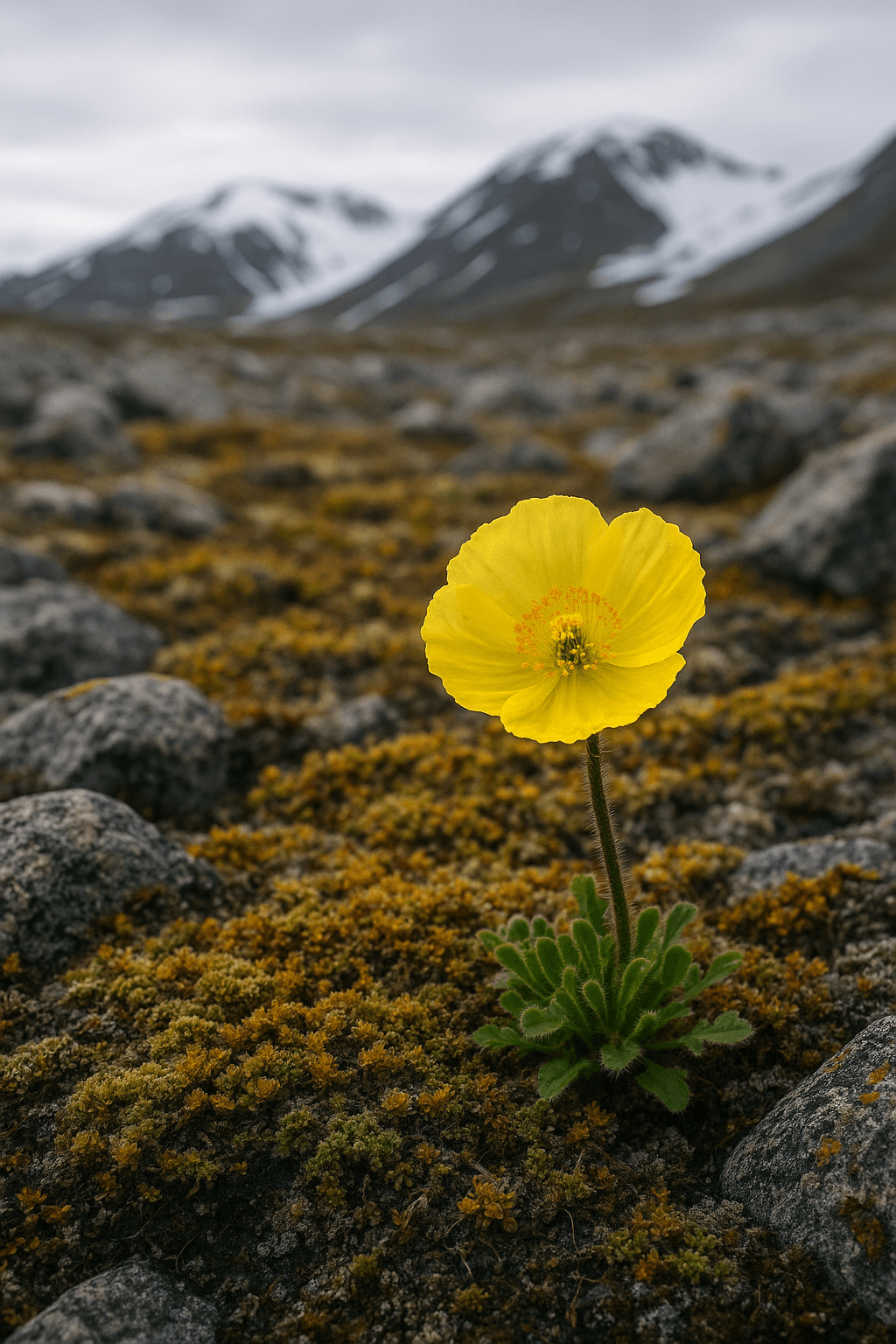
Arctic Poppy (Papaver radicatum)
Distribution Area | Greenland, Arctic tundras, stony slopes, disturbed areas near alluvial plains | ||||||||
|---|---|---|---|---|---|---|---|---|---|
Habitat and Climate | Extremely cold and windy areas | ||||||||
Flowering Period | June – July | ||||||||
Height(s) | 10–30 cm | ||||||||
Growth Form | Perennial herbaceous plant | ||||||||
Use as a Research Model | Model species for assessing climate change impacts | ||||||||
Arctic Poppy (Papaver radicatum) is a perennial herbaceous plant adapted to cold climatic conditions found at high latitudes such as Greenland. It is a characteristic species that thrives particularly on stony and loose slopes, low-elevation alluvial areas, and disturbed habitats.
This species is known for its high sensitivity to environmental factors such as surface temperature, soil moisture, active layer depth, and ionic composition of soil solution. It is frequently used as a model organism in ecological studies as an indicator reflecting biotic competition conditions in Arctic freshwater and terrestrial ecosystems.

Papaver Radicatum Plant (Flickr)
The plant grows 10 to 30 cm tall and has finely hairy stems and narrow leaves. It typically bears yellow flowers, although white-flowered individuals are occasionally observed. The close proximity of leaves and flowers to the soil surface maximizes utilization of limited sunlight during the short Arctic growing season. Hairy coverage reduces evaporation and helps maintain water balance. Leaf morphology is highly efficient in the photosynthetic process.
The root system exhibits shallow development; this structure enables access to minerals and limited soluble nutrients in loose soils. Seeds are dispersed by melting snow and water flow to different microhabitats. Flowering occurs between June and July and is dependent on temperature and the timing of snowmelt; this is a key phenological trait that determines interactions with pollinators.
Papaver radicatum is a species highly adapted to Arctic ecosystem conditions and is noted for its tolerance to environmental stress factors. It commonly colonizes stony mountain slopes, loose debris fields, riverbanks, and alluvial plains and can be found in both primary and secondary habitats. Secondary populations rapidly establish in areas exposed by erosion or physical disturbance, fulfilling a gap-filling function.
Due to its sensitivity to soil temperature, moisture, and concentration of dissolved ions, Papaver radicatum is regarded as an indicator species that responds to the physical and chemical dynamics of its habitat. Increasing surface temperatures and rising concentrations of dissolved nutrient ions—particularly Ca²⁺ and total dissolved nitrogen—have enriched its growth environment with nutrients while simultaneously intensifying biotic competition.【1】 This has led to population declines in Papaver radicatum, yet it also reveals the species’ critical role in ecosystem balance.
In areas where Papaver radicatum occurs, plant-microorganism interactions influence soil solution chemistry and moisture balance, shaping both mineral cycling and overall soil biochemistry. The species’ sensitive competitive dynamics reduce pressure on other plants, creating conditions favorable for increased microhabitat diversity. In this way, Papaver radicatum functions as an early colonizer and transient species in Arctic tundra ecosystems, contributing to habitat renewal.
Pollination is entomophilous, meaning it is mediated by insects. The conspicuous structure of its flowers has evolved to attract the limited number of Arctic pollinators. Flowering timing generally coincides with pollinator activity, enhancing cross-pollination success and genetic diversity.
The reproductive strategy is primarily seed-based. Seeds disperse from primary populations via meltwater and flowing snow, colonizing new areas. Vegetative reproduction is not prominent; seed dispersal remains the fundamental strategy for population persistence under Arctic conditions.

Although Papaver radicatum is not a direct aquatic plant, it indirectly influences water quality within the soil-water microecosystems of its Arctic habitats. As surface temperatures rise, ion release and concentration of dissolved nutrients in the soil increase; during this process, plant root activity has been observed to play a regulatory role in ion accumulation.
Measurements indicate that concentrations of ions such as Ca²⁺, K⁺, Mg²⁺, and Cl⁻ in soil solutions where Papaver radicatum grows have increased over time, likely linked to nutrient uptake by plant roots. The rise in cations enriches the soil solution with nutrients, supporting plant growth and intensifying biological competition among other species. However, these ions do not reach toxic levels, suggesting that the plant may act as a filter, helping maintain nutrient balance in the soil solution.
Although Papaver radicatum does not directly function as a water filtration plant, its shallow and widespread root system stabilizes soil structure in loose substrates, reducing erosion and enhancing retention of dissolved nutrients. These indirect effects may play an important ecosystem-level role in preserving the chemical integrity of Arctic freshwater sources.
Papaver radicatum, as a primary producer adapted to a short and intense growing season, initiates energy flow in Arctic tundra ecosystems. It provides a nutritional base for numerous organisms, from microbial activity to soil fauna. Its interactions with soil microorganisms support organic matter cycling and nitrogen transformation.
Its sensitivity to biotic competition limits its dominance in the habitat, thereby creating space for other species to establish. Thus, it helps maintain interspecific balance and supports biodiversity at both microscopic and macroscopic scales. Its colonizing ability initiates early succession in physically disturbed areas, promoting ecological renewal.
Its presence is valuable not only for plant diversity but also because it serves as an early-warning indicator of environmental change. Its response to chemical shifts in the soil solution provides indirect insights into ecosystem health. Consequently, monitoring and conserving Papaver radicatum constitutes a critical ecosystem service for sustaining Arctic biological diversity and ensuring the sustainable management of sensitive tundra systems.
Anadolu Ajansı. "Çiçek Açan Haşhaş Tarlaları Doğayı Renklendirdi." Accessed May 31, 2025. https://www.aa.com.tr/tr/pg/foto-galeri/cicek-acan-hashas-tarlalari-dogayi-renklendirdi/0
Doğramacı, Sezen, and Arslan, Neşat. "Haşhaş (Papaver somniferum L.) Çeşit ve Melezlerinin Bazı Özellikleri Üzerine Genel ve Özel Kombinasyon Yeteneğinin Etkisi." *Tarla Bitkileri Merkez Araştırma Enstitüsü Dergisi* 27, no. 2 (2018): 102–108. Accessed May 31, 2025. https://doi.org/10.21566/tarbitderg.501708
Flickr. "Papaver radicatum." Flickr. Accessed May 31, 2025. https://www.flickr.com/photos/gertjanvannoord/48393626632/
Modin, Hanna. "Higher Temperatures Increase Nutrient Availability in the High Arctic, Causing Elevated Competitive Pressure and a Decline in ." Master's thesis, Lund University, 2016. Accessed May 31, 2025. https://lup.lub.lu.se/student-papers/search/publication/8875404
[1]
Hanna Modin. "Higher Temperatures Increase Nutrient Availability in the High Arctic, Causing Elevated Competitive Pressure and a Decline in Papaver radicatum." Yüksek Lisans Tezi, Lund University, 2016. https://lup.lub.lu.se/student-papers/search/publication/8875404

Arctic Poppy (Papaver radicatum)
Distribution Area | Greenland, Arctic tundras, stony slopes, disturbed areas near alluvial plains | ||||||||
|---|---|---|---|---|---|---|---|---|---|
Habitat and Climate | Extremely cold and windy areas | ||||||||
Flowering Period | June – July | ||||||||
Height(s) | 10–30 cm | ||||||||
Growth Form | Perennial herbaceous plant | ||||||||
Use as a Research Model | Model species for assessing climate change impacts | ||||||||
No Discussion Added Yet
Start discussion for "Arctic Poppy (Papaver radicatum)" article
Botanical Structure and Morphological Characteristics
Habitat Adaptation and Ecosystem Role
Pollination and Reproductive Mechanisms
Water Quality and Filtration Function
Ecosystem Services and Biodiversity Contribution