


This article was automatically translated from the original Turkish version.
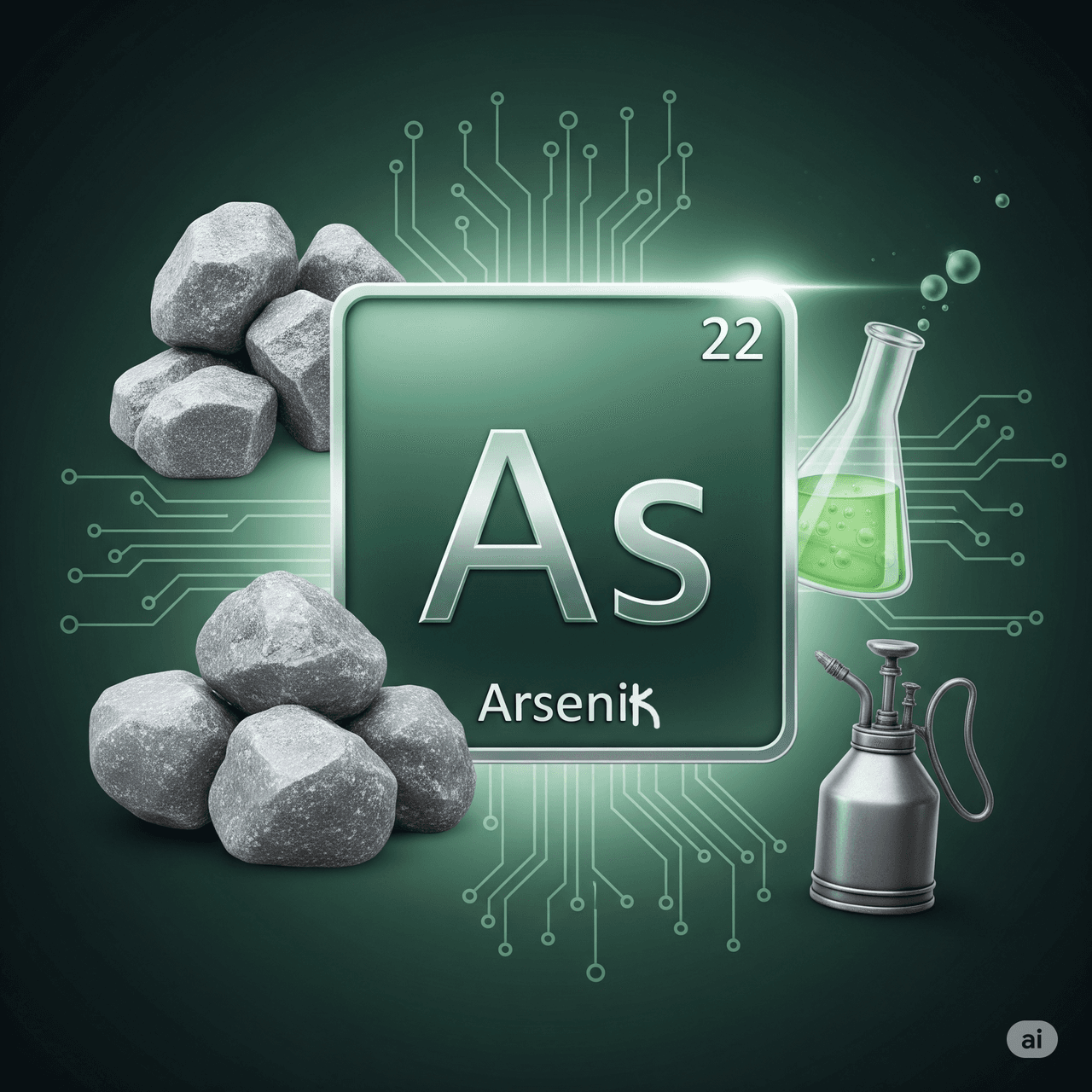
Arsenic (As) (Generated by artificial intelligence.)
Group / Period | 15 / 4 | ||||||||
|---|---|---|---|---|---|---|---|---|---|
Block | p-Block | ||||||||
Crystal Structure | Rhombohedral (Gray Arsenic) | ||||||||
Applications | Pigment Wood Protection Glass Semiconductor | ||||||||
Electronegativity | 2.18 (Pauling) | ||||||||
Oxidation States | -3, +3, +5 | ||||||||
Density | 5.75 g/cm³ | ||||||||
Stable Isotope | ⁷⁵As | ||||||||
Class | Metalloid | ||||||||
Arsenic (As) is a metalloid located in group 15 of the periodic table with an atomic number of 33. This element exhibits both metallic and nonmetallic properties and is commonly found in nature alongside sulfide minerals, forming stable compounds in various oxidation states. Throughout history, arsenic has gained notoriety as a poison but has also been used in industrial, agricultural, and medical applications. Due to its physical and chemical properties, environmental distribution, and biological effects, it is a subject of careful scientific study.
Arsenic compounds have been known since ancient times, but elemental arsenic was first identified in the 13th century by Albertus Magnus. However, free arsenic in the modern sense was obtained in the 17th century by the German pharmacist Johann Schroeder through the reduction of arsenic oxide with charcoal. During the alchemical period, arsenic was classified among volatile ores and used in the separation of metals.
Arsenic belongs to the metalloid class and displays both nonmetallic and metallic characteristics. It is located in period 4 and group 15 of the periodic table. Its electron configuration is [Ar] 3d¹⁰ 4s² 4p³. The atomic radius is approximately 1.85 Å and its density is 5.75 g/cm³. At room temperature, it exists as a solid and has three allotropes: gray, yellow, and black. The most stable and common form is gray arsenic.
Arsenic sublimes at 613 °C, transitioning directly from solid to gas. Although its melting point is reported as 817 °C, this value was measured under high pressure. When heated in air, arsenic forms arsenic trioxide (As₂O₃). It generally does not react with acids but readily reacts with oxidizing agents. Arsenic forms compounds in both arsenite (As³⁺) and arsenate (As⁵⁺) forms. These compounds exhibit different toxicity and mobility profiles in the environment and biological systems.
Arsenic has a Pauling electronegativity value of 2.18, making it a moderately electronegative element. Its oxidation states are −3, 0, +3, and +5. The most common and stable forms are +3 and +5. Arsenic can form both reducing and oxidizing compounds. Gaseous compounds such as arsine (AsH₃) are highly toxic and can form during industrial processes.
The only stable isotope found in nature is ⁷⁵As. Other radioactive isotopes such as As-72, As-74, and As-76 are used in medical diagnostic procedures. These isotopes have short half-lives and are typically produced in laboratory settings.
Arsenic is commonly found in nature in association with sulfide minerals. Its most abundant mineral is arsenopyrite (FeAsS). Other arsenic-containing minerals include realgar (As₄S₄), orpiment (As₂S₃), and scorodite (FeAsO₄·8H₂O). Arsenic can occur in dissolved form in groundwater, posing health risks in drinking water sources, particularly in geothermal regions. Arsenic concentrations in soil can vary between 0.1 and 40 ppm.
Arsenic is not an essential element for humans. Inorganic arsenic compounds are toxic and carcinogenic. Long-term exposure has been linked to skin lesions, cardiovascular diseases, and various types of cancer. Arsenic accumulates in keratinized tissues such as hair and nails. Some microorganisms can metabolize arsenic compounds and play a role in the environmental arsenic cycle. Organic arsenic compounds, such as arsenobetaine, are generally less toxic and are commonly found in seafood.
Arsenic has been used throughout history as a pigment, medicine, and poison. Its current applications include:
Semiconductor industry: Gallium arsenide (GaAs) is used in high-performance electronic devices.
Agriculture: Arsenic compounds formerly used as pesticides, such as Paris green and lead arsenate, are now banned.
Wood preservation: Zinc and chromium arsenates are used to prevent wood decay.
Medicine: Historically used in the treatment of syphilis; today, certain isotopes are used for diagnostic purposes.
Glass and alloy production: Arsenic is used in the manufacture of specialty glasses and to enhance the durability of alloys.

Applications of Arsenic (generated by artificial intelligence).
Arsenic is recognized as a global public health concern, primarily due to its presence in drinking water. More than 200 million people worldwide are exposed to drinking water with arsenic concentrations exceeding 10 µg/L. This issue is linked to both geological and industrial sources of arsenic. Arsenic contamination causes severe health problems, particularly in South Asia, China, and certain Latin American countries.
Kapp, Robert. “Arsenik.” *Toxikoloji Ansiklopedisi*, 2nd ed., 2005, pp. 168–171. Accessed August 16, 2025. https://www.sciencedirect.com/science/article/abs/pii/B0123694000000867
Rae, Ian D. “Arsenik: Kimyası, Yeryüzünde Meydana Gelmesi ve Endüstriye ve Çevreye Salınması.” *Chemistry Teacher International* 6, article no. 25 (2020). Course Material, published October 17, 2020. Accessed August 16, 2025. https://link.springer.com/article/10.1007/s40828-020-00118-7
Yağmur, Fatih, and Ý. Hamit Hancı. “Arsenik.” STED (Türk Tabipleri Birliği). Accessed August 16, 2025. https://www.ttb.org.tr/STED/sted0702/arsenik.pdf
“Arsenic.” *PubChem*, National Center for Biotechnology Information. Accessed August 16, 2025. https://pubchem.ncbi.nlm.nih.gov/compound/arsenic
“Arsenik.” Bilim Genç, TÜBİTAK. Accessed August 16, 2025. https://bilimgenc.tubitak.gov.tr/periyodik-tablo/arsenik

Arsenic (As) (Generated by artificial intelligence.)
Group / Period | 15 / 4 | ||||||||
|---|---|---|---|---|---|---|---|---|---|
Block | p-Block | ||||||||
Crystal Structure | Rhombohedral (Gray Arsenic) | ||||||||
Applications | Pigment Wood Protection Glass Semiconductor | ||||||||
Electronegativity | 2.18 (Pauling) | ||||||||
Oxidation States | -3, +3, +5 | ||||||||
Density | 5.75 g/cm³ | ||||||||
Stable Isotope | ⁷⁵As | ||||||||
Class | Metalloid | ||||||||
Discovery
Classification and Fundamental Properties
Physical and Chemical Properties
Electronegativity and Reactivity
Isotopes
Natural Occurrence and Compounds
Biological Role and Significance to Living Organisms
Applications
Environmental and Societal Impacts