


This article was automatically translated from the original Turkish version.

How much form can you give to stone? Or how much meaning can you imbue into an inanimate object? If the person doing so is a master of their craft, this is possible. Who is this person? The boundless architect of the Divriği Ulu Camii, Ahlatlı Hürrem Şah. Over fifteen years, he meticulously carved the stone of the Divriği Ulu Camii with exquisite detail, as if breathing life into the stone itself. The mosque has become an embodiment of refined thought and aesthetic intelligence.
Our ancestors began every endeavor with the phrase “In the name of Allah, the Most Gracious, the Most Merciful,” and continued their work with prayers. They wished that only those who carried gentleness in their hearts could uncover the secrets of their art. Ahlatlı Hürrem Şah, as the architect of this masterpiece known as the Divriği Ulu Camii, did not inscribe his name on the mosque’s entrance. Instead, he chose the place that would collapse first in an earthquake. He wished that if this mosque and darüşşifa were ever to fall, his name would be the first to vanish. In doing so, he demonstrated profound humility.
This magnificent structure has stood for over eight centuries—not merely as a place of worship, but as the pinnacle of stonemasonry, art, and cultural heritage. The Divriği Ulu Camii defies the erosive force of time, each stone holding a unique story, each relief concealing a hidden mystery.
The most significant factor that makes the Divriği Ulu Camii so extraordinary is its exceptional stonework. The mosque’s three main entrances—north, west, and east—are adorned with distinct geometric motifs, botanical patterns, and symbols. Each entrance, executed in a different style, has been described by art historians as “embroidering stone.”
The most striking of these entrances is the Taç Kapı. The three-dimensional motifs on this portal create a sense of depth, playing with shadow and light to reveal new details with every glance. Moreover, none of these motifs are identical, further enhancing the uniqueness of the structure. Another remarkable feature is the silhouette of a praying man reflected on the western entrance. At certain times of day, when sunlight strikes at a precise angle, the motifs cast the unmistakable shadow of a human figure on the ground. This phenomenon is another miracle born of the fusion of engineering and artistic mastery.
The Divriği Ulu Camii also dazzles through its architectural ingenuity. Despite lacking a dome, the interior achieves a vast spatial volume thanks to its monumental columns and arches. The stonework is so precisely conceived that structural integrity is achieved entirely without cement or binding materials—each stone fits perfectly into place.
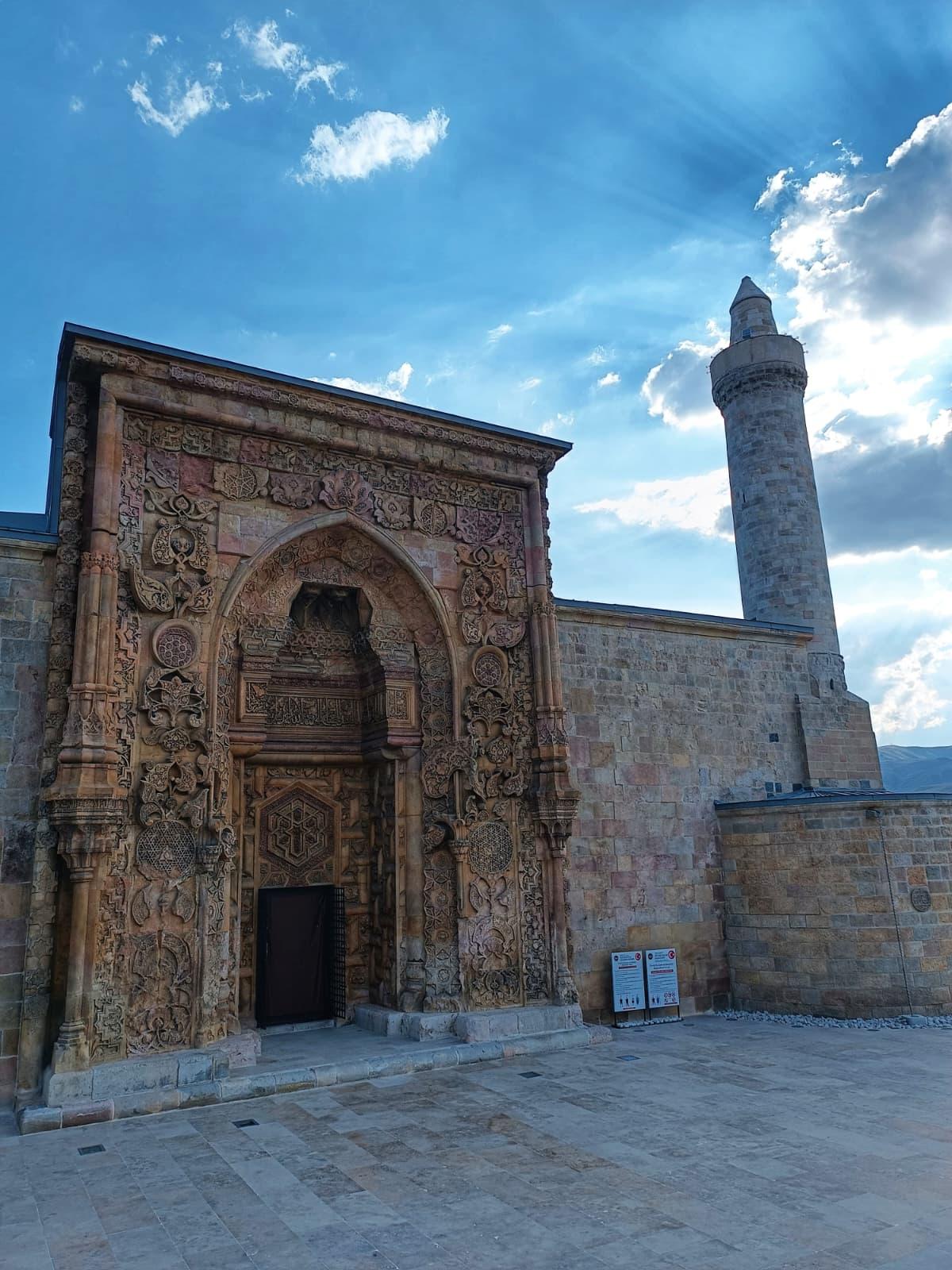
Divriği Ulu Camii (Photograph: Esra Ebrar Taşkın)
Ahlatlı Hürrem Şah, who lived in the 13th century during the Mengücekli Beylik period, is renowned as the architect of the Divriği Ulu Camii. As his name suggests, he originated from Ahlat, located within the boundaries of today’s Bitlis Province. At the time, Ahlat was a leading center for stonework and architecture, and master craftsmen from this region spread throughout Anatolia.
It is known that Ahlatlı Hürrem Şah’s only known work is the Divriği Ulu Camii. He devoted fifteen years to its construction, shaping stone as if it were dough and carving it as delicately as lace. Today, his name is known only to curious historians and art scholars, yet the traces he left in Divriği remain vividly alive.
The extraordinary ornamentation on the western entrance of the Divriği Ulu Camii, combined with its architectural subtlety, stands as a testament to artistic genius. Each motif on the stone resembles not an engraving but a painting. The sheer detail, depth, and technical complexity of these patterns, crafted by a single hand, have deepened admiration for Ahlatlı Hürrem Şah. He did not merely build a structure—he is remembered as an artist who breathed soul into stone.
The unparalleled stone reliefs of the Divriği Ulu Camii, its monumental entrances carved in three distinct styles, its deeply symbolic geometric and botanical motifs, and its ingeniously designed interior space have secured his name in history. The work of Architect Hürrem Şah is regarded as one of the rare examples in architectural history where individual mastery took center stage. If stone had a language, Hürrem Şah was undoubtedly among its most eloquent speakers.
The Darüşşifa located east of the mosque was not merely a hospital but also a medical school. Here, patients received treatment and physicians were trained. Interestingly, the building’s acoustics were so masterfully designed that it is believed water sounds were used for therapeutic purposes.
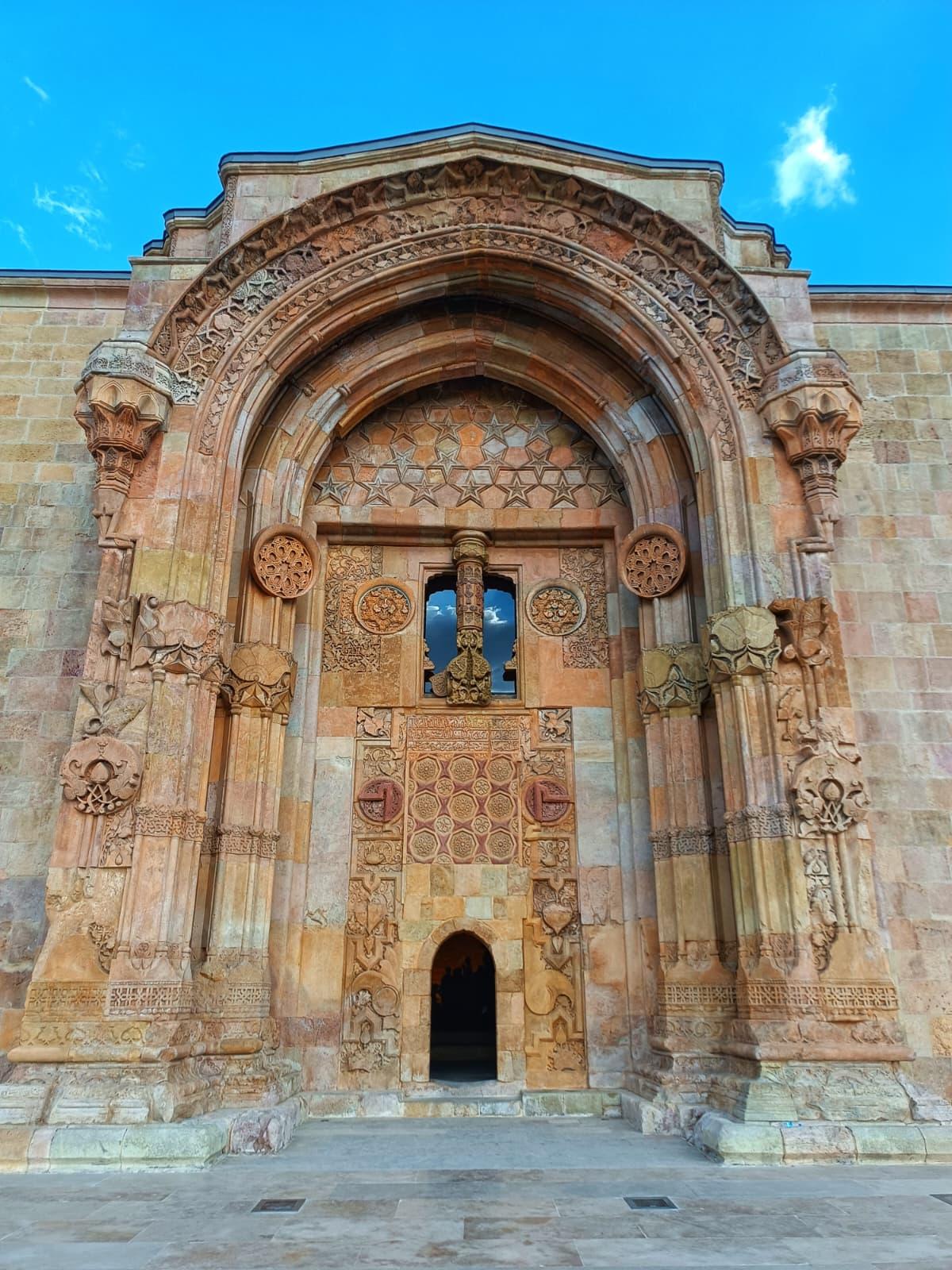
Entrance to the Divriği Darüşşifa (Photograph: Esra Ebrar Taşkın)
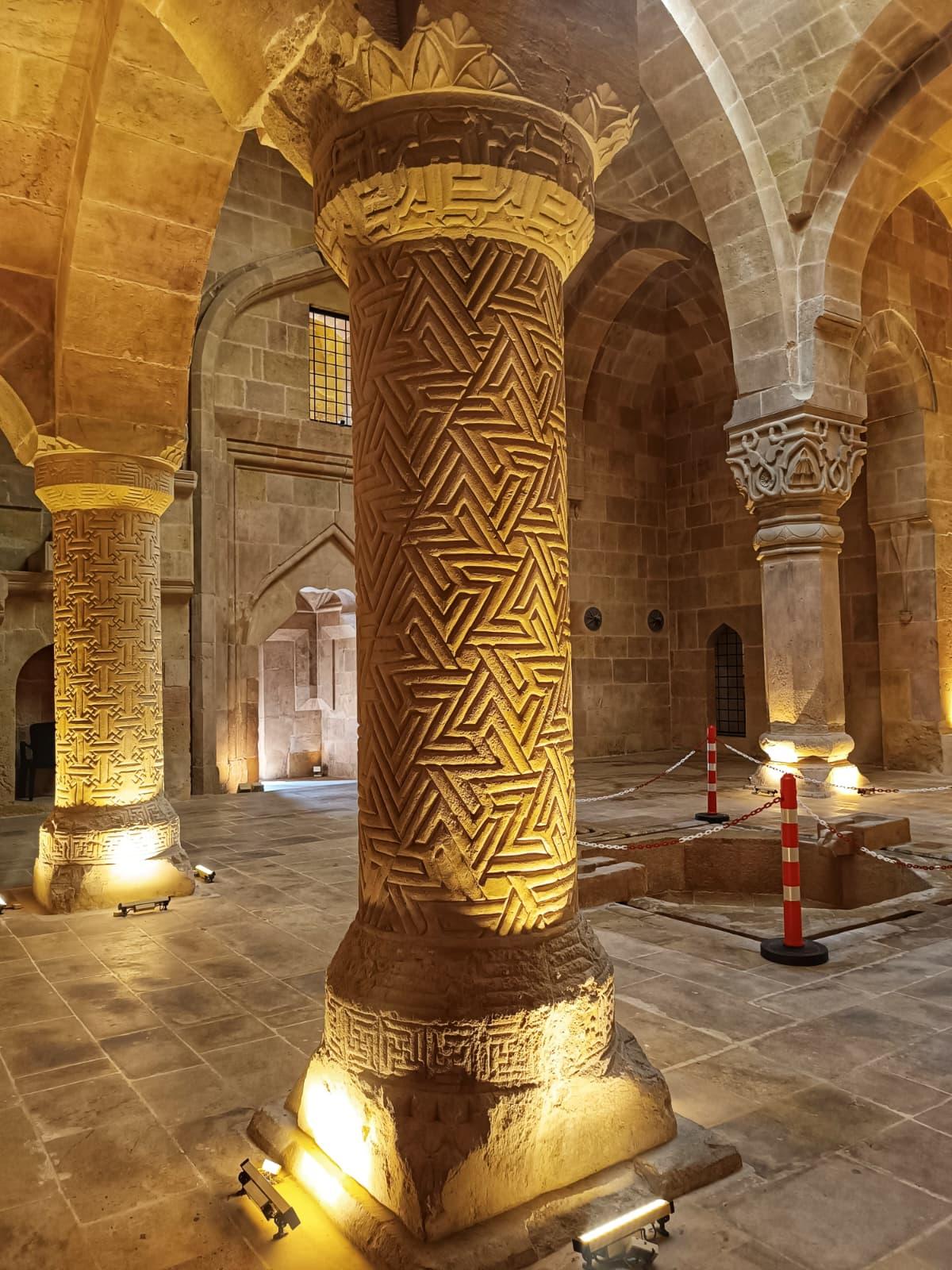
Columns Inside the Darüşşifa (Photograph: Esra Ebrar Taşkın)
According to one legend, during the reign of Kanuni Sultan Süleyman, news reached Istanbul that the Divriği Ulu Camii was tilting westward. In response, Kanuni dispatched Mimar Sinan and his team to Divriği to carry out necessary repairs. After completing the required work, Sinan engraved the seal of Kanuni on the mosque’s wall as a token of the Ottoman state. While historical documents do not fully corroborate this story, when considering the reverence for the structure and Sinan’s mastery, the legend carries cultural symbolic weight.
The Divriği Ulu Camii is not merely a place of worship—it is an artistic manifesto, forged from engineering, art, and faith, standing defiantly against time. Each stone, each motif carries meaning. To merely look at it is not enough; one must feel it, understand it, and pass it on to future generations. For some masterpieces belong not only to a nation but to all of humanity.
Duals and Delicacies Carved into Stone
A Legacy Beyond 800 Years
The Architect Who Spoke Through Stone: Ahlatlı Hürrem Şah
The Place Where Healing Met Art: The Darüşşifa
A Touch of Mimar Sinan to the Divriği Ulu Camii: Legend or Fact?
In Place of a Conclusion