


This article was automatically translated from the original Turkish version.
Artificial gravity is an inertial force created to simulate the force of gravity in spacecraft. Although this concept is frequently explored in science fiction works, it has also been an important subject of research in real space exploration. Various studies are underway to develop methods of generating artificial gravity in order to mitigate the challenges of space missions and preserve astronauts’ health.
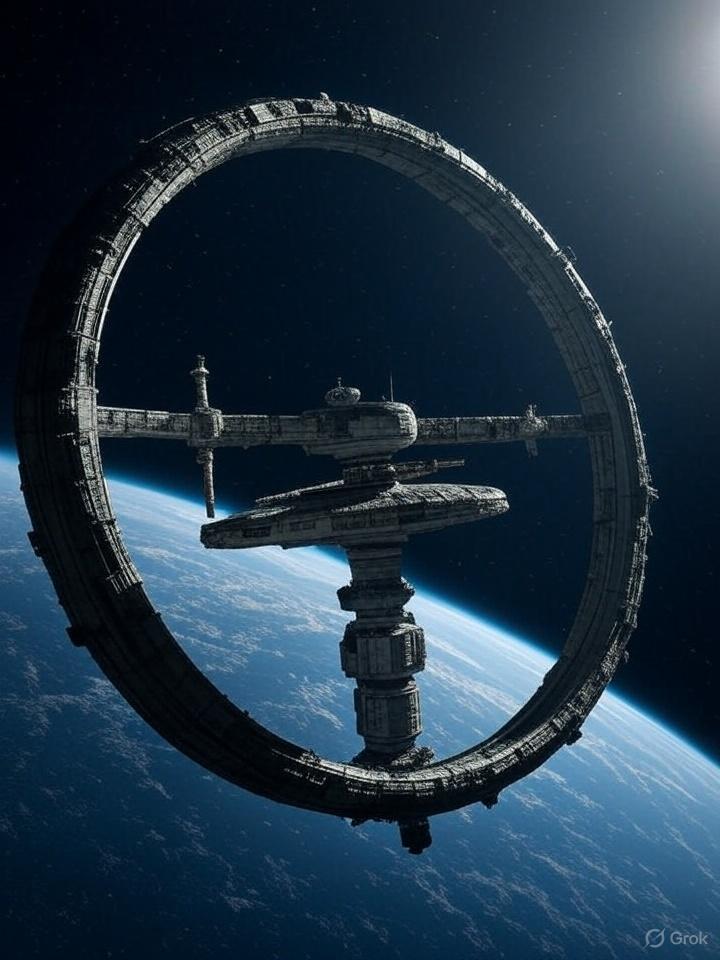
Example of a circular space station (generated by artificial intelligence)
There are several different approaches to generating artificial gravity. One method involves using rotating spacecraft to create centrifugal force, thereby simulating gravity. When a spacecraft rotates, objects and astronauts inside experience an outward force that mimics the sensation of gravity. This method may help prevent muscle and bone loss in astronauts who remain in microgravity conditions for extended periods.
Another method involves linear acceleration. In this case, a spacecraft can generate a force similar to gravity by accelerating in a straight line. However, this approach is impractical for spacecraft in orbit, as objects in orbit remain in free fall and thus experience microgravity. For this reason, generating artificial gravity through rotational motion and centrifugal force is the more commonly proposed method.
Albert Einstein stated in his theory of special relativity that acceleration and gravity are indistinguishable. In this context, a spacecraft accelerating at a specific rate can mimic the gravitational force experienced on Earth. However, producing such high levels of acceleration in space is difficult, so microgravity conditions prevail. In orbiting vehicles, gravity is effectively zero due to free fall, and artificial gravity can be achieved instead by using centrifugal force.
Microgravity can lead to various adverse effects on astronauts’ health during long-duration space missions. Research conducted by NASA’s Human Research Program has shown that astronauts in microgravity lose between 1% and 1.5% of bone mineral density per month. Additionally, microgravity causes rapid loss of muscle mass, a condition that becomes more pronounced the longer astronauts remain in space. Furthermore, fluid shifts in the body during spaceflight can create pressure on the eyes, leading to vision problems. Developing artificial gravity systems is therefore crucial to preventing these health issues. Artificial gravity will become a necessity for preserving astronauts’ health and ensuring the successful completion of long-duration missions.
Artificial gravity is a critical factor in the future of space research and human health. Developing systems to mitigate the negative effects of microgravity is an essential step toward achieving success in future space exploration. For astronauts who will spend extended periods in space, artificial gravity will be a vital requirement to prevent muscle and bone loss, reduce vision problems, and improve overall health.
Bilim Genç. "Yapay Yerçekiminin Nasıl Çalıştığını İnceleyelim." TÜBİTAK. Accessed [Date]. https://bilimgenc.tubitak.gov.tr/makale/yapay-yer-cekiminin-nasil-calistigini-inceleyelim.
Gary Jordan, Bill Paloski, NASA. "Artificial Gravity." Houston We Have a Podcast Series, Season 1, Episode 188. Accessed June 4, 2025. https://www.nasa.gov/podcasts/houston-we-have-a-podcast/artificial-gravity/

Methods of Generating Artificial Gravity
Einstein’s Theory of Relativity and Artificial Gravity
Effects of Microgravity on Human Health