


This article was automatically translated from the original Turkish version.
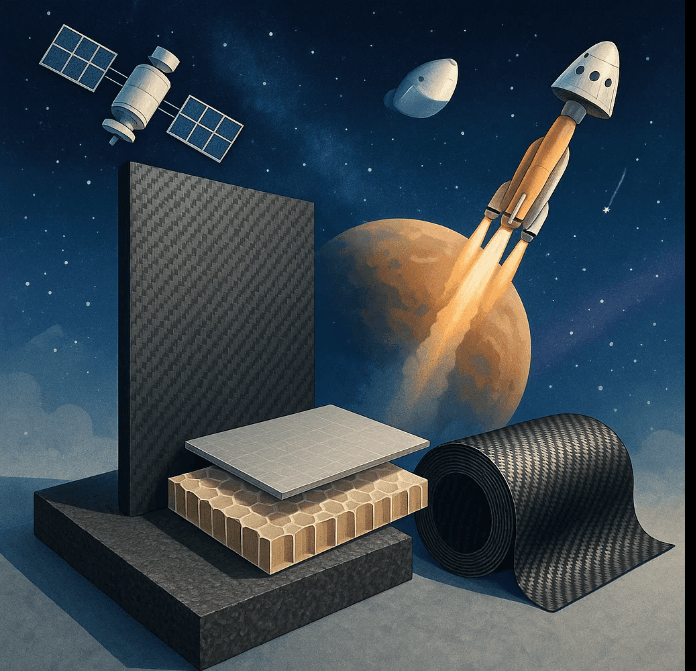
Generated with artificial intelligence
Critical Features | Lightweight, high strength, thermal stability, radiation resistance, low thermal expansion, outgassing resistance. | ||||||||
|---|---|---|---|---|---|---|---|---|---|
Application Area(s) | Satellite bodies external armor. data modules motor nozzles solar panels landing assemblies | ||||||||
Material Types | - Composites (CFRP, GFRP) - Metallic foams - Nanocomposites - High-performance alloys - Polymer-based structures | ||||||||
Challenges (Space Environment) | Vacuum, rapid temperature transitions (±150 °C), radiation, micrometeoroid impacts, electrostatic charging. | ||||||||
For Small Satellites | Compliant with volume/mass constraints: Multifunctional, integrated energy storage and structural material systems. | ||||||||
Test Requirements | Thermal vacuum tests, radiation simulations, micrometeoroid impact tests, acoustic resonance and vibration tests. | ||||||||
Spacecraft materials are advanced engineering materials designed to withstand the extreme physical and chemical conditions encountered by spacecraft operating outside Earth’s atmosphere. These materials must be engineered not only to meet individual performance requirements such as high strength or low density, but also to simultaneously satisfy multifaceted performance criteria. Mechanical, thermal, electrical, electromagnetic, and radiation resistance are the fundamental performance domains expected of spacecraft materials.
Since modern space missions represent some of the most complex examples of multidisciplinary engineering, the materials used are rarely mere “carriers”; they often serve as integrated components of the system. Therefore, unlike conventional engineering materials, spacecraft materials typically consist of composites, multifunctional systems, or nanoscale structures. The development of these structures requires the integrated consideration of materials science, applied mechanics, thermodynamics, electromagnetic theory, and space environment physics.
The space environment is technically classified as a “harsh physical environment” due to the absence of Earth’s atmospheric protection. Every material and system operating in this environment is simultaneously exposed to multiple destructive factors. Some of these effects cause structural deformation, while others lead to system failures through chemical degradation or electrical discharges.
Vacuum effects cause volatile components within materials to be released (outgassing) and alter surface properties such as adhesion. This results in significant performance degradation over mission duration, particularly in polymer-based insulation materials. Structural effects such as reduced thermal conductivity or changes in elastic modulus may also occur.
Temperature fluctuations are among the most common and hardest-to-control effects in space missions. A satellite panel exposed to direct sunlight can heat up to 120 °C, while shaded surfaces can cool down to -160 °C. These rapid transitions generate thermal stresses on material surfaces, which over time may lead to microstructural cracking or delamination between layers.
High-energy radiation causes atomic-level degradation in materials due to ionizing particles and gamma radiation, especially during solar storms. The chemical bonding structure of polymer-based materials may change, while electron bombardment on metal surfaces can lead to photoelectric charge accumulation.
Micrometeoroid and space debris impacts relate directly to physical material damage. Such collisions involve extremely high energy over millisecond timeframes and can create holes, cracks, or spallation in thin outer panels.
All these factors clearly demonstrate that spacecraft materials must be optimized not only for mechanical performance but also for thermal, electrical, and electromagnetic performance.
One of the most commonly used material types in spacecraft is composite materials. Composites are structures formed by combining two or more distinct phases at micro or macro scales. The most common configuration consists of a matrix phase with reinforcing elements dispersed within it. The matrix is typically polymer-based and reinforced with fibers such as carbon, glass, or aramid.
Carbon fiber-reinforced polymer (CFRP) composites are preferred in applications requiring lightweight construction and high specific strength. Structural skeletons of spacecraft, solar panel support arms, load-bearing surface elements, battery enclosures, and insulation housings are manufactured using such materials.
Another significant advantage of composites is their tailorable properties. For instance, fiber orientation can be aligned parallel to load-bearing directions, enabling reinforcement only where needed and achieving weight and volume optimization. Additionally, different functions can be assigned to distinct layers within composite structures to create multifunctional materials.
In next-generation composite applications, the integration of piezoelectric fibers or magnetic nanoparticles enables the development of self-sensing or radiation-detecting structures. Such systems are increasingly favored in small satellites like CubeSats because they reduce ground monitoring costs.
Use of composite materials in spacecraft – YouTube
Metallic foams can be defined as cellular metals containing a high number of pores within a given volume. Their key characteristic is high mechanical performance despite low density. They also offer numerous superior properties including energy absorption, impact damping, acoustic insulation, and thermal stability.
In space environments, metallic foams are typically used for impact protection, thermal insulation, micro-impact damping, and structural buffering. Types such as aluminum foam, titanium foam, and stainless steel foam exhibit resistance to both high temperatures and prolonged radiation exposure.
These materials are especially preferred in components subject to impact loads, such as landing modules, satellite landing platforms, and micrometeoroid shields. Moreover, their compatibility with 3D printing technologies enables the production of custom protective structures with unique geometries.
Metallic foams also provide excellent thermal insulation by slowing heat transfer between the external environment and internal structures. This allows them to serve dual purposes as both structural supports and thermal control elements.
Additive Manufacturing (AM) technologies have been increasingly adopted in recent years as alternatives to traditional subtractive manufacturing, particularly in the aerospace sector. This method enables the production of complex-geometry, lightweight, and optimized components. Furthermore, it facilitates in-situ manufacturing capabilities, paving the way for production on celestial bodies such as the Moon or Mars.
The most commonly used materials in additive manufacturing include titanium alloys (Ti6Al4V), aluminum matrix composites, high-temperature polymers such as PEEK, and nickel-based superalloys. These materials are typically employed in motor housings, propulsion system nozzles, support columns, and panel connection elements.
This manufacturing method offers significant advantages in small satellite systems where weight constraints are critical. It reduces production time, minimizes material waste, and allows control over the system’s overall thermal conductivity by eliminating unnecessary material usage.
Additive manufacturing is also suitable for in-situ repair and production scenarios. Components required for space stations or future lunar/Martian bases can now be manufactured in space using this method, representing a groundbreaking advancement in sustainability.
One of the most serious threats in the space environment is radiation. Gamma rays, neutron fluxes, and high-energy particles can cause atomic-level damage upon impact with material surfaces. This threat is particularly critical for the reliability of electronic systems.
Recently developed carbon nanotube (CNT) and boron nitride (BN)-reinforced carbon/epoxy nanocomposite structures provide superior protection against such high-energy radiation. Their primary advantage lies in offering high shielding capacity with low density.
Due to their extremely high specific surface area, these nanocomposites exhibit high energy absorption capacity. Additionally, they have been shown to attenuate electromagnetic radiation at specific frequencies. Consequently, they can serve dual functions as both mechanical protection and electromagnetic shielding.
These materials are used on the outer shells of satellites, in communication modules, data processing units, and behind solar cell arrays. Such solutions are critical for deep space missions exposed to high radiation doses.
Graphene production facility – Nanocomposites – YouTube
The primary constraints in designing small satellite systems (CubeSats, NanoSats) are volume and mass. Multifunctional material systems developed to overcome these limitations are advanced composites capable of performing multiple functions within a single structural unit.
These systems can simultaneously provide structural load-bearing, thermal control, and electromagnetic shielding. For example, carbon fiber-reinforced panels can incorporate embedded battery systems, cooling channels, and antenna structures.
These structures typically consist of multilayer hybrid composites. Conductive fibers, heat-distributing metals, smart sensors, and energy storage systems may be integrated between layers. Thus, a single structural panel can also function as a data transmission infrastructure or an energy storage unit.
This multifunctional approach provides substantial benefits not only in terms of weight and volume reduction but also in manufacturing, maintenance, integration, and mission reliability.
Material selection in spacecraft design is determined not only by engineering values but also by mission duration, orbit type, propulsion system type, thermal control requirements, and electromagnetic environment.
Systematic selection criteria developed for this purpose include:
Furthermore, selection decisions are made objective through multi-criteria decision-making algorithms (AHP, TOPSIS, etc.) that weight all these factors.
Future human missions to the Moon, Mars, and more distant planets are planned. It is crucial that materials used in these missions can be produced not only on Earth but also at the mission site. Consequently, research into in-situ resource utilization and material synthesis from local regolith is accelerating.
Additionally, biocompatible and environmentally friendly materials, self-healing structures, thermally responsive active surfaces, and nanoscale radiation shields are emerging among advancing materials technologies. The advancement of materials science is inevitable for sustainable space missions.
Arslan, M. M., B. Çalık, and G. Uzun. “Eklemeli İmalatta Kullanılan Yeni Malzemeler: Uzay Araştırmaları.” Havacılık ve Uzay Çalışmaları Dergisi, 2025. https://dergipark.org.tr/en/download/article-file/4229986.
Eren, Z., M. Nikbay, and A. R. Aslan. “Çok Fonksiyonlu Yapıların Küçük Uydularda Uygulanması.” ResearchGate, 2014. https://www.researchgate.net/publication/268685365.
Peker, M. Y. “Uzay Uygulamaları İçin Karbon Nanotüp ve Bor Nitrür Takviyeli Karbon/Epoksi Nanokompozitler ile Nötron ve Gama Radyasyonu Zırhlaması.” ResearchGate, 2024. https://www.researchgate.net/publication/385648258.
Yavuz, İ. “Metalik Köpük Malzemeler ve Uygulama Alanları.” *Taşıt Teknolojileri Elektronik Dergisi* 2, no. 2 (2010): 34–39. https://www.researchgate.net/publication/350451801.
Ölmez, C., Z. Sever, and S. Güneş. “Kompozit Malzemelerin Mühendislik Uygulamaları: Sınıflandırılması, Mekanik Hesaplamaları, Üretim Yöntemleri ve Kullanım Alanları.” ResearchGate, 2023. https://www.researchgate.net/publication/371863654.

Generated with artificial intelligence
Critical Features | Lightweight, high strength, thermal stability, radiation resistance, low thermal expansion, outgassing resistance. | ||||||||
|---|---|---|---|---|---|---|---|---|---|
Application Area(s) | Satellite bodies external armor. data modules motor nozzles solar panels landing assemblies | ||||||||
Material Types | - Composites (CFRP, GFRP) - Metallic foams - Nanocomposites - High-performance alloys - Polymer-based structures | ||||||||
Challenges (Space Environment) | Vacuum, rapid temperature transitions (±150 °C), radiation, micrometeoroid impacts, electrostatic charging. | ||||||||
For Small Satellites | Compliant with volume/mass constraints: Multifunctional, integrated energy storage and structural material systems. | ||||||||
Test Requirements | Thermal vacuum tests, radiation simulations, micrometeoroid impact tests, acoustic resonance and vibration tests. | ||||||||
No Discussion Added Yet
Start discussion for "Spacecraft Materials" article
Physical Effects of the Space Environment on Materials
Composite Materials and Space Applications
Mechanical and Thermal Performance of Metallic Foams
Integration of Additive Manufacturing Technologies into Space Materials
Development of Radiation-Resistant Nanocomposites
Multifunctional Material Systems and Applications in Small Satellites
Systematic Approaches and Criteria for Material Selection
Future Trends in Materials Science for Spacecraft