


This article was automatically translated from the original Turkish version.
Artificial intelligence-supported intelligence is defined as the systematic use of artificial intelligence methods in the processes of collecting, processing, analyzing, and presenting interpreted outputs to decision-makers from multi-source data. This approach does not reduce the entire intelligence production cycle to a single automated mechanism; rather, it creates decision-support layers that work alongside human expertise to alleviate the pressure imposed by increasing data volume and velocity on analysts and command structures, enhance situational awareness in time-sensitive scenarios, and reinforce evaluation quality through transparent processes.
Artificial intelligence-supported intelligence touches upon all stages of the intelligence cycle—not only analysis—but also requirement definition, collection planning, preprocessing, fusion, analytical production, and dissemination. Some assessments emphasize that one of the primary motivations for early AI adoption was the strain placed on analysts’ capacity for selective attention and filtering within what has been termed a “data smog”; over time, the focus has shifted toward improving the entire cycle. Within this framework, artificial intelligence functions as an accelerator that transforms raw data into meaningful indicators, while aspects of intelligence requiring accuracy, context, justification, and accountability remain under human oversight.
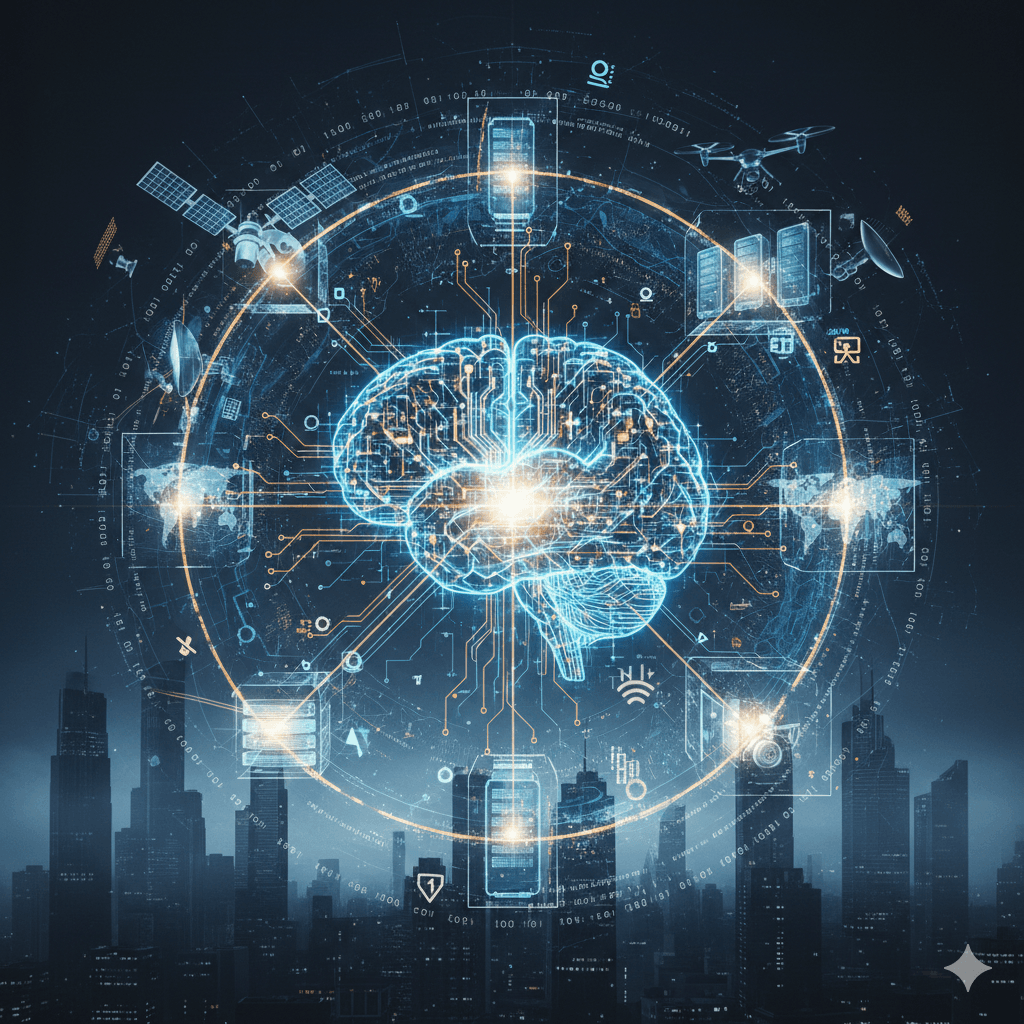
Artificial Intelligence-Supported Intelligence (Generated by Artificial Intelligence.)
Intelligence production relies on the integrated analysis of heterogeneous sources such as remote sensing, autonomous sensor networks, communications and signals data, cyber domain observations, open-source streams, and human intelligence inputs. In multi-domain and coalition operations, the distributed nature of these sources across different institutions and partners introduces additional complexity in terms of data formats, access permissions, security constraints, and temporal synchronization. Consequently, in AI-supported intelligence architectures, preprocessing functions such as data quality control, noise reduction, handling missing data, and inference under uncertainty are considered critical. Moreover, adversaries’ attempts to deceive algorithms through manipulation techniques necessitate a broader assurance approach than mere optimization for “accuracy.”
Value generation in a multi-source environment is achieved not through individual signals but through the integration of disparate sources in a complementary manner. AI techniques support the data fusion layer through mechanisms such as entity resolution, pattern recognition, anomaly detection, event clustering, and contextual linking. At this stage, the fundamental challenge is not merely to construct a unified picture but to make visible which assumptions underlie which data, where uncertainty increases, and where human judgment must intervene. Explainable AI approaches, particularly those employing layered explanation frameworks, are used to simultaneously address operational speed requirements and oversight needs by providing justifications at varying levels of detail for the same assessment.
Artificial intelligence-supported intelligence directly intersects with command and control processes, as intelligence outputs frequently feed into decision cycles at stages such as perception, processing, comprehension, and decision support. The integration of AI into command and control systems is pursued with the goal of enhancing situational awareness and supporting time-critical decisions, while data quality, cyber security vulnerabilities, and the need for explainability emerge as key risk areas. Such assessments underscore that AI use must be balanced to preserve human command authority and that implementation typically progresses as a gradual transformation through doctrinal, procedural, and educational adaptations rather than through abrupt disruption.
In artificial intelligence-supported intelligence, automation is viewed not as a replacement for analysts but as a component that reshapes their workflow. Automated extraction and summarization tools, thematic clustering, and alternative hypothesis generation systems can redirect analysts’ attention toward critical deviations, sources of uncertainty, and verification needs. However, the outputs of analytical production—particularly when expressed in textual assessments—require additional validation and traceability mechanisms due to the risk that AI-generated systems may produce fluent but erroneous or unjustified content. Within this framework, the value of automation lies less in accelerating output generation and more in organizing evidence chains, making alternatives visible, and enhancing the effectiveness of human oversight.
In operational intelligence environments, “trust” depends not only on model performance but also on resilience to changing data conditions, approaches to managing uncertainty, resistance to deception, and the ability to justify outcomes. In multi-domain operations, rapidly evolving situations, restricted access to real data, noisy and incomplete inputs during operations, and adversary deception widen the gap between training and operational conditions. Therefore, explainability is used not only to answer the “why” question for users but also to define the boundaries of model reliability, identify high-risk use cases, and clarify the human-machine division of labor. Neuro-symbolic approaches, which combine neural networks with symbolic reasoning, are discussed in this context as a direction that integrates flexible pattern learning with rule-based justification to meet the needs for interpretability and knowledge representation in decision support processes.
The success of artificial intelligence-supported intelligence in alliances and coalition structures depends not only on technical capacity but also on adoption processes. Areas such as iterative development, access to qualified human resources, data accessibility, and interaction with the civilian technology ecosystem directly influence joint decision-making and policy alignment. Differing rates of technology adoption among partners can increase interoperability risks, while data sharing and data retention regimes are constrained by both national laws and international regulations. Therefore, artificial intelligence-supported intelligence must be evaluated not merely as a technical modernization but as an integration of institutional trust relationships, standards, and governance design.
Organizational strategy documents and policy analyses do not limit the use of artificial intelligence in defense and security to goals of speed and efficiency; they also incorporate principles of accountability, responsibility, security, and risk management as integral components of implementation. This approach aims to ensure that AI-supported intelligence does not function as a mechanism forcing decision-makers toward a “single correct answer,” but instead makes evidence-based options and uncertainties visible while preserving decision-making responsibility within human authority. This perspective reinforces the need for common standards, training, oversight, and evaluation processes at the alliance level.
A significant dimension of intelligence relies on cyber indicators observable through networks and information systems. Proposed reference architectures for autonomous cyber defense agents integrate functions such as detection and situation determination, planning, action selection and execution, impact monitoring, learning, and cooperation when necessary. From an intelligence perspective, such architectures are important in two ways: first, they provide automated observation and preliminary assessment capabilities in the face of the continuity and volume of cyber data; second, they establish tighter feedback loops between intelligence’s warning and early detection functions and action-oriented cyber defense processes. However, as autonomy increases, so do risks of misidentification, inappropriate responses, and adversary manipulation; therefore, the operational boundaries, control points, and logging mechanisms of such agents must be explicitly designed.
Artificial intelligence-supported intelligence gains meaning not through the promise of “fully automated intelligence” but through high-impact support functions in limited domains. Rules governing data collection and storage, privacy and authority boundaries, data-sharing practices across institutions, and relationships with the civilian technology ecosystem are fundamental factors determining the actual transition of technical capacity into operational use. Furthermore, data quality issues, cyber security vulnerabilities, insufficient explainability, and deception attempts can generate false confidence and negatively affect decision-making processes. Therefore, artificial intelligence-supported intelligence is understood as a socio-technical system that continuously re-negotiates the balance between the advantages of speed and scale and the requirements of assurance, oversight, and preservation of human authority.
Borene, Alice B. “Intelligence Analysis, Synthesis, and Automation.” *Studies in Intelligence* 67, no. 4 (December 2023). Accessed February 18, 2026. https://www.cia.gov/resources/csi/static/a3f91ec21ddbc4b2d14a44dba51b3b0f/Article-Intelligence-Analysis-Synthesis-Automation.pdf
Christie, Edward. “The NATO Alliance and the Challenges of Artificial Intelligence Adoption.” *NATO Decision-Making in the Age of Big Data and Artificial Intelligence*, 2021. Accessed February 18, 2026. https://www.researchgate.net/publication/352710123_The_NATO_Alliance_and_the_Challenges_of_Artificial_Intelligence_Adoption
Dylan, H., and N. Stivang. “Emerging Technologies and National Security Intelligence.” *Intelligence and National Security* 40, no. 6 (2025): 988–1009. Accessed February 18, 2026. https://doi.org/10.1080/02684527.2025.2565948
Hagos, Desta Haileselassie, and Danda B. Rawat. “Neuro-Symbolic AI for Military Applications.” *IEEE Transactions on Artificial Intelligence* 5.12 (2024): 6012-6026. Accessed February 18, 2026. https://arxiv.org/abs/2408.09224
Kott, Alexander, Paul Théron, Martin Drašar, Edlira Dushku, Benoît LeBlanc, Paul Losiewicz, Alessandro Guarino, Luigi Mancini, Agostino Panico, Mauno Pihelgas, Krzysztof Rzadca, and Fabio De Gaspari. “Autonomous Intelligent Cyber-defense Agent (AICA) Reference Architecture. Release 2.0.” 2023. Accessed February 18, 2026. https://arxiv.org/abs/1803.10664
Moran, Christopher R., Joe Burton, and George Christou. “The US Intelligence Community, Global Security, and AI: From Secret Intelligence to Smart Spying.” *Journal of Global Security Studies* 8, no. 2 (June 2023): ogad005. Accessed February 18, 2026. https://doi.org/10.1093/jogss/ogad005
Preece, Alun, Dave Braines, Federico Cerutti, and Tien Pham. “Explainable AI for Intelligence Augmentation in Multi-Domain Operations.” *arXiv preprint arXiv:1910.07563* (2019). Accessed February 18, 2026. https://arxiv.org/abs/1910.07563
van Rijn, Max, Rabia Saylam, Marcel Scherrenburg, and Mesut Dönmez. “AI in Military C2-Systems: An Introduction and Recent Advances.” *Annals of C2*, Vol. 2 (2025). NATO Command and Control Centre of Excellence. Accessed February 18, 2026. https://c2coe.org/wp-content/uploads/Library%20Documents/Annals/Seperate%20Articles/20250701%20AI%20in%20Military%20C2%20Systems%20An%20Introduction%20and%20Recent%20Advances%20%28C2COE%29%20Annals%20of%20C2%20Vol2.pdf
Özbek, Cengiz, and Tolga Erdem. “Technological Trends in Security Policies of NATO: Artificial Intelligence (AI).” *Journal of Mehmet Akif Ersoy University Economics and Administrative Sciences Faculty,* 12(4), 1545-1563. Accessed February 18, 2026. https://dergipark.org.tr/en/download/article-file/4779609

No Discussion Added Yet
Start discussion for "Artificial Intelligence-Assisted Intelligence" article
Conceptual Framework and Relationship with the Intelligence Cycle
Data Sources, Collection, and Preprocessing
Data Fusion and Interpretation
Decision Support in Command and Control Contexts
Human Expertise, Analytical Production, and Automation
Explainability, Assurance, and Trust
Coalition Environment and Technology Adoption Challenges
Organizational Strategies and Responsible Use Principles
Cyber Domain and Autonomous Agents
Limits and Risks