


This article was automatically translated from the original Turkish version.
+4 More
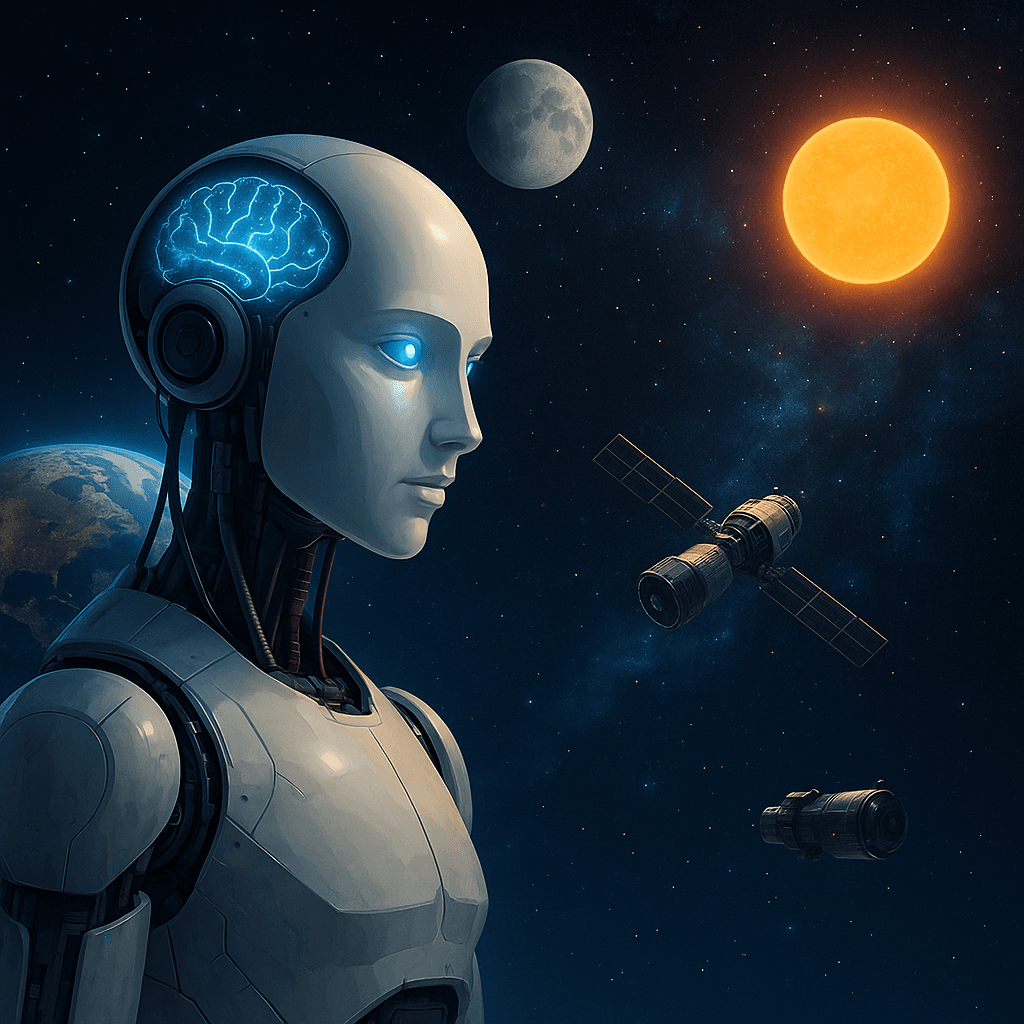
Artificial Intelligence in Space
Main Applications | Data analysis, Autonomous navigation, Mission planning, Robotics, Astronaut support | ||||||||
|---|---|---|---|---|---|---|---|---|---|
Important Projects | NASA Perseverance, Cimon, ExoMiner, China Three Celestial Bodies Constellation, SpaceMIRA | ||||||||
Purpose(s) | and scientific discovery potential in space missions safety To enhance efficiency | ||||||||
Challenge(s) | Radiation Data reliability Cybersecurity Ethical responsibility | ||||||||
Future Vision | Autonomous space colonization, Interplanetary networks, Space mining | ||||||||
Artificial Intelligence in Space is the collective set of technologies that enable computer systems to mimic human-like cognitive processes in humanity’s efforts to understand and explore the universe. These technologies are applied across a wide range of fields including mission planning, autonomous system management, big data analysis, astronaut support, and space debris tracking. Artificial intelligence plays a critical role in addressing the uncertainties and challenges inherent in space research by enhancing the efficiency, safety, and scientific return of missions. Thanks to advancing algorithms and increased computational power, artificial intelligence has become an indispensable tool for space agencies and private companies alike.
Mission planning in space is a complex, multi-layered process. Artificial intelligence optimizes this process by saving time and reducing costs. While traditional mission planning relies on limited data from previous missions, AI-supported systems can analyze all available data to generate more flexible and efficient plans.
For example, design engineering assistants like Daphne, developed by NASA to support satellite design teams, facilitate access to the technical information engineers need. AI algorithms simulate various scenarios before a spacecraft launch to determine the optimal trajectory and timing.
Artificial intelligence is also used in planning interplanetary missions, particularly for optimizing fuel consumption and efficient resource utilization. These systems enable preventive measures by anticipating potential problems that may arise during missions.
Space missions generate enormous volumes of data through telescopes, satellites, and probes. Manually analyzing such vast data sets is both time-consuming and inefficient. Artificial intelligence steps in to process large data sets quickly and effectively. Machine learning algorithms can detect patterns and anomalies in satellite imagery, telescope data, and other sensor recordings that the human eye might overlook.
This has accelerated the discovery of new planets, stars, galaxies, and cosmic events such as gamma-ray bursts. For instance, NASA’s ExoMiner technology uses machine learning to identify exoplanets and distant solar systems.
Similarly, the Prithvi foundational model, developed through a collaboration between NASA and IBM, analyzes atmospheric and climate data and is used across a broad spectrum from short-term weather forecasting to long-term climate projections. Data from Earth observation satellites is also processed by AI to predict urban heat storage or wind speed patterns.

Artificial Intelligence in Space (Generated by artificial intelligence.)
Artificial intelligence plays a central role in enabling spacecraft and robots to make decisions and move autonomously, without human intervention. Especially on distant planets like Mars, exploration vehicles must operate autonomously due to communication delays with Earth. NASA’s Mars Perseverance Rover uses artificial intelligence to analyze environmental conditions, navigate safely, avoid obstacles, and carry out its scientific tasks.
Robots designed to assist astronauts are also equipped with AI. Cimon, operating aboard the International Space Station (ISS), provides assistance to astronauts, while NASA’s Robonaut project aims to develop a humanoid robot capable of performing tasks too risky for humans.
Robotic applications in space even extend to surgery. In a 2024 experiment aboard the ISS, the mini-robot spaceMIRA successfully performed simulated surgical procedures under remote control from Earth in a microgravity environment. STAR (Smart Tissue Autonomous Robot), developed by Johns Hopkins University, can perform more precise autonomous surgeries than human surgeons thanks to artificial intelligence.
Navigation systems widely used on Earth, such as GPS, are not available on other celestial bodies like the Moon or Mars. Artificial intelligence provides alternative solutions to fill this gap. Millions of images captured by observation satellites are processed by AI models to create virtual maps. A system developed through a collaboration between NASA and Intel used this method to construct a virtual map of the Moon and to develop an intelligent navigation system for planetary exploration.
Artificial intelligence is also used to optimize communication systems in space. By selecting the most suitable and reliable path among multiple communication networks, it ensures uninterrupted and efficient data transmission between spacecraft and ground control centers. Global internet access projects utilizing satellite constellations in Low Earth Orbit (LEO) rely on AI-supported network management technologies.
Orbital space debris, or space junk, poses a serious threat to active satellites and crewed missions. According to the European Space Agency, there are approximately 34,000 hazardous objects larger than 10 cm in orbit. Artificial intelligence is used to track this debris and predict potential collisions. Machine learning techniques help develop methods for designing collision avoidance maneuvers. In its strategy for space sustainability, NASA plans to leverage artificial intelligence across a broad spectrum, from detecting orbital debris to removing it.
Long-duration space missions have significant effects on astronauts’ physical and mental health. Artificial intelligence is used in various ways to support astronauts. Intelligent assistants detect potential hazards such as rising carbon dioxide levels or sensor malfunctions aboard spacecraft, alerting the crew and offering solutions. According to United Arab Emirates astronaut Nora Al Matrooshi, artificial intelligence can allow astronauts to spend more time on scientific experiments by monitoring life support systems and reducing the need for routine manual tasks.
AI-supported systems can continuously monitor astronauts’ health conditions and detect potential issues early. Projects such as those led by Turkish academic Dr. Öğretim Üyesi Emel Sokullu aim to pave the way for personalized medicine by modeling how human cells respond to the space environment under microgravity and analyzing this data with artificial intelligence.
Advances in artificial intelligence and space technologies have created a new arena of competition among nations. One of the most concrete examples of this competition is the migration of computing infrastructure into space. China is building a space-based AI supercomputer network through its “Three Body Computing Constellation” project. This initiative aims to bypass bandwidth limitations on Earth and improve energy efficiency by directly performing data processing and AI computations on satellites in orbit. Once completed, this network of thousands of satellites is expected to achieve processing power surpassing the most powerful supercomputers on Earth. Similarly, Russia plans to integrate its AI model Gigachat into the infrastructure of the International Space Station to assist astronauts in processing satellite imagery. Such initiatives are positioning space not only as a domain of exploration but also as a strategic arena for computational and military advantage.
The use of artificial intelligence in space brings significant technical and ethical challenges. The harsh conditions of space—including intense radiation and extreme temperature fluctuations—pose serious threats to electronic hardware and AI systems. Reliable and fault-tolerant operation of these systems requires radiation-hardened hardware and advanced engineering solutions.
Another major challenge lies in ethical and legal issues. Questions such as who is responsible when an autonomous AI system makes an error or fails create a complex legal and ethical landscape under international law. How to evaluate the consequences of decisions made without human oversight and how to protect these systems from cyberattacks remain critical issues to be addressed in the future.
Acente Haber. "Uzayda Yapay Zeka Uygulamaları ve Geleceği." Accessed July 16, 2025. https://acentehaber.com/tr/uncategorized/applications-of-artificial-intelligence-in-space-and-its-future.
Akın, Osman. “Uzayda yapay zekâ bilgisayarları: Çin'in yeni uzay hamlesi.” GazeteBilim. Accessed July 16, 2025. https://gazetebilim.com.tr/uzayda-yapay-zeka-bilgisayarlari-cinin-yeni-uzay-hamlesi/.
Aybars, Handan. “2025 gündemi yapay zeka ve uzay yarışı.” BThaber. Accessed July 16, 2025. https://www.bthaber.com/2025-gundemi-yapay-zeka-ve-uzay-yarisi/.
Cemper, Christoph. “Uzay Araştırmaları ve Astronomi Eğitiminde Yapay Zekanın Kullanımı.” AIPRM. Accessed July 16, 2025. https://www.aiprm.com/tr/egitim/uzayda-yap-kesif-ve-astronomi-egitiminde-kullanimi/.
Dr. Tedo. “Uzayda ve Dünyada Robotik Cerrahinin Geleceği: Yapay Zeka, 5G ve Uzaktan Operasyonlar.” *Tedolog.* Accessed July 16, 2025. https://www.tedolog.com/robotik-cerrahinin-gelecegi-uzayda-5g-ve-yapay-zeka/.
Duyar, Zeynep. “Uzayda kolonileşmenin önünü 'yapay zeka destekli deneysel platformlar' açacak.” Anadolu Ajansı. Accessed July 16, 2025. https://www.aa.com.tr/tr/bilim-teknoloji/uzayda-kolonilesmenin-onunu-yapay-zeka-destekli-deneysel-platformlar-acacak/3609571.
Güllebağatur, Hakan. “Yapay Zeka Uzay Araştırmalarında.” Bilişim School. Accessed July 16, 2025. https://www.bilisimschool.com/yapay-zeka-uzay-arastirmalarinda/.
Innova. "Uzay Keşfinde Yapay Zeka." Innova Blog. Accessed July 16, 2025. https://www.innova.com.tr/blog/uzay-kesfinde-yapay-zeka.
M5 Dergi. “NASA, Dünya'da ve uzayda yapay zeka teknolojilerinden nasıl yararlanıyor?” M5 Dergi. Accessed July 16, 2025. https://m5dergi.com/genel/nasa-dunyada-ve-uzayda-yapay-zeka-teknolojilerinden-nasil-yararlaniyor/.
Yanık, Tolga. “Yapay zeka astronotlara zaman kazandırabilir.” Anadolu Ajansı. Accessed July 16, 2025. https://www.aa.com.tr/tr/bilim-teknoloji/yapay-zeka-astronotlara-zaman-kazandirabilir/3577149.
Çoban, Gizem. “Uzay çalışmalarında yapay zekâ.” Birgün. Accessed July 16, 2025. https://www.birgun.net/haber/uzay-calismalarinda-yapay-zeka-588632.
Özen, Ege Buğra. “Rusya'dan uzayda yapay zeka hamlesi.” AirTurkHaber.com. Accessed July 16, 2025. https://www.airturkhaber.com/haberler/rusyadan-uzayda-yapay-zeka-hamlesi/

Artificial Intelligence in Space
Main Applications | Data analysis, Autonomous navigation, Mission planning, Robotics, Astronaut support | ||||||||
|---|---|---|---|---|---|---|---|---|---|
Important Projects | NASA Perseverance, Cimon, ExoMiner, China Three Celestial Bodies Constellation, SpaceMIRA | ||||||||
Purpose(s) | and scientific discovery potential in space missions safety To enhance efficiency | ||||||||
Challenge(s) | Radiation Data reliability Cybersecurity Ethical responsibility | ||||||||
Future Vision | Autonomous space colonization, Interplanetary networks, Space mining | ||||||||
No Discussion Added Yet
Start discussion for "Artificial Intelligence in Space" article
Mission Planning and Management
Data Analysis and Scientific Discovery
Autonomous Systems and Robotics
Navigation and Communication
Space Debris and Mission Safety
Astronaut Support and Health
Space-Based Computing and Strategic Competition
Challenges and Ethical Issues