
This article was automatically translated from the original Turkish version.
Crew Structure | Canadian Space Agency (CSA) Astronaut NASA Astronauts | ||||||||
|---|---|---|---|---|---|---|---|---|---|
Strategic Objective | Infrastructure for Mars Missions Sustainable Lunar Missions Operational Preparation for Artemis III Validation of Crewed Systems Around the Moon | ||||||||
Planned Launch Date | 7 March 2026 04:29:00 (GMT+3) 6 March 2026 20:29:00 (EST) | ||||||||
First Signatory Country | United States of America | ||||||||
Agreement Type | Multilateral International Space Cooperation Framework | ||||||||
Artemis Agreement Signing Year | 2020 | ||||||||
Lunar Landing | No | ||||||||
Flight Trajectory | Free Return Orbit Around the Moon | ||||||||
Mission Duration | 10 Days | ||||||||
Crew Capacity | 4 Astronauts | ||||||||
Service Module | European Service Module (ESM) | ||||||||
Mission Module Type | Crew Module | ||||||||
Spacecraft Name | Orion | ||||||||
Rocket Name | Space Launch System (SLS) | ||||||||
Position in Program | First Crewed Mission of the Artemis Program | ||||||||
Mission Type | Crewed Test Flight | ||||||||
Mission Name | Artemis II | ||||||||
Artemis II, the United States National Aeronautics and Space Administration (NASA)’s Artemis Program, is the first crewed spaceflight beyond Earth orbit since Apollo 17. The mission is designed to be carried out by a four-person crew using the Space Launch System (SLS) rocket and the Orion spacecraft in a free-return trajectory around the Moon. Artemis II is a test mission aimed at validating crewed deep space systems, testing human operations, and evaluating the technical and operational infrastructure for future lunar missions.【1】

NASA’s Artemis Campaign Briefing, 5 December 2024 (NASA)
From left to right: NASA Administrator Bill Nelson, NASA Deputy Administrator Pam Melroy, NASA Acting Associate Administrator Jim Free and Artemis II Commander Reid Wiseman
Artemis Program is a comprehensive space exploration initiative led by the United States National Aeronautics and Space Administration (NASA) with the goal of extending human spaceflight beyond Earth orbit. The program aims to establish a sustainable human presence around and on the Moon, develop the technological and operational infrastructure necessary for long-duration deep space missions, and advance preparations for crewed missions to Mars.【2】 The Artemis Program is built on a multi-phase structure combining crewed and uncrewed missions, with an emphasis on technological validation, system testing, and operational knowledge transfer between missions.
After the conclusion of the Apollo Program, crewed spaceflight remained largely confined to Earth orbit for decades. International Space Station missions formed the primary focus of this era. The Artemis Program is the first initiative to move beyond this limited orbital paradigm and systematically return human spaceflight to the Moon and deep space. In this regard, Artemis represents the first effort since Apollo to establish crewed missions beyond Earth orbit within a systematic and sustainable framework.【3】
Key objectives of the Artemis Program include enabling long-term human activities around and on the Moon, validating human spaceflight systems under deep space conditions, and gaining operational experience for future missions.【4】 Systems developed under the program encompass crewed spacecraft, heavy-lift launch systems, and deep space communication infrastructure.【5】 Artemis missions are planned to progressively expand the scope of human spaceflight.
The Artemis Program consists of a sequence of complementary and progressively advanced missions, each designed to establish the technical and operational foundation for the next phase.
Completed Artemis I Mission (Boeing)
Artemis I is an uncrewed spaceflight testing the Space Launch System (SLS) rocket and the Orion spacecraft. Launched on 16 November 2022 from NASA’s Kennedy Space Center, Orion remained in space for a total of 25 days during this uncrewed test. After completing its lunar flyby, the spacecraft safely returned to Earth with a splashdown in the Pacific Ocean. This mission validated system integration, flight performance, and operational capabilities in lunar orbit.【6】
Artemis II is the first crewed mission of the Artemis Program. It is designed to test the Orion spacecraft with a crew in a free-return trajectory around the Moon. Artemis II represents a critical milestone in validating crewed deep space flight systems.【7】
Artemis III is planned as the first Artemis mission to land humans on the Moon. This mission marks the program’s transition to surface operations.【8】
Artemis IV and future missions aim to develop infrastructure for long-duration operations in lunar orbit and on the lunar surface. At this stage, the program incorporates expanded mission profiles for sustainable human activities.【9】

Diagram Showing Separation of Solid Rocket Boosters and Rocket Stages During Artemis II Flight and Deployment of CubeSat Payloads into Deep Space (NASA)
Artemis II is the first mission representing the transition from uncrewed testing to crewed deep space operations within the Artemis Program. In this capacity, it constitutes a critical threshold in the program’s technical and operational continuity. The primary objective of Artemis II is to validate the integrated performance of the Space Launch System (SLS) rocket and the Orion spacecraft under crewed flight conditions and to evaluate the performance of systems developed for human missions in the deep space environment. The mission aims to test the operational capabilities of crewed spacecraft beyond Earth orbit through a lunar flyby.【10】
Although Artemis II does not involve direct surface activities, it aims to complete the system validation process necessary for the transition to crewed lunar missions.【11】 In this context, the mission serves as a prerequisite for Artemis III and subsequent missions.
Artemis II holds historical importance as the first crewed spaceflight beyond Earth orbit since the end of the Apollo Program. It represents the resumption of crewed deep space exploration after a prolonged period during which human missions were confined exclusively to low Earth orbit.
The mission is also positioned as the first crewed lunar flyby using modern spaceflight systems.【12】 In terms of technology, flight profile, and operational structure, Artemis II reflects a distinct technical approach compared to Apollo missions. In this way, the mission demonstrates that crewed lunar flights are being restructured according to contemporary engineering and operational standards.【13】

Artemis II Mission Profile (NASA)
The Artemis II mission features a multi-phase flight profile extending from launch to Earth re-entry and landing. The mission duration encompasses the phases of launch, departure from Earth orbit, transfer to the Moon, lunar flyby, return to Earth, and atmospheric entry.【14】 This timeline is designed to test the operational requirements of crewed deep space missions.【15】
Each flight phase is structured to enable monitoring of the Orion spacecraft’s system performance and crewed operations. The timeline is coordinated with onboard system checks, maneuvers, and mission-specific tests.
The Artemis II mission employs a flight profile known as the free return trajectory.【16】 This trajectory is designed to allow the spacecraft to return to Earth using the Moon’s gravity without requiring additional propulsion maneuvers. The free return trajectory is considered a critical safety feature for crewed missions.
This trajectory ensures that in the event of an unexpected failure, the spacecraft will naturally be directed back toward Earth through orbital dynamics. The selection of the free return trajectory for Artemis II demonstrates the prioritization of safety in crewed deep space missions. This approach represents the modern application of a principle previously used in earlier crewed lunar missions.【17】
During the Artemis II mission, the Orion spacecraft will travel far beyond Earth orbit into deep space. The mission profile anticipates the spacecraft reaching a specific maximum distance from Earth before entering the return phase under the Moon’s gravitational influence. This distance represents a significant deep space test for crewed spaceflight.
This flight will enable a crewed spacecraft to reach distances not accessed in decades. The data collected will be critical for evaluating deep space communications, navigation, system resilience, and the sustainability of crewed operations.
The final phase of the Artemis II mission consists of the controlled re-entry of the Orion spacecraft into Earth’s atmosphere. During this phase, the spacecraft will enter the atmosphere at high velocity and be protected from intense thermal loads by its heat shield. Earth re-entry is regarded as one of the most critical operational phases in crewed deep space missions.
The Artemis II mission plans to employ the atmospheric entry technique known as skip entry.【18】 In this method, the spacecraft enters the upper atmosphere at a controlled angle, briefly generating lift before exiting and re-entering to complete its descent. The skip entry technique aims to distribute thermal and structural loads more evenly during atmospheric entry.
This technique provides a crucial validation process for evaluating Orion’s suitability for deep space return conditions. The atmospheric entry performed during Artemis II will provide foundational data for determining entry profiles for future crewed missions.

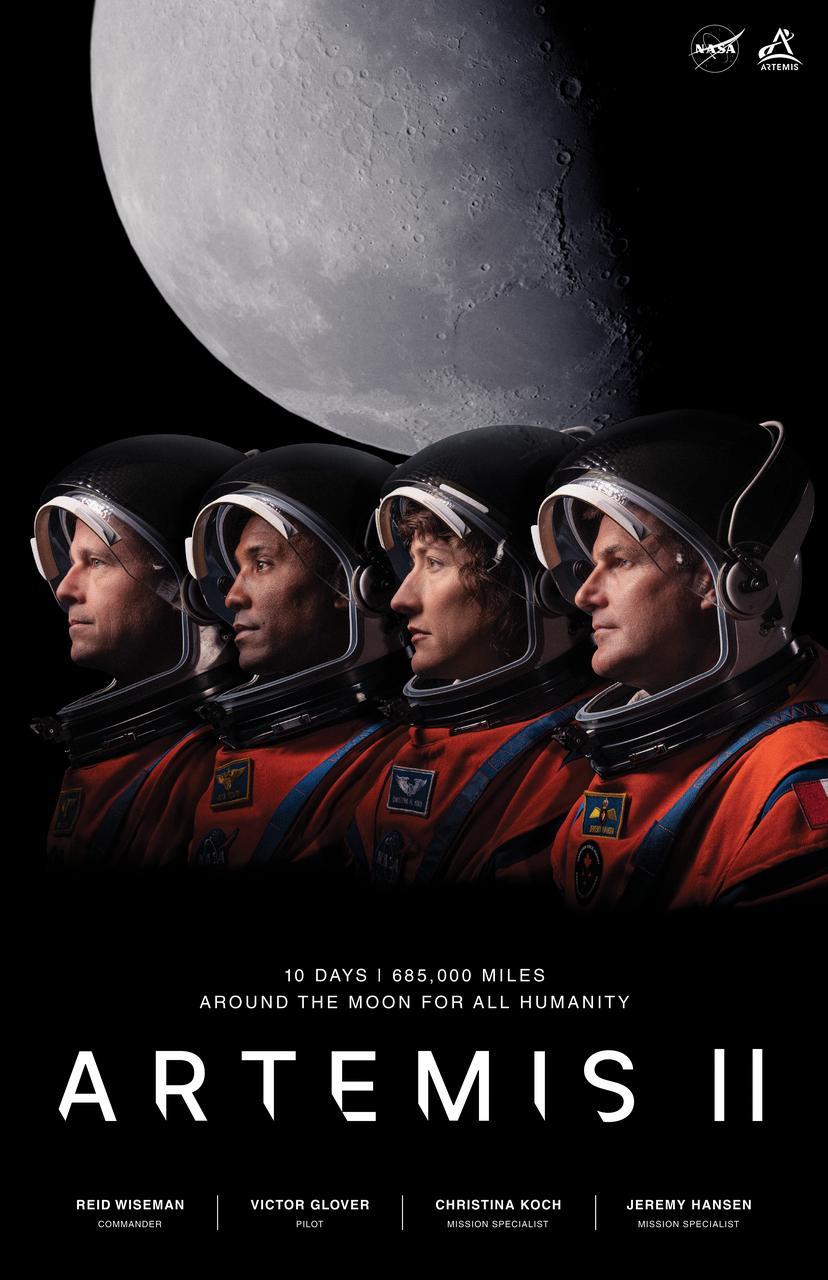
Artemis II Astronauts (NASA)
From left to right: Christina Koch, (rear) Victor Glover, (front) Reid Wiseman, Jeremy Hansen
Artemis II is NASA’s first crewed mission under the Artemis Program and consists of four astronauts. The crew is responsible for testing the Orion spacecraft under crewed flight conditions, validating life support and communication systems, and executing the free-return trajectory around the Moon. The Artemis II crew is the first human team sent beyond Earth orbit since the Apollo Program.
Reid Wiseman serves as commander of the Artemis II mission. Previously, he served as a flight engineer aboard the International Space Station during Expedition 40/41, spending over 165 days in space. During that mission, he conducted two spacewalks and participated in numerous scientific experiments.
In his NASA roles, Wiseman has also led the Astronaut Office. With Artemis II, he became the first astronaut to serve as commander on a crewed mission beyond the Moon since Apollo. His educational background includes computer and systems engineering, and his military aviation and test pilot experience directly align with Artemis II’s test-oriented mission structure.【19】
Victor Glover is the pilot of the Artemis II mission. He previously flew to the International Space Station aboard the SpaceX Crew-1 mission and served during Expedition 64, participating in four spacewalks.
With Artemis II, Glover becomes the first Black astronaut to travel beyond the Moon. He served as a test pilot in his military aviation career and has flown numerous aircraft types. His educational background includes engineering, flight test engineering, systems engineering, and military operational science.【20】 As pilot, his role is critical in testing Orion’s manual control, orientation, and close-proximity operations.【21】
Artemis II Crew (NASA)
Christina Koch serves as a mission specialist on the Artemis II crew. Previously, she served as a flight engineer aboard the International Space Station during Expedition 59, 60, and 61, spending a total of 328 days in space and setting the record for the longest single spaceflight by a woman. She also participated in the first all-female spacewalk in history.
With Artemis II, Koch becomes the first woman to travel beyond the Moon. Her educational and professional background includes electrical engineering, physics, and space science.【22】 During the mission, she is responsible for evaluating life support systems, monitoring onboard operations, and conducting technical tests.【23】
Jeremy Hansen is a mission specialist on the Artemis II crew and represents the Canadian Space Agency (CSA). Artemis II marks Hansen’s first spaceflight and makes him the first Canadian astronaut to travel beyond the Moon.
Following his selection as an astronaut, Hansen served as CAPCOM at NASA’s Mission Control Center and led teams responsible for astronaut training. He has also participated in NASA’s NEEMO missions in underwater environments and ESA’s CAVES program. His educational background includes space science and physics. During Artemis II, Hansen is responsible for onboard operations and system monitoring.【24】

Cross-sectional Schematic Showing Major Components of the SLS Rocket and the Orion Spacecraft Mounted on Top (NASA)
Space Launch System (SLS) is the heavy-lift launch vehicle designed to carry the Orion spacecraft and its crew beyond Earth orbit for the Artemis II mission. SLS is a super-heavy class rocket developed for crewed deep space missions and forms the core launch infrastructure of the Artemis Program. Artemis II holds a unique place in the system’s operational history as the first mission to use SLS with a crew.【25】
SLS features a modular, multi-stage architecture designed for deep space missions. The system consists of a core stage, two solid rocket boosters, and upper stage systems configurable according to mission requirements. The configuration used for Artemis II is tailored to meet the needs of crewed deep space flight.
The rocket is designed with high thrust capacity, extended burn duration, and structural safety standards required for crewed missions. For Artemis II, SLS provides the necessary energy and velocity profile to propel Orion from Earth orbit into a lunar transfer trajectory, serving as the primary vehicle for deep space transit.
The SLS core stage forms the primary structural backbone of the rocket and provides the majority of thrust during launch. Standing approximately 212 feet (about 64 meters) tall, it is the largest and heaviest component of the system. The core stage contains two main tanks holding over 733,000 gallons of supercooled liquid propellant to power four RS-25 engines.【26】
Structural components: The core stage includes liquid hydrogen and liquid oxygen tanks, the engine section, and integration structures such as the intertank and forward skirt. This structure is engineered to withstand extreme mechanical and thermal loads during launch and serves as the primary platform for transferring loads from all other components to the Orion spacecraft.【27】
Propellant systems: The propellant systems deliver over 733,000 gallons of supercooled liquid hydrogen and liquid oxygen in a controlled and continuous manner to the four RS-25 engines.【28】
For the Artemis II mission, these systems underwent comprehensive validation processes, including wet dress rehearsals, to identify potential technical risks before launch.【29】

Four RS-25 Engines Mounted on the SLS Rocket’s Core Stage (NASA)
The SLS core stage is powered by four RS-25 liquid-fueled engines. These engines were previously used in the Space Shuttle program and have been modernized for the Artemis Program. The RS-25 engines form the primary thrust source of SLS, offering high thrust efficiency and extended burn capability.
Artemis II is the first operational mission to use the RS-25 engines in a crewed deep space flight. Their performance, thrust control, and reliability will be evaluated under actual flight conditions during this mission.
Two identical solid rocket boosters, each approximately 177 feet (54 meters) long, are integrated on either side of the SLS core stage and provide more than 75 percent of the total thrust at liftoff. Each booster consists of five segments and, working in tandem with the core stage during initial ascent, propels the vehicle through the upper atmosphere.【30】
The solid rocket boosters play a critical role in overcoming Earth’s gravity during launch and are among the key determinants of SLS’s heavy-lift capacity.
SLS features a flexible architecture that allows configuration with different upper stage systems depending on mission requirements. For the Artemis II mission, the Block 1 configuration employs the Interim Cryogenic Propulsion Stage (ICPS) to propel the Orion spacecraft into lunar orbit.【31】 The ICPS performs the trans-lunar injection maneuver after Earth orbit departure, placing Orion on its transfer trajectory to the Moon.
For Artemis IV and subsequent missions, the Block 1B configuration will be introduced, featuring the more powerful Exploration Upper Stage (EUS).【32】 The EUS is designed to enable the transport of heavier payloads and the execution of more complex deep space missions.
SLS’s multi-stage architecture is assembled through integration components that enable seamless operation of different systems. Structural elements such as the Launch Vehicle Stage Adapter and Orion Stage Adapter ensure physical and functional integration between upper stages, the core stage, and propulsion systems.
These adapter systems facilitate both mechanical load transfer and electrical and data connectivity, enabling all components to operate as a unified, synchronized, and safe vehicle. In this way, the integration architecture is considered one of the fundamental technical elements ensuring SLS’s suitability for crewed deep space missions.
SLS’s avionics and flight control systems constitute an integrated digital control infrastructure that manages launch, ascent, attitude control, and stage separation. These systems perform guidance, navigation, and control (GNC) functions, continuously monitoring the rocket’s flight profile and automatically executing necessary corrections.
The avionics architecture consists of redundant computer systems, sensor networks, and communication interfaces designed to meet the critical requirements of fault tolerance and system continuity for crewed missions. Artemis II is the first flight in which these avionics systems will be fully operational in a crewed mission. The telemetry and performance data collected will serve as the primary reference for evaluating SLS’s operational reliability in future Artemis missions.

Schematic Diagram Showing Orion Spacecraft Components (NASA)
The Orion spacecraft is used in the Artemis II mission to safely transport, sustain life for, and return the crew beyond Earth orbit. Designed specifically for crewed deep space missions, Orion aims to validate systems tested during Artemis I under crewed flight conditions.
During Artemis II, Orion will be the first spacecraft to be fully active with a crew throughout all mission phases: post-launch elliptical orbits around Earth, entry into the free-return trajectory toward the Moon, lunar flyby, and return to Earth.
The mission’s objective is to test Orion’s life support systems, communication infrastructure, attitude and navigation systems, and crewed operational capabilities in the actual deep space environment. Artemis II is a critical step in validating Orion’s operational readiness for Artemis III and future missions.

Artemis II Astronauts in Front of the Orion Crew Module (NASA)
From left to right: Jeremy Hansen, Victor Glover, Reid Wiseman and Christina Hammock Koch
Orion’s crew module is the pressurized habitable volume where astronauts live and conduct all human operations during the mission. It is designed to protect the crew during launch, spaceflight, manual piloting, and atmospheric entry.【33】
During Artemis II, the crew module will be evaluated for ergonomics, visibility, control interfaces, and emergency accessibility. The astronauts will conduct external observations and manual flight tests using onboard windows and integrated cameras.
The European Service Module (ESM) provides propulsion, power, thermal control, and life support functions for the Orion spacecraft. Developed by the European Space Agency (ESA), the ESM enables Orion to operate independently during deep space missions.
During the Artemis II mission, the ESM provides the thrust required for the trans-lunar injection maneuver, generates electrical power via solar arrays, maintains thermal balance, and supplies oxygen and water to the life support systems.【34】
Orion’s Environmental Control and Life Support System (ECLSS) will be fully tested with a crew for the first time during Artemis II. The system performs essential life functions including breathable air generation, carbon dioxide and humidity removal, and temperature and pressure control.

Sleeping Bag Configurations Used in Orion Spacecraft Mockup for Artemis II Astronaut Training (NASA)
During the mission, ECLSS will be tested under varying metabolic loads, during sleep and exercise periods, and during transitions from suit mode to cabin mode. These evaluations aim to validate the system’s scalability for longer-duration lunar and Mars missions.【35】
Orion’s heat shield is designed to withstand the extreme velocities and thermal loads generated during return from deep space. During Artemis II, Orion will re-enter Earth’s atmosphere at lunar return velocities, and the performance of its heat shield will be evaluated.
The skip entry profile planned for this mission enables the spacecraft to interact with the atmosphere multiple times, distributing thermal and structural loads more evenly. This flight profile allows for the operational validation of Orion’s heat shield and aerodynamic systems under high-speed conditions.【36】
Artemis II will be the first crewed mission to test Orion’s manual control capabilities in space.【37】 The crew will manually engage the spacecraft during close-proximity operations with the ICPS upper stage in Earth orbit to conduct orientation and positioning tests.
These piloting activities will evaluate Orion’s control software, hardware interfaces, and human-machine interaction. The data collected will serve as a reference for future lunar orbit operations and docking maneuvers during Artemis III and subsequent missions.
The communication and data systems used during the Artemis II mission are configured to ensure continuous, reliable, and high-accuracy data transmission required for crewed deep space flight. These systems encompass both traditional radio frequency communication infrastructure and advanced optical communication solutions. Throughout the mission, this infrastructure ensures continuous communication between the spacecraft and ground stations and facilitates mission data transfer.
The Artemis II mission uses traditional communication infrastructure as its primary means of communication. This infrastructure consists of systems operating via radio frequencies that enable two-way data transmission between the spacecraft and ground stations on Earth.【38】
Traditional communication systems are used for voice communication, telemetry data, command transmission, and mission status updates. Continuous communication between the crew and mission control centers is maintained through this infrastructure. During Artemis II, these systems are being evaluated for their ability to sustain long-duration, uninterrupted operation beyond Earth orbit.
This infrastructure enables real-time or delayed transmission of critical data such as spacecraft orientation, system status, and environmental measurements to Earth. Artemis II serves as a mission to validate the sufficiency of these communication systems for crewed operations in deep space.

Ground Testing of Orion’s Optical (Laser) Communication System Before Integration into the Capsule (NASA)
Alongside the traditional communication infrastructure, the Artemis II mission is also testing an optical communication system. Optical communication is an advanced technology based on laser-based data transmission, aiming to deliver high data volumes through a narrower beam.【39】
This system was developed to meet the growing data demands of deep space missions and is being tested in an operational environment during Artemis II.
The optical communication system consists of a laser transmission unit on the Orion spacecraft, precise pointing and targeting components, and ground-based optical receiving stations. The system on the spacecraft is integrated with orientation and stabilization mechanisms to ensure accurate laser signal transmission.
Ground-based optical receivers detect laser signals from space, decode the data, and transfer it to terrestrial communication networks. This structure represents a new technological approach to space-Earth communication.
Optical communication systems offer significantly higher data transfer potential than radio frequency systems. During Artemis II, this system provides a test environment for the more efficient transmission of high-volume mission data, imagery, and technical measurements.
Results from the mission will contribute to evaluating the feasibility of optical communication for future lunar and Mars missions. Artemis II represents a critical validation phase for applying this technology to crewed deep space missions.
The Artemis II mission has been supported by comprehensive testing and validation processes due to its status as the first crewed mission of the Artemis Program. These processes aim to verify the suitability of launch systems, the spacecraft, life support infrastructure, and crewed operations under actual mission conditions. Tests are structured to cover both pre-launch preparations and systems to be validated during the mission.
Pre-flight tests constitute a comprehensive technical preparation process essential for the safe execution of the Artemis II mission. During this phase, the Space Launch System (SLS) rocket, Orion spacecraft, and ground support systems were tested as an integrated whole. Tests focused on hardware integration, software validation, and the applicability of operational procedures.
These tests included system integration checks, launch sequence simulations, and operational coordination exercises between ground teams and flight control centers. The pre-flight tests aimed to confirm that all components function correctly according to the mission profile.
As Artemis II is the first mission to use the Orion spacecraft with a crew, crewed system validations hold critical importance. These validations cover life support systems, cabin pressure, temperature control, communication infrastructure, and human-machine interfaces.
Orion’s heat shield is one of the most critical components validated during Artemis II. The extreme velocities and thermal loads generated during return from deep space directly impact the heat shield’s performance. Therefore, the heat shield is evaluated through pre-flight ground tests and the atmospheric entry during the mission.

Pre-Flight Ground Tests of RS-25 Engines at Stennis Space Center (NASA)
The Artemis II mission enables the heat shield to be tested under actual mission conditions through atmospheric entry at lunar return velocities. The planned skip entry profile allows for controlled distribution of thermal loads and generates data validating the shield’s durability.
The crew evaluates the operational adequacy of spacecraft systems through direct interaction before and during the mission. Manual control modes, emergency scenarios, and onboard procedures are tested within this framework. This validation process aims to ensure that systems can be operated safely and sustainably during crewed deep space missions.
Pre-launch propellant loading tests and countdown simulations aim to identify potential risks in advance. Safety tests also evaluated emergency procedures, escape systems, and ground support team intervention plans. These processes aim to ensure that Artemis II is conducted with the highest safety standards for a crewed mission.

Launch Availability Calendar for Early 2026 for the Artemis II Mission (NASA)
(Green days indicate technically viable launch windows)
The preparation process for the Artemis II mission is conducted within a multi-phase planning framework aligned with the safety and system validation standards required for a crewed deep space flight. This process aims to test both the spacecraft systems and ground support infrastructure under scenarios closely resembling actual flight conditions.
The planned launch time for the Artemis II mission was determined based on the readiness of the Space Launch System (SLS) rocket, the Orion spacecraft, and ground support infrastructure. As NASA’s first crewed deep space mission, the launch was scheduled to occur only after all systems had been fully tested and validated. Accordingly, the launch date was shaped not only by operational timelines but also by safety and technical readiness criteria.
The earliest planned launch date was initially set for 6 February 2026, but technical issues identified during comprehensive pre-launch tests prompted a revision of the schedule. In particular, anomalies detected during the January wet dress rehearsal in the propellant loading process necessitated a delay to a later date.
The Artemis II launch schedule has been updated based on technical findings from pre-launch testing and validation. The planned launch window in February 2026 was canceled due to a liquid hydrogen leak in the fueling system, technical corrections to certain Orion hardware components, and communication issues with ground equipment.【40】 Additionally, unusual cold weather conditions at Kennedy Space Center hindered the planned progress of test operations.
Following these developments, NASA management, prioritizing crew safety, revised the launch schedule. The planned March 2026 window was canceled; due to a helium leak detected in the rocket’s upper stage, the launch vehicle was rolled back from the launch pad to the Vehicle Assembly Building (VAB) at Kennedy Space Center for repairs. After evaluation, the new target launch date was announced as 1 April 2026 (or early April).【41】
Operational preparations constitute the final phase before launch and represent the transition of scheduling into practical execution. During this phase, intensive coordination occurred between the crew, flight control teams, and ground support personnel. Simulations, mission scenarios, and emergency procedures were used to test potential risks in advance. These preparations aim to evaluate not only nominal mission flow but also system responses to unexpected events.

Emergency Scenario Simulations (NASA)
In addition, spacecraft integration, launch pad operations, countdown procedures, and propellant and safety tests are key components of operational preparations. Leak-tightness of liquid propellant systems, integrity of pressurized lines, and reliable operation of ground infrastructure are decisive technical criteria for finalizing the launch schedule. In this way, operational preparations demonstrate that Artemis II is not merely a timeline but a institutional and technical threshold to crewed deep space flight.
Artemis II serves as a transitional mission that establishes the foundation for subsequent phases of the Artemis Program. The technical and operational data collected during this mission will be directly used in planning future crewed lunar missions.
Artemis II is positioned as a critical validation step before the planned crewed lunar landing of Artemis III. The crewed flight systems, Orion spacecraft performance, and human operations procedures to be used in Artemis III are being tested during Artemis II.
Data from this mission enables adaptation of flight safety, life support systems, and crewed control capabilities for Artemis III. Thus, Artemis II serves as an intermediate step in transitioning to crewed surface operations on the Moon.【42】

Official Mission Patch of the Artemis II Crew (NASA)
Artemis II provides operational experience for crewed flights around the Moon. Navigation, communication, and flight dynamics in lunar orbit are being evaluated during this mission and will form the basis for future infrastructure planning.
In this context, Artemis II contributes to building the technical knowledge base required for sustainable human activities around the Moon.【43】
Artemis II is regarded as a critical intermediate step in the long-term goals of the Artemis Program. The mission holds a central position in the restart of crewed deep space flight and its transformation into a sustainable program.
The experience gained from Artemis II will not be limited to lunar missions but will also serve as a reference for planning longer-duration and more distant crewed space missions.
The Artemis II mission is planned as part of the Artemis Program’s framework of international cooperation. The program’s framework envisions civil space activities being conducted within a multilateral structure guided by legal, operational, and technical principles. In this context, Artemis II is both an implementation of these principles and a mission embodying international contributions.
Artemis Accords are a set of multilateral framework documents establishing the foundational principles and norms for civil space activities under the Artemis Program.【44】 These accords emphasize peaceful purposes, transparency, cooperation, and mutual information sharing in space activities.
The Artemis Accords define principles such as sharing scientific data, registering space objects, emergency assistance, and accountability in space activities. They also aim to ensure that activities on the Moon and other celestial bodies are conducted in accordance with international law. This framework seeks to establish a common operational and legal foundation among participating nations.

European Service Module (ESM) of the Orion Spacecraft Used in Artemis II (NASA)
The Artemis II mission, planned and executed under these accords, represents the operational application of these principles.
The Artemis II mission is conducted with contributions from different countries and international institutions. The spacecraft systems and crew composition reflect concrete examples of this multilateral cooperation.
The European Space Agency (ESA) provides technical contribution to Artemis II through the European Service Module, which provides essential functions such as propulsion, power generation, thermal control, and life support. ESA’s contribution demonstrates that international cooperation is a central element in the technical infrastructure of the Artemis Program.【45】
Additionally, the presence of a Canadian astronaut on the Artemis II crew demonstrates the international nature of the mission from a human resources perspective. This underscores that the Artemis Program is built not only on technical collaboration but also on a multinational operational structure.
In this regard, Artemis II stands as an example mission demonstrating the feasibility and sustainability of international cooperation in crewed deep space missions.

61 Countries that Have Signed the Artemis Accords (NASA)
International cooperation under the Artemis Program is structured through the Artemis Accords, a multilateral framework initiated by the United States and expanded through participation by multiple nations.
Signatory nations include, alongside the United States, Germany, Angola, Argentina, Australia, Austria, Bahrain, Bangladesh, Belgium, United Arab Emirates, United Kingdom, Brazil, Bulgaria, Czechia, Denmark, Dominican Republic, Ecuador, Armenia, Estonia, Philippines, Finland, France, South Korea, India, Netherlands, Israel, Spain, Sweden, Switzerland, Italy, Iceland, Japan, Canada, Colombia, Cyprus, Liechtenstein, Lithuania, Luxembourg, Hungary, Malaysia, Mexico, Nigeria, Norway, Panama, Peru, Poland, Portugal, Romania, Rwanda, Senegal, Singapore, Slovakia, Slovenia, Saudi Arabia, Chile, Thailand, Ukraine, Oman, Uruguay, New Zealand, and Greece.【46】
These nations have agreed to adhere to common principles in technical contributions, scientific cooperation, data sharing, and operational coordination within the Artemis Program. Artemis II is positioned within the program as one of the missions applying this international framework to crewed spaceflight.

Artemis II Launch (NASA)
The Artemis II mission successfully launched on 1 April 2026 at 18:35 Eastern Daylight Time from Launch Complex 39B at NASA’s Kennedy Space Center in Florida.【47】 The mission was carried out as a crewed flight using NASA’s Space Launch System (SLS) rocket and Orion spacecraft, marking the beginning of a critical test flight carrying four astronauts into deep space.
The mission is structured as a comprehensive test flight lasting approximately 10 days. After launch, the Orion spacecraft entered Earth orbit and conducted system checks before performing a series of orbital maneuvers to optimize its trajectory, including perigee and apogee raising tests.
Following this initial phase, the Trans-Lunar Injection (TLI) maneuver was executed. This critical engine burn separated the spacecraft from Earth orbit and placed it on a free-return trajectory that leverages the Moon’s gravitational influence. Although this trajectory naturally directs the spacecraft back toward Earth, minor trajectory correction maneuvers (small additional burns) are required to fine-tune the return path.【48】
According to the mission plan, the crew will reach the far side of the Moon on 6 April, becoming the crew with the greatest distance traveled from Earth in human spaceflight history. During this transit, the far side will not be completely dark but will receive partial sunlight. The mission’s final phase is planned for Orion’s parachute-assisted splashdown in the Pacific Ocean on 10 April.
Various technical anomalies occurred before and during the Artemis II mission. Prior to launch, a disruption in helium flow in the rocket’s upper stage caused the mission to be delayed from March to April. To resolve this issue, the rocket was rolled back from the launch pad to the Vehicle Assembly Building for repairs.
During the countdown, a high-temperature alert was triggered in one of the Launch Abort System (LAS) batteries, but it was determined to be an instrumentation error and the launch proceeded. A brief technical issue with the Flight Termination System (FTS) was also resolved, allowing the mission to continue without interruption.
After achieving orbit, technical issues emerged aboard Orion. The crew encountered a fan malfunction in the waste management system, which was addressed in coordination with ground control. Additionally, a fault occurred in the helium pressurization system of the service module’s propulsion system, but the system was quickly switched to a backup unit to ensure mission safety. The crew also addressed a minor water valve issue.
Artemis II Countdown and Launch Moment (CNN)
The launch and flight phases of the Artemis II mission were broadcast live through NASA’s official platforms. Broadcasts under the title “NASA's Artemis II Live Mission Coverage (Official Broadcast)” on NASA+, YouTube, and other digital channels enabled global public access to the mission.
In addition, space journalism platforms used NASA’s live broadcast feed to support the mission with real-time blog content, photographs, and videos. Images and videos of Earth and space captured by the astronauts from inside the spacecraft were also shared with the public via NASA’s social media accounts.
During the Artemis II mission, the crew will reach a distance of 406,773 kilometers from Earth while flying around the far side of the Moon, setting a new record for the farthest human spaceflight. This distance surpasses the previous record of 400,171 kilometers set by the Apollo 13 crew in 1970. Thus, the Artemis II crew will become the farthest-traveling humans in history.【49】

New Images Captured During the Artemis II Mission (NASA)
The Artemis II mission includes various scientific experiments aimed at studying the effects of deep space conditions on humans and preparing for future lunar missions. In this context, the crew’s sleep patterns, mobility, and general physiological responses are being closely monitored.
AVATAR Project experiments use “organ-on-a-chip” technology to analyze biological responses at the cellular level. This method investigates the effects of deep space radiation and microgravity on human DNA.
The mission also tests shelter systems designed to protect against space radiation and evaluates protection mechanisms against potential solar storms. Additionally, exercise equipment designed for zero-gravity environments is being tested to collect data for long-duration missions.【50】
The Artemis II crew will conduct detailed observations of the Moon’s far side during its close flyby. High-resolution photographs and videos of regions never directly observed by the human eye will be captured.
The partial illumination of lunar terrain features such as crater rims, slopes, ridges, and depressions will allow for detailed geological analysis. These data will be used to inform planning for future Artemis III landing missions.
During the mission, the ICPS upper stage deployed four CubeSats developed by different countries. Argentina, Germany, South Korea, and Saudi Arabia each contributed a small satellite for scientific research and technology demonstration. This activity is regarded as a significant operational initiative under international cooperation.
On 6 April 2026, during the mission phase, the four-person Artemis II crew reached a distance of 252,756 miles (approximately 406,000 kilometers) from Earth, setting a new record for the farthest human spaceflight. This distance surpasses the previous record of approximately 248,000 miles set by the Apollo 13 crew in 1970.
On the sixth day of the mission, the Orion spacecraft completed a six-hour flight around the far side of the Moon. During this transit, the spacecraft approached within 4,070 miles (6,550 kilometers) of the lunar surface. Throughout the flyby, the crew directly observed “impact flashes” — brief luminous events caused by meteoroid impacts — on the Moon’s dark surface. These observations were recorded simultaneously by scientists at NASA’s Johnson Space Center.
The data collected during the mission include visual and scientific evidence demonstrating that the lunar surface is actively bombarded by meteorites. The crew also proposed temporary names for previously unclassified craters, including “Integrity” after the Orion capsule and “Carroll” in memory of Commander Wiseman’s late wife.
During the lunar far side transit, the spacecraft experienced approximately 40 minutes of communication blackout, during which signals from Earth were blocked by the Moon’s mass.
Images captured during the flight recorded the rare perspective of Earth rising and setting over the lunar horizon. This phenomenon can only be directly observed by crews from the Apollo and Artemis programs.
ABC News. “NASA's Artemis II Moon Mission Delayed to March. Here's What You Need to Know.” Accessed February 10, 2026. https://www.abc.net.au/news/science/2026-02-04/artemis-2-mission-delayed-hydrogen-leak/106302956.
Adkison, Michael. “Artemis II’s Lunar Mission is Delayed to March After Problems in NASA’s Dress Rehearsal.” Houston Public Media, February 3, 2026. Accessed February 10, 2026. https://www.houstonpublicmedia.org/articles/news/nasa/2026/02/03/542379/moon-nasa-artemis-2-launch-delay/
BBC News Türkçe. “NASA'nın 50 yıl sonraki ilk insanlı Ay seyahati ne zaman başlıyor?” Accessed February 7, 2026. https://www.bbc.com/turkce/articles/c0r40zvpy55o.
Boeing. “NASA's Artemis I Mission, powered by Boeing-built Space Launch System Rocket, is Complete.” YouTube, 12 December 2022. Accessed February 10, 2026. https://www.youtube.com/watch?v=LDbHFXqeOhQ.
CNN. "Artemis II countdown & launch: Full liftoff video." YouTube. Accessed April 4, 2026. https://www.youtube.com/watch?v=PGBoVotHqIE
Costa, Jason. “Artemis II Wet Dress Rehearsal: Core Stage Slow Fill Begins.” NASA Missions, February 2, 2026. Accessed February 7, 2026. https://www.nasa.gov/blogs/missions/2026/02/02/artemis-ii-wet-dress-rehearsal-core-stage-slow-fill-begins/
Costa, Jason. “NASA Stacks First Artemis II Segment on Mobile Launcher.” NASA Missions. Accessed February 7, 2026. https://www.nasa.gov/blogs/artemis/2024/11/20/nasa-stacks-first-artemis-ii-segment-on-mobile-launcher/.
Dean, Brandi. “Artemis II Wet Dress Rehearsal: Test Terminated at T-5:15.” NASA Missions, February 3, 2026. Accessed February 7, 2026. https://www.nasa.gov/blogs/missions/2026/02/03/artemis-ii-wet-dress-rehearsal-test-terminated-at-t-515/
Deutsches Zentrum für Luft- und Raumfahrt (DLR). "Artemis II – Small German Satellite to Fly to the Moon." Accessed February 8, 2026. https://www.dlr.de/en/latest/news/2024/artemis-ii-small-german-satellite-to-fly-to-the-moon.
Donaldson, Abbey A. “NASA Shares Orion Heat Shield Findings, Updates Artemis Moon Missions.” NASA, December 5, 2024. Accessed February 7, 2026. https://www.nasa.gov/news-release/nasa-shares-orion-heat-shield-findings-updates-artemis-moon-missions/
Hambleton, Kathryn and Catherine E. Williams. “NASA’s Artemis IV: Building First Lunar Space Station.” NASA, March 29, 2024. Accessed February 7, 2026. https://www.nasa.gov/general/nasas-artemis-iv-building-first-lunar-space-station/
Hambleton, Kathryn. “NASA’s Deep Space Exploration System is Coming Together.” NASA, March 8, 2019. Accessed February 7, 2026. https://www.nasa.gov/missions/artemis/orion/nasas-deep-space-exploration-system-is-coming-together/
Hambleton, Kathryn. “NASA’s First Flight With Crew Important Step on Long-term Return to the Moon, Missions to Mars.” NASA, April 8, 2025. Accessed February 7, 2026. https://www.nasa.gov/missions/artemis/nasas-first-flight-with-crew-important-step-on-long-term-return-to-the-moon-missions-to-mars/
Kennedy Space Center. "ARTEMIS II - Sending Humans Back to the Moon." Accessed April 4, 2026. https://www.kennedyspacecenter.com/landing-pages/artemis-ii/
Kennedy Space Center. "NASA Space Launch System (SLS) Artemis II." Accessed February 26, 2026. https://www.kennedyspacecenter.com/event/nasa-space-launch-system-sls-artemis-ii/.
Kraft, Rachel H. “NASA Conducts Artemis II Fuel Test, Eyes March for Launch Opportunity.” NASA Missions, February 3, 2026. Accessed February 7, 2026. https://www.nasa.gov/blogs/missions/2026/02/03/nasa-conducts-artemis-ii-fuel-test-eyes-march-for-launch-opportunity/
Kraft, Rachel H. “NASA Signs Agreement with Argentina’s Space Agency for Artemis II CubeSat.” NASA Missions, May 20, 2025. Accessed February 7, 2026. https://www.nasa.gov/blogs/missions/2025/05/20/nasa-signs-agreement-with-argentinas-space-agency-for-artemis-ii-cubesat/
Kraft, Rachel H. “NASA to Fly International CubeSats Aboard Artemis II Test Flight.” NASA Missions, September 20, 2024. Accessed February 7, 2026. https://www.nasa.gov/blogs/missions/2024/09/20/nasa-to-fly-international-cubesats-aboard-artemis-ii-test-flight/
Kraft, Rachel H. “Orion Spacecraft to Test New Entry Technique on Artemis I Mission.” NASA, April 8, 2021. Accessed February 7, 2026. https://www.nasa.gov/missions/orion-spacecraft-to-test-new-entry-technique-on-artemis-i-mission/
Luabeya, Monika. “Artemis II Core Stage on the Move.” NASA, July 18, 2024. Accessed February 7, 2026. https://www.nasa.gov/image-article/artemis-ii-core-stage-on-the-move/
Mohon Lee and Catherine E. Williams. “Artemis III: NASA’s First Human Mission to Lunar South Pole.” NASA, January 12, 2023. Accessed February 7, 2026. https://www.nasa.gov/missions/artemis/artemis-iii/
Mohon, Lee. “All Engines Added to NASA’s Artemis II Moon Rocket Core Stage.” NASA Missions, September 25, 2023. Accessed February 7, 2026. https://www.nasa.gov/blogs/artemis/2023/09/25/all-engines-added-to-nasas-artemis-ii-moon-rocket-core-stage/
Mohon, Lee. “Six Adapters for Crewed Artemis Flights Tested, Built at NASA Marshall.” NASA, June 25, 2024. Accessed February 7, 2026. https://www.nasa.gov/centers-and-facilities/marshall/six-adapters-for-crewed-artemis-flights-tested-built-at-nasa-marshall/
Murphy, Kendall. “Lasers Light the Way for Artemis II Moon Mission.” NASA Exploration Communications, June 3, 2021. Accessed February 7, 2026. https://esc.gsfc.nasa.gov/news/Lasers_Light_the_Way_for_Artemis_II_Moon_Mission
NASA. "Artemis II Flight Update: Perigee Raise Burn Complete." Missions. April 2, 2026. Accessed April 4, 2026. https://www.nasa.gov/blogs/missions/2026/04/02/artemis-ii-flight-update-perigee-raise-burn-complete/
NASA. "Artemis II Launch." NASA Gallery. Accessed April 4, 2026. https://www.nasa.gov/gallery/artemis-ii-launch/
NASA. "Artemis II Mission Availability – Early 2026." Information note. Accessed February 6, 2026. https://www.nasa.gov/wp-content/uploads/2026/01/artemis-ii-mission-availability.pdf?emrc=51eb50
NASA. "Artemis II Reference Guide." Accessed February 5, 2026. https://www.nasa.gov/wp-content/uploads/2026/01/a2-reference-guide-012825.pdf.
NASA. "Journey to the Moon." NASA Gallery. Accessed April 4, 2026. https://www.nasa.gov/gallery/journey-to-the-moon/.
NASA. "Liftoff! NASA Launches Astronauts on Historic Artemis Moon Mission." NASA News Bulletin. Accessed April 4, 2026. https://www.nasa.gov/news-release/liftoff-nasa-launches-astronauts-on-historic-artemis-moon-mission/
NASA. "Share Your NASAMoonCrew and Get Excited for Artemis II." January 26, 2026. Accessed February 11, 2026. https://images.nasa.gov/details/Share%20Your%20NASAMoonCrew%20and%20Get%20Excited%20for%20Artemis%20II.
NASA. "Space Launch System Engines: Launching Artemis Astronauts to the Moon." Accessed February 6, 2026. https://www.nasa.gov/image-article/space-launch-system-engines-launching-artemis-astronauts-moon/.
NASA. "The Apollo Lunar Surface Journal and Apollo Flight Journal." Accessed February 6, 2026. https://www.nasa.gov/history/alsj-and-afj/.
NASA. "The Official Artemis II Mission Crew Patch." NASA Image and Video Library, Accessed February 11, 2026. https://images.nasa.gov/details/jsc2025e034457
NASA. “Artemis II Astronauts.” NASA, Photo Gallery. Accessed February 6, 2026. https://www.nasa.gov/gallery/artemis-ii-astronauts/.
NASA. “Artemis II Day of Launch Demonstration Test ISVV-A1.” Photograph. Accessed February 6, 2026. https://www.nasa.gov/image-detail/afs-8-101-1050/.
NASA. “Artemis II Map.” Accessed February 6, 2026. https://www.nasa.gov/image-article/artemis-ii-map-2/
NASA. “Artemis.” Accessed February 5, 2026. https://www.nasa.gov/humans-in-space/artemis/.
NASA. “Principles for a Safe, Peaceful, and Prosperous Future in Space: The Artemis Accords.” Accessed February 6, 2026. https://www.nasa.gov/artemis-accords/.
NBC News. “Going the Farthest.” Accessed February 7, 2026. https://www.nbcnews.com/science/space/nasa-moon-astronauts-artemis-ii-mission-rcna255621
O’Neal, Daniel. "Artemis II Crew Poster." NASA, July 25, 2024. Accessed February 11, 2026. https://images.nasa.gov/details/ArtemisIICrewPoster.
Reuters. “Artemis II Moon Crew Flies Farther Than Humans Have Ever Gone Before.” Accessed April 7, 2026. https://www.reuters.com/science/artemis-crew-reaches-moon-approaches-record-breaking-distance-earth-2026-04-06/
Space.com. "Artemis 2 LIVE: Artemis 2 astronauts will break Apollo 13 distance record at moon." Accessed April 4, 2026. https://www.space.com/news/live/artemis-2-nasa-moon-mission-launch-updates-april-3-2026
Stamm, Amy. “Meet the Crew of Artemis II.” National Air and Space Museum, Smithsonian, March 3, 2023. Accessed February 7, 2026. https://airandspace.si.edu/stories/editorial/meet-crew-artemis-ii
The European Space Agency (ESA). “Artemis I.” Science and Exploration. Accessed February 6, 2026. https://www.esa.int/Science_Exploration/Human_and_Robotic_Exploration/Orion/Artemis_I.
The European Space Agency (ESA). “Artemis II.” Science Exploration. Accessed February 6, 2026. https://www.esa.int/Science_Exploration/Human_and_Robotic_Exploration/Orion/Artemis_II
The Planetary Society. "Artemis II mission: What to expect (Live mission updates)." Accessed April 4, 2026. https://www.planetary.org/articles/artemis-ii-what-to-expect.
[1]
Kathryn Hambleton, “NASA’s First Flight With Crew Important Step on Long-term Return to the Moon, Missions to Mars,” NASA, 8 April 2025,https://www.nasa.gov/missions/artemis/nasas-first-flight-with-crew-important-step-on-long-term-return-to-the-moon-missions-to-mars/.
[2]
Abbey A. Donaldson, “NASA Shares Orion Heat Shield Findings, Updates Artemis Moon Missions,” NASA, 5 December 2024, https://www.nasa.gov/news-release/nasa-shares-orion-heat-shield-findings-updates-artemis-moon-missions/.
[3]
Pallab Ghosh ve Alison Francis, “NASA'nın 50 yıl sonraki ilk insanlı Ay seyahati ne zaman başlıyor?,” BBC News Türkçe, 24 January 2026, https://www.bbc.com/turkce/articles/c0r40zvpy55o.
[4]
Deutsches Zentrum für Luft- und Raumfahrt (DLR), “Artemis II – Small German Satellite to Fly to the Moon,” DLR, 18 September 2024, https://www.dlr.de/en/latest/news/2024/artemis-ii-small-german-satellite-to-fly-to-the-moon.
[5]
Lee Mohon, “All Engines Added to NASA’s Artemis II Moon Rocket Core Stage,” NASA Missions (blog), 25 September 2023, https://www.nasa.gov/blogs/artemis/2023/09/25/all-engines-added-to-nasas-artemis-ii-moon-rocket-core-stage/.
[6]
European Space Agency (ESA), “Artemis I,” Science & Exploration, accessed 6 February 2026, https://www.esa.int/Science_Exploration/Human_and_Robotic_Exploration/Orion/Artemis_I.
[7]
European Space Agency (ESA), “Artemis II,” Science & Exploration, accessed 6 February 2026, https://www.esa.int/Science_Exploration/Human_and_Robotic_Exploration/Orion/Artemis_II
[8]
Lee Mohon ve Catherine E. Williams, “Artemis III: NASA’s First Human Mission to Lunar South Pole,” NASA, 12 January 2023, https://www.nasa.gov/missions/artemis/artemis-iii/.
[9]
Kathryn Hambleton ve Catherine E. Williams, “NASA’s Artemis IV: Building First Lunar Space Station,” NASA, 29 March 2024,https://www.nasa.gov/general/nasas-artemis-iv-building-first-lunar-space-station/.
[10]
Kathryn Hambleton, “NASA’s First Flight With Crew Important Step on Long-term Return to the Moon, Missions to Mars,” NASA, 8 April 2025, https://www.nasa.gov/missions/artemis/nasas-first-flight-with-crew-important-step-on-long-term-return-to-the-moon-missions-to-mars/.
[11]
Michael Adkison, “Artemis II’s Lunar Mission is Delayed to March After Problems in NASA’s Dress Rehearsal,” Houston Public Media, 3 February 2026, https://www.houstonpublicmedia.org/articles/news/nasa/2026/02/03/542379/moon-nasa-artemis-2-launch-delay/.
[12]
European Space Agency (ESA), “Artemis II,” Science & Exploration, accessed 6 February 2026, https://www.esa.int/Science_Exploration/Human_and_Robotic_Exploration/Orion/Artemis_II
[13]
NASA, “Principles for a Safe, Peaceful, and Prosperous Future in Space (Artemis Accords),” accessed 6 February 2026, https://www.nasa.gov/artemis-accords/.
[14]
European Space Agency (ESA), “Artemis II,” Science & Exploration, accessed 6 February 2026, https://www.esa.int/Science_Exploration/Human_and_Robotic_Exploration/Orion/Artemis_II
[15]
Kathryn Hambleton, “NASA’s First Flight With Crew Important Step on Long-term Return to the Moon, Missions to Mars,” NASA, 8 April 2025, https://www.nasa.gov/missions/artemis/nasas-first-flight-with-crew-important-step-on-long-term-return-to-the-moon-missions-to-mars/.
[16]
Jacinta Bowler, “NASA's Artemis II Moon Mission Delayed to March. Here's What You Need to Know,” ABC News, 4 February 2026, https://www.abc.net.au/news/science/2026-02-04/artemis-2-mission-delayed-hydrogen-leak/106302956/.
[17]
Amy Stamm, “Meet the Crew of Artemis II,” National Air and Space Museum, Smithsonian, 3 April 2023, https://airandspace.si.edu/stories/editorial/meet-crew-artemis-ii.
[18]
Abbey A. Donaldson, “NASA Shares Orion Heat Shield Findings, Updates Artemis Moon Missions,” NASA, 5 December 2024, https://www.nasa.gov/news-release/nasa-shares-orion-heat-shield-findings-updates-artemis-moon-missions/.
[19]
Amy Stamm, “Meet the Crew of Artemis II,” National Air and Space Museum, Smithsonian, 3 April 2023, https://airandspace.si.edu/stories/editorial/meet-crew-artemis-ii.
[20]
Amy Stamm, “Meet the Crew of Artemis II,” National Air and Space Museum, Smithsonian, 3 April 2023, https://airandspace.si.edu/stories/editorial/meet-crew-artemis-ii.
[21]
European Space Agency (ESA), “Artemis II,” Science & Exploration, accessed 6 February 2026, https://www.esa.int/Science_Exploration/Human_and_Robotic_Exploration/Orion/Artemis_II
[22]
Amy Stamm, “Meet the Crew of Artemis II,” National Air and Space Museum, Smithsonian, 3 April 2023, https://airandspace.si.edu/stories/editorial/meet-crew-artemis-ii.
[23]
Abbey A. Donaldson, “NASA Shares Orion Heat Shield Findings, Updates Artemis Moon Missions,” NASA, 5 December 2024, https://www.nasa.gov/news-release/nasa-shares-orion-heat-shield-findings-updates-artemis-moon-missions/.
[24]
Amy Stamm, “Meet the Crew of Artemis II,” National Air and Space Museum, Smithsonian, 3 April 2023, https://airandspace.si.edu/stories/editorial/meet-crew-artemis-ii.
[25]
Amy Stamm, “Meet the Crew of Artemis II,” National Air and Space Museum, Smithsonian, 3 April 2023, https://airandspace.si.edu/stories/editorial/meet-crew-artemis-ii.
[26]
Lee Mohon, “All Engines Added to NASA’s Artemis II Moon Rocket Core Stage,” NASA Missions (blog), 25 September 2023, https://www.nasa.gov/blogs/artemis/2023/09/25/all-engines-added-to-nasas-artemis-ii-moon-rocket-core-stage/.
[27]
Lee Mohon, “All Engines Added to NASA’s Artemis II Moon Rocket Core Stage,” NASA Missions (blog), 25 September 2023, https://www.nasa.gov/blogs/artemis/2023/09/25/all-engines-added-to-nasas-artemis-ii-moon-rocket-core-stage/.
[28]
Lee Mohon, “All Engines Added to NASA’s Artemis II Moon Rocket Core Stage,” NASA Missions (blog), 25 September 2023, https://www.nasa.gov/blogs/artemis/2023/09/25/all-engines-added-to-nasas-artemis-ii-moon-rocket-core-stage/.
[29]
Jason Costa, “Artemis II Wet Dress Rehearsal: Core Stage Slow Fill Begins,” NASA Missions (blog), 2 February 2026, https://www.nasa.gov/blogs/missions/2026/02/02/artemis-ii-wet-dress-rehearsal-core-stage-slow-fill-begins/.
[30]
Jason Costa, “NASA Stacks First Artemis II Segment on Mobile Launcher,” NASA Missions (blog), 20 November 2024,https://www.nasa.gov/blogs/artemis/2024/11/20/nasa-stacks-first-artemis-ii-segment-on-mobile-launcher/.
[31]
Kathryn Hambleton, “NASA’s First Flight With Crew Important Step on Long-term Return to the Moon, Missions to Mars,” NASA, 8 April 2025, https://www.nasa.gov/missions/artemis/nasas-first-flight-with-crew-important-step-on-long-term-return-to-the-moon-missions-to-mars/.
[32]
Lee Mohon, “Six Adapters for Crewed Artemis Flights Tested, Built at NASA Marshall,” NASA, 25 June 2024, https://www.nasa.gov/centers-and-facilities/marshall/six-adapters-for-crewed-artemis-flights-tested-built-at-nasa-marshall/.
[33]
Lee Mohon ve Catherine E. Williams, “Artemis III: NASA’s First Human Mission to Lunar South Pole,” NASA, 12 January 2023, https://www.nasa.gov/missions/artemis/artemis-iii/.
[34]
Deutsches Zentrum für Luft- und Raumfahrt (DLR), “Artemis II – Small German Satellite to Fly to the Moon,” DLR, 18 September 2024, https://www.dlr.de/en/latest/news/2024/artemis-ii-small-german-satellite-to-fly-to-the-moon.
[35]
European Space Agency (ESA), “Artemis II,” Science & Exploration, accessed 6 February 2026, https://www.esa.int/Science_Exploration/Human_and_Robotic_Exploration/Orion/Artemis_II
[36]
Kathryn Hambleton, “NASA’s First Flight With Crew Important Step on Long-term Return to the Moon, Missions to Mars,” NASA, 8 April 2025, https://www.nasa.gov/missions/artemis/nasas-first-flight-with-crew-important-step-on-long-term-return-to-the-moon-missions-to-mars/.
[37]
Abbey A. Donaldson, “NASA Shares Orion Heat Shield Findings, Updates Artemis Moon Missions,” NASA, 5 December 2024,https://www.nasa.gov/news-release/nasa-shares-orion-heat-shield-findings-updates-artemis-moon-missions/.
[38]
Kathryn Hambleton, “NASA’s First Flight With Crew Important Step on Long-term Return to the Moon, Missions to Mars,” NASA, 8 April 2025, https://www.nasa.gov/missions/artemis/nasas-first-flight-with-crew-important-step-on-long-term-return-to-the-moon-missions-to-mars/.
[39]
Kendall Murphy, “Lasers Light the Way for Artemis II Moon Mission,” Exploration & SPACE Communications, 3 June 2021, https://esc.gsfc.nasa.gov/news/Lasers_Light_the_Way_for_Artemis_II_Moon_Mission.
[40]
Michael Adkison, “Artemis II’s Lunar Mission is Delayed to March After Problems in NASA’s Dress Rehearsal,” Houston Public Media, 3 February 2026, https://www.houstonpublicmedia.org/articles/news/nasa/2026/02/03/542379/moon-nasa-artemis-2-launch-delay/
[41]
"NASA Space Launch System (SLS) Artemis II," Kennedy Space Center, accessed 26 February 2026, https://www.kennedyspacecenter.com/event/nasa-space-launch-system-sls-artemis-ii/.
[42]
Abbey A. Donaldson, “NASA Shares Orion Heat Shield Findings, Updates Artemis Moon Missions,” NASA, 5 December 2024, https://www.nasa.gov/news-release/nasa-shares-orion-heat-shield-findings-updates-artemis-moon-missions/.
[43]
Deutsches Zentrum für Luft- und Raumfahrt (DLR), “Artemis II – Small German Satellite to Fly to the Moon,” DLR, 18 September 2024, https://www.dlr.de/en/latest/news/2024/artemis-ii-small-german-satellite-to-fly-to-the-moon.
[44]
NASA, “Principles for a Safe, Peaceful, and Prosperous Future in Space (Artemis Accords),” accessed 6 February 2026, https://www.nasa.gov/artemis-accords/.
[45]
Deutsches Zentrum für Luft- und Raumfahrt (DLR), “Artemis II – Small German Satellite to Fly to the Moon,” DLR, 18 September 2024, https://www.dlr.de/en/latest/news/2024/artemis-ii-small-german-satellite-to-fly-to-the-moon.
[46]
NASA, “Principles for a Safe, Peaceful, and Prosperous Future in Space (Artemis Accords),” accessed 6 February 2026, https://www.nasa.gov/artemis-accords/.
[47]
Space.com, "Artemis 2 LIVE: Artemis 2 astronauts will break Apollo 13 distance record at moon," Space.com, 3 April 2026, Accessed 4 April 2026, https://www.space.com/news/live/artemis-2-nasa-moon-mission-launch-updates-april-3-2026.
[48]
Planetary Society, "Artemis II mission: What to expect (Live mission updates)," The Planetary Society, Accessed 4 April 2026, https://www.planetary.org/articles/artemis-ii-what-to-expect.
[49]
Space.com, "Artemis 2 LIVE: Artemis 2 astronauts will break Apollo 13 distance record at moon," Space.com, 3 April 2026, Accessed 4 April 2026, https://www.space.com/news/live/artemis-2-nasa-moon-mission-launch-updates-april-3-2026.
[50]
Space.com, "Artemis 2 LIVE: Artemis 2 astronauts will break Apollo 13 distance record at moon," Space.com, 3 April 2026, Accessed 4 April 2026, https://www.space.com/news/live/artemis-2-nasa-moon-mission-launch-updates-april-3-2026.


Crew Structure | Canadian Space Agency (CSA) Astronaut NASA Astronauts | ||||||||
|---|---|---|---|---|---|---|---|---|---|
Strategic Objective | Infrastructure for Mars Missions Sustainable Lunar Missions Operational Preparation for Artemis III Validation of Crewed Systems Around the Moon | ||||||||
Planned Launch Date | 7 March 2026 04:29:00 (GMT+3) 6 March 2026 20:29:00 (EST) | ||||||||
First Signatory Country | United States of America | ||||||||
Agreement Type | Multilateral International Space Cooperation Framework | ||||||||
Artemis Agreement Signing Year | 2020 | ||||||||
Lunar Landing | No | ||||||||
Flight Trajectory | Free Return Orbit Around the Moon | ||||||||
Mission Duration | 10 Days | ||||||||
Crew Capacity | 4 Astronauts | ||||||||
Service Module | European Service Module (ESM) | ||||||||
Mission Module Type | Crew Module | ||||||||
Spacecraft Name | Orion | ||||||||
Rocket Name | Space Launch System (SLS) | ||||||||
Position in Program | First Crewed Mission of the Artemis Program | ||||||||
Mission Type | Crewed Test Flight | ||||||||
Mission Name | Artemis II | ||||||||
Artemis Program
Context of Crewed Spaceflight After the Apollo Program
Objectives of the Artemis Program
Overview of Artemis Missions
Artemis I
Artemis II
Artemis III
Artemis IV and Subsequent Missions
Scope and Positioning of the Artemis II Mission
Role Within the Program
Historical Significance of Artemis II
Mission Profile and Flight Plan
Mission Duration and General Timeline
Free Return Trajectory
Maximum Distance Reached and Deep Space Record
Earth Return and Entry Profile
Skip Entry Technique
Crew
Reid Wiseman
Victor Glover
Christina Hammock Koch
Jeremy Hansen
Space Systems Used
Space Launch System (SLS) Rocket
General Technical Characteristics
Core Stage
RS-25 Engines
Solid Rocket Boosters
Upper Stage Systems
Integration and Adapter Systems
Avionics and Flight Control Systems
Orion Spacecraft
Orion’s Role in the Mission
Crew Module
European Service Module (ESM)
Environmental Control and Life Support System (ECLSS)
Heat Shield and Atmospheric Entry Technologies
Manual Control and Piloting Capabilities
Communication and Data Systems
Traditional Communication Infrastructure
Optical Communication System
System Components
Data Transfer Capacity
Tests and Validation Processes
Pre-Flight Tests
Crewed System Validations
Heat Shield Tests
Propellant and Safety Tests
Launch Schedule and Preparation Process
Planned Launch Time
Schedule Updates
Operational Preparations
Relationship of Artemis II to Subsequent Missions
Impacts on Artemis III
Contribution to Lunar Orbit Infrastructure
Position in the Long-Term Program
International Cooperation and Program Framework
Artemis Accords
International Contributions to Artemis II
Signatory Nations of the Artemis Accords
Launch and Mission Start
Mission Execution Process
Technical Anomalies During the Mission
Mission Broadcast and Public Outreach
Distance Record and Historical Achievement
Scientific Experiments and Research
Lunar Observations and Geological Data Collection
Deployment of CubeSats
Distance Record and Far Side Lunar Observations in Crewed Flight