


This article was automatically translated from the original Turkish version.
+2 More
Ashby’s Law of Requisite Variety is a fundamental principle of systems theory, formulated in the mid-20th century by British cyberneticist and psychiatrist W. Ross Ashby. This law states that for a system to respond effectively to environmental variety, its regulatory mechanism must possess at least as much internal variety as the environment it seeks to regulate.
Ashby’s Law is expressed in systems theory as: “A system must be able to generate responses as varied as the environmental conditions it encounters.”【1】 According to this principle, a system’s stability depends on the alignment between its internal response capacity and the variety of external conditions.
W. Ross Ashby (1903–1972), trained in medicine and psychiatry, sought to understand mental disorders not through classical psychiatric approaches but by examining mental processes dynamically, systematically, and mathematically. Ashby recognized the inadequacy of traditional methods in treating conditions such as schizophrenia and began searching for a more systematic model to explain behavior.
Ashby began to view an individual’s psychological balance as “system stability.” Rather than treating mental states as fixed diagnoses, he modeled the individual as a system that responds to the environment and seeks equilibrium. This perspective led him to the foundational concepts of cybernetics: equilibrium, control, and feedback theory.
In 1948–1949, Ashby studied how living organisms maintain balance against environmental changes. He focused on questions such as how a system adapts to environmental variation and what properties it must possess to sustain stability. During this period, he examined mechanical control systems such as thermostats and compared them with nervous systems.
Ashby began to conceptualize the human brain as a similar homeostatic system and developed an electromechanical device he called the “Homeostat.” Composed of four electrical units, this system could re-adjust its internal balance according to environmental conditions. The Homeostat was significant because it provided an experimental embodiment of Ashby’s theoretical concepts of variety and equilibrium.
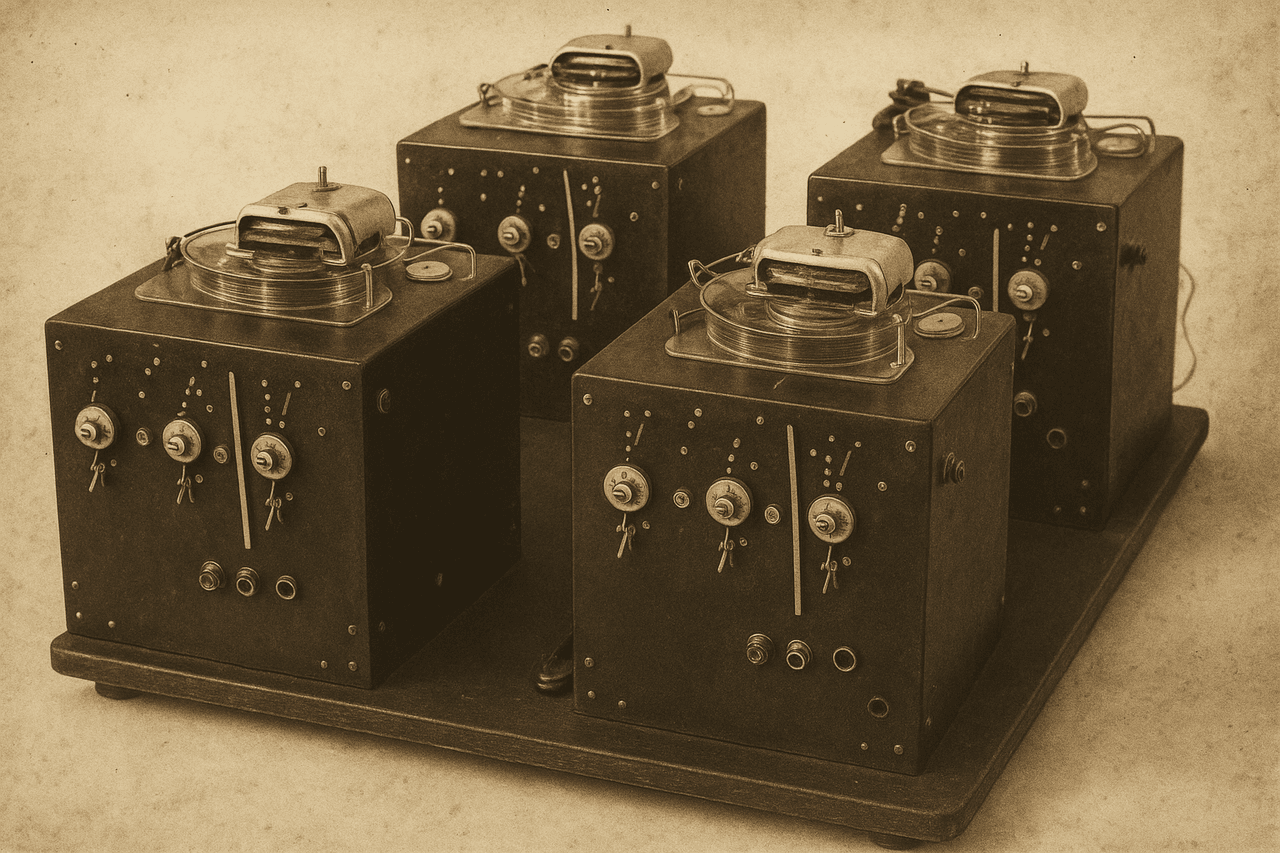
Homeostat Design (Generated by artificial intelligence.)
Ashby’s 1952 book Design for a Brain is among the first theoretical texts to apply a systems approach to psychology. In this work, Ashby sought answers to fundamental questions such as: “How does an organism interact with its environment?”, “How does it maintain internal balance under changing conditions?”, and “How can learning and adaptation be systematized?”
The key ideas presented in the book include: The brain must operate in a variable environment. Learning is the ability to select appropriate responses to environmental variety. Equilibrium (homeostasis) can be maintained only if sufficient behavioral variety is available. At this point, Ashby offers a functional and systems-based model for explaining behavior, rather than a statistical or causal one.
Design for a Brain was followed in 1956 by An Introduction to Cybernetics. In this second work, Ashby formally defined the Law of Requisite Variety. This book is also recognized as the first systematic textbook on cybernetics.
Ashby defines a system as a structure composed of inputs, states, and outputs. To control environmental variability, the control mechanism must possess at least as much variety as the environment. This principle is formulated as:
Where:
If this inequality is not satisfied, the system will either fail or break down.
In developing this law, Ashby was influenced by Claude Shannon’s Information Theory. According to Shannon, information reduces entropy—that is, uncertainty. Ashby applied this concept to systems theory, asserting that to reduce uncertainty (entropy) in the environment, a system must possess sufficient information capacity. In this context:
When Ashby’s principle of “variety” in systems is applied to individual psychology, it relates to an individual’s internal capacity to adapt to environmental variability. In this context, an individual’s psychological balance depends on their cognitive and emotional variety. Cognitive flexibility enables a person to evaluate events through multiple thought patterns, while emotional regulation refers to the ability to manage negative emotions and express them in healthy ways. Effective coping strategies allow for the development of diverse, situation-appropriate responses to external stressors such as stress, uncertainty, and social pressure. Social skills are essential for communicating with different people, resolving conflicts, and building empathy. Value-based decision-making enables individuals to maintain their core values while adapting to changing environmental conditions.
When evaluated within Ashby’s framework, a lack of sufficient internal response variety to match environmental variety can lead to various psychological problems. These include anxiety arising from rigid thought patterns that are inadequate in the face of uncertainty; burnout caused by limited coping strategies; anger outbursts or withdrawal linked to insufficient emotional expression; relationship difficulties resulting from one-dimensional responses to social environments; and an inability to adapt to new situations.
In this framework, psychological resilience can be understood as the individual-level manifestation of Ashby’s Law of Requisite Variety. Resilient individuals do not rely on a single coping strategy; they can flexibly deploy different strategies according to situational demands, mobilize social and internal resources adaptively, and develop diverse emotion-thought patterns to respond effectively to environmental variety. Thus, individual psychological balance becomes sustainable only when sufficient internal variety is maintained to counter environmental uncertainty.
Ashby, W. Ross. *Design for a Brain: The Origin of Adaptive Behavior*. London: Chapman & Hall, 1952. Accessed Adresi.
Ashby, W. Ross. An Introduction to Cybernetics. Chapman & Hall, London, 1956. Internet (1999).
Heylighen, Francis, and Cliff Joslyn. “Cybernetics and Second-Order Cybernetics.” In *Encyclopedia of Life Support Systems (EOLSS)*, edited by UNESCO. Oxford: Eolss Publishers, 2001. Accessed Adresi.
Pickering, Andrew. *The Cybernetic Brain: Sketches of Another Future*. Chicago: University of Chicago Press, 2010.
Shannon, Claude E. “A Mathematical Theory of Communication.” The Bell System Technical Journal 27, no. 3 (1948): 379–423. Accessed Adresi.
[1]
Ashby, W. Ross. An Introduction to Cybernetics, Chapman & Hall, London, 1956. Internet (1999). Erişim Adresi.

No Discussion Added Yet
Start discussion for "Ashby's Law of Required Variety" article
Conceptual Framework
Historical Background
Transition from Psychiatry to Systems Theory (1930s–1940s)
Comparing Control Systems with Living Systems (Mid-1940s)
Theoretical Publications
Formal Definition of the Law
Connection to Information Theory and Entropy
Applications
Implications of Ashby’s Law of Requisite Variety for Individual Psychology