badge icon

This article was automatically translated from the original Turkish version.

Article
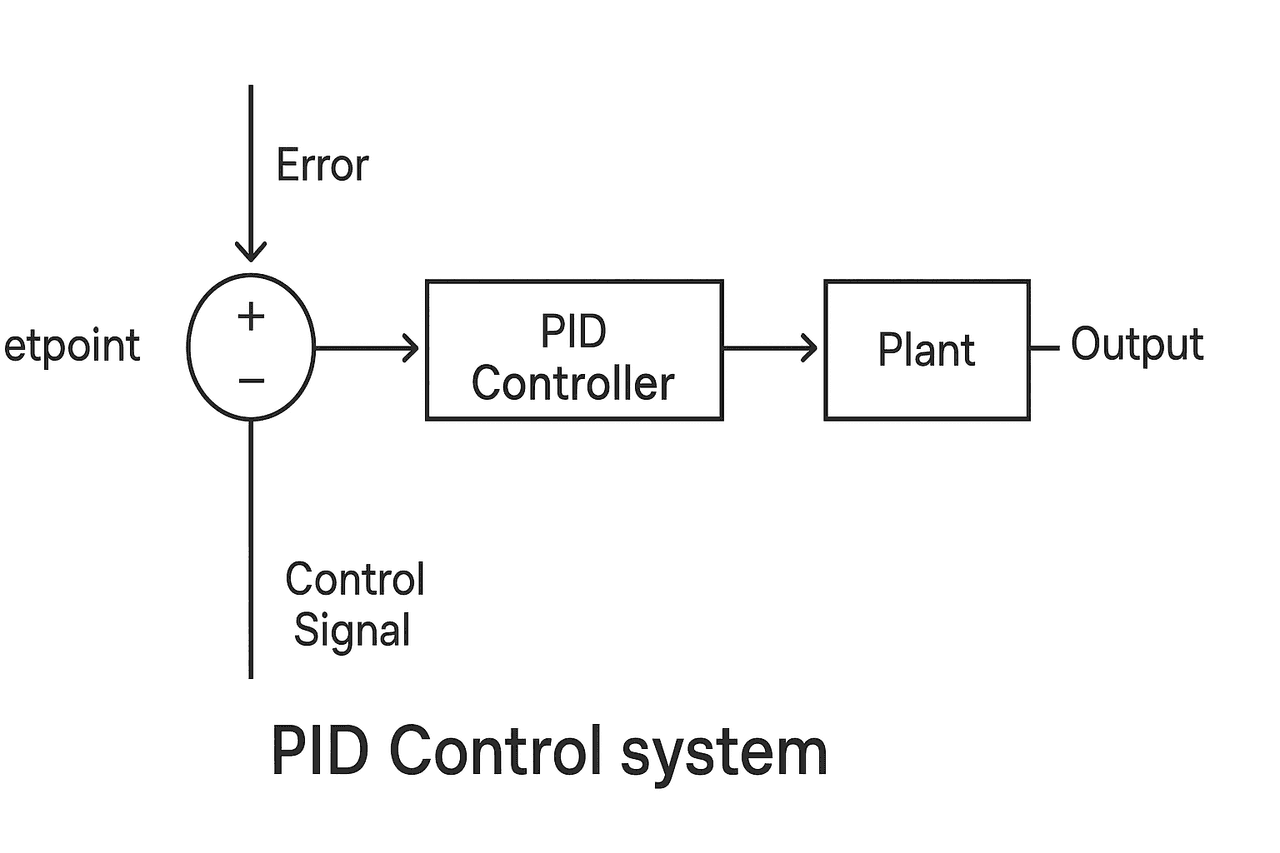
PIDKontrolSis.jpeg
PID Control Systems
Basic Structure
PID = Proportional (P) + Integral (I) + Derivative (D)
Error Definition
e(t) = r(t) − y(t)
Control Signal
u(t) = Kp·e(t) + Ki·∫e(t)dt + Kd·de(t)/dt

PID, or Proportional-Integral-Derivative, is one of the most widely used feedback control algorithms in control engineering. It is designed to bring a system’s output as quickly, accurately, and stably as possible to a desired reference value. Due to their simple structure and broad range of applications, PID controllers have become indispensable in industry and technology.

Basic Principles of PID Control

The PID controller operates by analyzing the difference between the system’s output and the desired reference value, known as the error <span class="katex"><span class="katex-html" aria-hidden="true"><span class="base"><span class="strut" style="height:1em;vertical-align:-0.25em;"></span><span class="mord mathnormal">e</span><span class="mopen">(</span><span class="mord mathnormal">t</span><span class="mclose">)</span></span></span></span>. This error is expressed by the following formula:

<span class="katex"><span class="katex-html" aria-hidden="true"><span class="base"><span class="strut" style="height:1em;vertical-align:-0.25em;"></span><span class="mord mathnormal">e</span><span class="mopen">(</span><span class="mord mathnormal">t</span><span class="mclose">)</span><span class="mspace" style="margin-right:0.2778em;"></span><span class="mrel">=</span><span class="mspace" style="margin-right:0.2778em;"></span></span><span class="base"><span class="strut" style="height:1em;vertical-align:-0.25em;"></span><span class="mord mathnormal" style="margin-right:0.02778em;">r</span><span class="mopen">(</span><span class="mord mathnormal">t</span><span class="mclose">)</span><span class="mspace" style="margin-right:0.2222em;"></span><span class="mbin">−</span><span class="mspace" style="margin-right:0.2222em;"></span></span><span class="base"><span class="strut" style="height:1em;vertical-align:-0.25em;"></span><span class="mord mathnormal" style="margin-right:0.03588em;">y</span><span class="mopen">(</span><span class="mord mathnormal">t</span><span class="mclose">)</span></span></span></span>


Where:

  • <span class="katex"><span class="katex-html" aria-hidden="true"><span class="base"><span class="strut" style="height:1em;vertical-align:-0.25em;"></span><span class="mord mathnormal" style="margin-right:0.02778em;">r</span><span class="mopen">(</span><span class="mord mathnormal">t</span><span class="mclose">)</span></span></span></span>: Reference (desired) value
  • <span class="katex"><span class="katex-html" aria-hidden="true"><span class="base"><span class="strut" style="height:1em;vertical-align:-0.25em;"></span><span class="mord mathnormal" style="margin-right:0.03588em;">y</span><span class="mopen">(</span><span class="mord mathnormal">t</span><span class="mclose">)</span></span></span></span>: Actual (measured) output value
  • <span class="katex"><span class="katex-html" aria-hidden="true"><span class="base"><span class="strut" style="height:1em;vertical-align:-0.25em;"></span><span class="mord mathnormal">e</span><span class="mopen">(</span><span class="mord mathnormal">t</span><span class="mclose">)</span></span></span></span>: Error signal


The PID controller processes this error using three distinct components: proportional, integral, and derivative. Each component affects the system’s behavior differently, and when combined, they enable the system to operate quickly, accurately, and stably. The control signal

𝑢(𝑡), is calculated as follows:

<span class="katex"><span class="katex-html" aria-hidden="true"><span class="base"><span class="strut" style="height:1em;vertical-align:-0.25em;"></span><span class="mord mathnormal">u</span><span class="mopen">(</span><span class="mord mathnormal">t</span><span class="mclose">)</span><span class="mspace" style="margin-right:0.2778em;"></span><span class="mrel">=</span><span class="mspace" style="margin-right:0.2778em;"></span></span><span class="base"><span class="strut" style="height:1em;vertical-align:-0.25em;"></span><span class="mord mathnormal" style="margin-right:0.07153em;">K</span><span class="mord mathnormal">p</span><span class="mord">​</span><span class="mord mathnormal">e</span><span class="mopen">(</span><span class="mord mathnormal">t</span><span class="mclose">)</span><span class="mspace" style="margin-right:0.2222em;"></span><span class="mbin">+</span><span class="mspace" style="margin-right:0.2222em;"></span></span><span class="base"><span class="strut" style="height:1.1111em;vertical-align:-0.3061em;"></span><span class="mord mathnormal" style="margin-right:0.07153em;">K</span><span class="mord mathnormal">i</span><span class="mord">​</span><span class="mspace" style="margin-right:0.1667em;"></span><span class="mop op-symbol small-op" style="margin-right:0.19445em;position:relative;top:-0.0006em;">∫</span><span class="mspace" style="margin-right:0.1667em;"></span><span class="mord mathnormal">e</span><span class="mopen">(</span><span class="mord mathnormal">t</span><span class="mclose">)</span><span class="mord mathnormal">d</span><span class="mord mathnormal">t</span><span class="mspace" style="margin-right:0.2222em;"></span><span class="mbin">+</span><span class="mspace" style="margin-right:0.2222em;"></span></span><span class="base"><span class="strut" style="height:1em;vertical-align:-0.25em;"></span><span class="mord mathnormal" style="margin-right:0.07153em;">K</span><span class="mord mathnormal">d</span><span class="mord">​</span><span class="mord mathnormal">d</span><span class="mord mathnormal">t</span><span class="mord mathnormal">d</span><span class="mord mathnormal">e</span><span class="mopen">(</span><span class="mord mathnormal">t</span><span class="mclose">)</span><span class="mord">​</span></span></span></span>


Where:


  • <span class="katex"><span class="katex-html" aria-hidden="true"><span class="base"><span class="strut" style="height:0.8778em;vertical-align:-0.1944em;"></span><span class="mord mathnormal" style="margin-right:0.07153em;">K</span><span class="mord mathnormal">p</span></span></span></span>: Proportional gain
  • <span class="katex"><span class="katex-html" aria-hidden="true"><span class="base"><span class="strut" style="height:0.6833em;"></span><span class="mord mathnormal" style="margin-right:0.07153em;">K</span><span class="mord mathnormal">i</span></span></span></span>: Integral gain
  • <span class="katex"><span class="katex-html" aria-hidden="true"><span class="base"><span class="strut" style="height:0.6944em;"></span><span class="mord mathnormal" style="margin-right:0.07153em;">K</span><span class="mord mathnormal">d</span></span></span></span>: Derivative gain

PID Components

1. Proportional Control

Proportional control applies a correction proportional to the error signal. The larger the error, the larger the control signal. Mathematically:

<span class="katex"><span class="katex-html" aria-hidden="true"><span class="base"><span class="strut" style="height:1em;vertical-align:-0.25em;"></span><span class="mord mathnormal">u</span><span class="mord mathnormal">p</span><span class="mord">​</span><span class="mopen">(</span><span class="mord mathnormal">t</span><span class="mclose">)</span><span class="mspace" style="margin-right:0.2778em;"></span><span class="mrel">=</span><span class="mspace" style="margin-right:0.2778em;"></span></span><span class="base"><span class="strut" style="height:1em;vertical-align:-0.25em;"></span><span class="mord mathnormal" style="margin-right:0.07153em;">K</span><span class="mord mathnormal">p</span><span class="mord">​</span><span class="mord mathnormal">e</span><span class="mopen">(</span><span class="mord mathnormal">t</span><span class="mclose">)</span></span></span></span>

Role and Effect

  • Proportional control focuses on the instantaneous magnitude of the error to rapidly bring the system output toward the reference value. For example, in a temperature control system, if the current temperature is far from the target, the proportional term generates a larger correction signal (e.g., more heating).
  • <span class="katex"><span class="katex-html" aria-hidden="true"><span class="base"><span class="strut" style="height:0.8778em;vertical-align:-0.1944em;"></span><span class="mord mathnormal" style="margin-right:0.07153em;">K</span><span class="mord mathnormal">p</span></span></span></span> gain determines the strength of the correction signal. A high <span class="katex"><span class="katex-html" aria-hidden="true"><span class="base"><span class="strut" style="height:0.8778em;vertical-align:-0.1944em;"></span><span class="mord mathnormal" style="margin-right:0.07153em;">K</span><span class="mord mathnormal">p</span></span></span></span> value provides a more aggressive response, but excessively high values can cause oscillations or instability in the system.
  • Low <span class="katex"><span class="katex-html" aria-hidden="true"><span class="base"><span class="strut" style="height:0.8778em;vertical-align:-0.1944em;"></span><span class="mord mathnormal" style="margin-right:0.07153em;">K</span><span class="mord mathnormal">p</span></span></span></span> values slow down the system and increase the time required to reach the target.

Advantages

  • Fast Response: The system responds immediately to the error, enhancing dynamic performance. For example, in motor speed control, proportional control provides a rapid correction when a speed deviation is detected.
  • Simplicity: Proportional control is easy to compute and requires low computational power since it depends only on the instantaneous error.
  • Linear Response: It provides predictable control by producing a correction proportional to the error magnitude.

Disadvantages

  • Steady-State Error: When used alone, proportional control typically cannot bring the system exactly to the reference value. For example, in speed control of a loaded motor, a constant speed deviation may persist due to the load.
  • Risk of Instability: Very high <span class="katex"><span class="katex-html" aria-hidden="true"><span class="base"><span class="strut" style="height:0.8778em;vertical-align:-0.1944em;"></span><span class="mord mathnormal" style="margin-right:0.07153em;">K</span><span class="mord mathnormal">p</span></span></span></span> values can cause the system to overreact and produce continuous oscillations. For example, in robotic arm position control, a high <span class="katex"><span class="katex-html" aria-hidden="true"><span class="base"><span class="strut" style="height:0.8778em;vertical-align:-0.1944em;"></span><span class="mord mathnormal" style="margin-right:0.07153em;">K</span><span class="mord mathnormal">p</span></span></span></span> value may cause the arm to overshoot the target.
  • Limited Control: Proportional control considers only the instantaneous error and provides no information about past errors or the rate of error change, which can be insufficient for some systems.

2. Integral Control

Integral control accounts for the accumulation of past errors and drives the error toward zero over time. Mathematically:


<span class="katex"><span class="katex-html" aria-hidden="true"><span class="base"><span class="strut" style="height:1em;vertical-align:-0.25em;"></span><span class="mord mathnormal">u</span><span class="mord mathnormal">i</span><span class="mord">​</span><span class="mopen">(</span><span class="mord mathnormal">t</span><span class="mclose">)</span><span class="mspace" style="margin-right:0.2778em;"></span><span class="mrel">=</span><span class="mspace" style="margin-right:0.2778em;"></span></span><span class="base"><span class="strut" style="height:1.1111em;vertical-align:-0.3061em;"></span><span class="mord mathnormal" style="margin-right:0.07153em;">K</span><span class="mord mathnormal">i</span><span class="mord">​</span><span class="mspace" style="margin-right:0.1667em;"></span><span class="mop op-symbol small-op" style="margin-right:0.19445em;position:relative;top:-0.0006em;">∫</span><span class="mspace" style="margin-right:0.1667em;"></span><span class="mord mathnormal">e</span><span class="mopen">(</span><span class="mord mathnormal">t</span><span class="mclose">)</span><span class="mord mathnormal">d</span><span class="mord mathnormal">t</span></span></span></span>

Role and Effect

  • Integral control improves the long-term accuracy of the system. By accumulating past errors, it eliminates steady-state error. For example, in a temperature control system, if a small temperature deviation remains due to proportional control, the integral term gradually corrects this deviation over time.
  • <span class="katex"><span class="katex-html" aria-hidden="true"><span class="base"><span class="strut" style="height:0.6833em;"></span><span class="mord mathnormal" style="margin-right:0.07153em;">K</span><span class="mord mathnormal">i</span></span></span></span> gain determines the strength of the integral term. A high <span class="katex"><span class="katex-html" aria-hidden="true"><span class="base"><span class="strut" style="height:0.6833em;"></span><span class="mord mathnormal" style="margin-right:0.07153em;">K</span><span class="mord mathnormal">i</span></span></span></span> value enables faster error correction, but excessively high values can lead to system instability or overreaction.
  • Integral control must be used carefully when the system reaches physical limits (e.g., a motor’s maximum speed).

Advantages

  • Elimination of Steady-State Error: Integral control ensures the system reaches the exact reference value. For example, in a cruise control system, the integral term maintains the vehicle’s speed precisely at the desired level.
  • Long-Term Accuracy: By accounting for past errors, it prevents continuous deviations, which is critical in applications requiring high precision, such as chemical reactors.
  • Low Error Tolerance: Integral control can accumulate and correct even small errors, enabling high sensitivity.

Disadvantages

  • Overshoot and Oscillations: High <span class="katex"><span class="katex-html" aria-hidden="true"><span class="base"><span class="strut" style="height:0.6833em;"></span><span class="mord mathnormal" style="margin-right:0.07153em;">K</span><span class="mord mathnormal">i</span></span></span></span> values can cause the system to overshoot the target and oscillate. For example, in robotic arm position control, the integral term may drive the arm beyond the target position.
  • Integral Windup: When the system reaches physical limits (e.g., a valve fully open), the integral term continues accumulating errors. This can cause the control signal to become unnecessarily large and result in delayed system response. Anti-windup techniques mitigate this issue.
  • Slow Response: Because integral control depends on the accumulation of errors, it responds slowly to sudden changes, potentially reducing performance in dynamic systems.
  • Computational Complexity: The integral term requires continuous summation of errors, increasing memory and processing requirements in digital systems.

3. Derivative Control

Derivative control analyzes the rate of change of the error and makes corrections based on predictions of the system’s future behavior. Mathematically:

<span class="katex"><span class="katex-html" aria-hidden="true"><span class="base"><span class="strut" style="height:1em;vertical-align:-0.25em;"></span><span class="mord mathnormal">u</span><span class="mord mathnormal">d</span><span class="mord">​</span><span class="mopen">(</span><span class="mord mathnormal">t</span><span class="mclose">)</span><span class="mspace" style="margin-right:0.2778em;"></span><span class="mrel">=</span><span class="mspace" style="margin-right:0.2778em;"></span></span><span class="base"><span class="strut" style="height:1em;vertical-align:-0.25em;"></span><span class="mord mathnormal" style="margin-right:0.07153em;">K</span><span class="mord mathnormal">d</span><span class="mord">​</span><span class="mord mathnormal">d</span><span class="mord mathnormal">t</span><span class="mord mathnormal">d</span><span class="mord mathnormal">e</span><span class="mopen">(</span><span class="mord mathnormal">t</span><span class="mclose">)</span><span class="mord">​</span></span></span></span>

Role and Effect

  • Derivative control evaluates how the error is changing (increasing or decreasing) and applies a damping effect to prevent overshoot and improve stability.
  • <span class="katex"><span class="katex-html" aria-hidden="true"><span class="base"><span class="strut" style="height:0.6944em;"></span><span class="mord mathnormal" style="margin-right:0.07153em;">K</span><span class="mord mathnormal">d</span><span class="mord">​</span></span></span></span>​ gain determines the strength of the derivative term. A high <span class="katex"><span class="katex-html" aria-hidden="true"><span class="base"><span class="strut" style="height:0.6944em;"></span><span class="mord mathnormal" style="margin-right:0.07153em;">K</span><span class="mord mathnormal">d</span><span class="mord">​</span></span></span></span> value provides stronger damping but may cause issues in noisy signals.
  • Derivative control is typically used in combination with proportional and integral control, as it cannot correct the error on its own.

Advantages

  • Reduction of Overshoot: Derivative control prevents the system from exceeding the target. For example, in drone altitude control, the derivative term slows rapid ascent to achieve a stable height.
  • Improved Stability: By damping oscillations, it enhances system stability, which is critical in fast dynamic systems such as robotics.
  • Predictive Capability: By analyzing the rate of error change, it forecasts future system behavior and enables proactive corrections.
  • Fast Dynamic Response: Derivative control improves the system’s ability to respond to sudden changes, making it beneficial in applications requiring rapid reaction.

Disadvantages

  • Noise Sensitivity: The derivative term can amplify small noise in measurement signals because noise often causes rapid fluctuations. This may lead to incorrect control actions. For example, noise from a temperature sensor can cause the derivative term to generate erroneous corrections.
  • Computational Difficulty: Calculating the derivative, especially in digital systems, requires a high sampling rate to accurately determine the rate of error change, increasing computational demands.
  • Limitation of Standalone Use: Derivative control does not directly correct the error; it only responds to its rate of change. Therefore, it cannot bring the system to the reference value when used alone.
  • Parameter Sensitivity: Incorrect tuning of the <span class="katex"><span class="katex-html" aria-hidden="true"><span class="base"><span class="strut" style="height:0.6944em;"></span><span class="mord mathnormal" style="margin-right:0.07153em;">K</span><span class="mord mathnormal">d</span></span></span></span> value can cause excessive damping (slow response) or insufficient damping (oscillations).

Basic Principles of PID Control

The PID controller operates by analyzing the difference between the system’s output and the desired reference value, known as the error <span class="katex"><span class="katex-html" aria-hidden="true"><span class="base"><span class="strut" style="height:1em;vertical-align:-0.25em;"></span><span class="mord mathnormal">e</span><span class="mopen">(</span><span class="mord mathnormal">t</span><span class="mclose">)</span></span></span></span>. This error is expressed by the following formula:

<span class="katex"><span class="katex-html" aria-hidden="true"><span class="base"><span class="strut" style="height:1em;vertical-align:-0.25em;"></span><span class="mord mathnormal">e</span><span class="mopen">(</span><span class="mord mathnormal">t</span><span class="mclose">)</span><span class="mspace" style="margin-right:0.2778em;"></span><span class="mrel">=</span><span class="mspace" style="margin-right:0.2778em;"></span></span><span class="base"><span class="strut" style="height:1em;vertical-align:-0.25em;"></span><span class="mord mathnormal" style="margin-right:0.02778em;">r</span><span class="mopen">(</span><span class="mord mathnormal">t</span><span class="mclose">)</span><span class="mspace" style="margin-right:0.2222em;"></span><span class="mbin">−</span><span class="mspace" style="margin-right:0.2222em;"></span></span><span class="base"><span class="strut" style="height:1em;vertical-align:-0.25em;"></span><span class="mord mathnormal" style="margin-right:0.03588em;">y</span><span class="mopen">(</span><span class="mord mathnormal">t</span><span class="mclose">)</span></span></span></span>


Where:

  • <span class="katex"><span class="katex-html" aria-hidden="true"><span class="base"><span class="strut" style="height:1em;vertical-align:-0.25em;"></span><span class="mord mathnormal" style="margin-right:0.02778em;">r</span><span class="mopen">(</span><span class="mord mathnormal">t</span><span class="mclose">)</span></span></span></span>: Reference (desired) value
  • <span class="katex"><span class="katex-html" aria-hidden="true"><span class="base"><span class="strut" style="height:1em;vertical-align:-0.25em;"></span><span class="mord mathnormal" style="margin-right:0.03588em;">y</span><span class="mopen">(</span><span class="mord mathnormal">t</span><span class="mclose">)</span></span></span></span>: Actual (measured) output value
  • <span class="katex"><span class="katex-html" aria-hidden="true"><span class="base"><span class="strut" style="height:1em;vertical-align:-0.25em;"></span><span class="mord mathnormal">e</span><span class="mopen">(</span><span class="mord mathnormal">t</span><span class="mclose">)</span></span></span></span>: Error signal


The PID controller processes this error using three distinct components: proportional, integral, and derivative. Each component affects the system’s behavior differently, and when combined, they enable the system to operate quickly, accurately, and stably. The control signal

𝑢(𝑡), is calculated as follows:


<span class="katex"><span class="katex-html" aria-hidden="true"><span class="base"><span class="strut" style="height:1em;vertical-align:-0.25em;"></span><span class="mord mathnormal">u</span><span class="mopen">(</span><span class="mord mathnormal">t</span><span class="mclose">)</span><span class="mspace" style="margin-right:0.2778em;"></span><span class="mrel">=</span><span class="mspace" style="margin-right:0.2778em;"></span></span><span class="base"><span class="strut" style="height:1em;vertical-align:-0.25em;"></span><span class="mord mathnormal" style="margin-right:0.07153em;">K</span><span class="mord mathnormal">p</span><span class="mord">​</span><span class="mord mathnormal">e</span><span class="mopen">(</span><span class="mord mathnormal">t</span><span class="mclose">)</span><span class="mspace" style="margin-right:0.2222em;"></span><span class="mbin">+</span><span class="mspace" style="margin-right:0.2222em;"></span></span><span class="base"><span class="strut" style="height:1.1111em;vertical-align:-0.3061em;"></span><span class="mord mathnormal" style="margin-right:0.07153em;">K</span><span class="mord mathnormal">i</span><span class="mord">​</span><span class="mspace" style="margin-right:0.1667em;"></span><span class="mop op-symbol small-op" style="margin-right:0.19445em;position:relative;top:-0.0006em;">∫</span><span class="mspace" style="margin-right:0.1667em;"></span><span class="mord mathnormal">e</span><span class="mopen">(</span><span class="mord mathnormal">t</span><span class="mclose">)</span><span class="mord mathnormal">d</span><span class="mord mathnormal">t</span><span class="mspace" style="margin-right:0.2222em;"></span><span class="mbin">+</span><span class="mspace" style="margin-right:0.2222em;"></span></span><span class="base"><span class="strut" style="height:1em;vertical-align:-0.25em;"></span><span class="mord mathnormal" style="margin-right:0.07153em;">K</span><span class="mord mathnormal">d</span><span class="mord">​</span><span class="mord mathnormal">d</span><span class="mord mathnormal">t</span><span class="mord mathnormal">d</span><span class="mord mathnormal">e</span><span class="mopen">(</span><span class="mord mathnormal">t</span><span class="mclose">)</span><span class="mord">​</span></span></span></span>


Where:

  • <span class="katex"><span class="katex-html" aria-hidden="true"><span class="base"><span class="strut" style="height:0.8778em;vertical-align:-0.1944em;"></span><span class="mord mathnormal" style="margin-right:0.07153em;">K</span><span class="mord mathnormal">p</span></span></span></span>: Proportional gain
  • <span class="katex"><span class="katex-html" aria-hidden="true"><span class="base"><span class="strut" style="height:0.6833em;"></span><span class="mord mathnormal" style="margin-right:0.07153em;">K</span><span class="mord mathnormal">i</span></span></span></span>: Integral gain
  • <span class="katex"><span class="katex-html" aria-hidden="true"><span class="base"><span class="strut" style="height:0.6944em;"></span><span class="mord mathnormal" style="margin-right:0.07153em;">K</span><span class="mord mathnormal">d</span></span></span></span>: Derivative gain

PID Components

1. Proportional Control

Proportional control applies a correction proportional to the error signal. The larger the error, the larger the control signal. Mathematically:


<span class="katex"><span class="katex-html" aria-hidden="true"><span class="base"><span class="strut" style="height:1em;vertical-align:-0.25em;"></span><span class="mord mathnormal">u</span><span class="mord mathnormal">p</span><span class="mord">​</span><span class="mopen">(</span><span class="mord mathnormal">t</span><span class="mclose">)</span><span class="mspace" style="margin-right:0.2778em;"></span><span class="mrel">=</span><span class="mspace" style="margin-right:0.2778em;"></span></span><span class="base"><span class="strut" style="height:1em;vertical-align:-0.25em;"></span><span class="mord mathnormal" style="margin-right:0.07153em;">K</span><span class="mord mathnormal">p</span><span class="mord">​</span><span class="mord mathnormal">e</span><span class="mopen">(</span><span class="mord mathnormal">t</span><span class="mclose">)</span></span></span></span>

Role and Effect

  • Proportional control focuses on the instantaneous magnitude of the error to rapidly bring the system output toward the reference value. For example, in a temperature control system, if the current temperature is far from the target, the proportional term generates a larger correction signal (e.g., more heating).
  • <span class="katex"><span class="katex-html" aria-hidden="true"><span class="base"><span class="strut" style="height:0.8778em;vertical-align:-0.1944em;"></span><span class="mord mathnormal" style="margin-right:0.07153em;">K</span><span class="mord mathnormal">p</span></span></span></span> gain determines the strength of the correction signal. A high <span class="katex"><span class="katex-html" aria-hidden="true"><span class="base"><span class="strut" style="height:0.8778em;vertical-align:-0.1944em;"></span><span class="mord mathnormal" style="margin-right:0.07153em;">K</span><span class="mord mathnormal">p</span></span></span></span> value provides a more aggressive response, but excessively high values can cause oscillations or instability in the system.
  • Low <span class="katex"><span class="katex-html" aria-hidden="true"><span class="base"><span class="strut" style="height:0.8778em;vertical-align:-0.1944em;"></span><span class="mord mathnormal" style="margin-right:0.07153em;">K</span><span class="mord mathnormal">p</span></span></span></span> values slow down the system and increase the time required to reach the target.

Advantages

  • Fast Response: The system responds immediately to the error, enhancing dynamic performance. For example, in motor speed control, proportional control provides a rapid correction when a speed deviation is detected.
  • Simplicity: Proportional control is easy to compute and requires low computational power since it depends only on the instantaneous error.
  • Linear Response: It provides predictable control by producing a correction proportional to the error magnitude.

Disadvantages

  • Steady-State Error: When used alone, proportional control typically cannot bring the system exactly to the reference value. For example, in speed control of a loaded motor, a constant speed deviation may persist due to the load.
  • Risk of Instability: Very high <span class="katex"><span class="katex-html" aria-hidden="true"><span class="base"><span class="strut" style="height:0.8778em;vertical-align:-0.1944em;"></span><span class="mord mathnormal" style="margin-right:0.07153em;">K</span><span class="mord mathnormal">p</span></span></span></span> values can cause the system to overreact (overshoot) and produce continuous oscillations. For example, in robotic arm position control, a high <span class="katex"><span class="katex-html" aria-hidden="true"><span class="base"><span class="strut" style="height:0.8778em;vertical-align:-0.1944em;"></span><span class="mord mathnormal" style="margin-right:0.07153em;">K</span><span class="mord mathnormal">p</span></span></span></span> value may cause the arm to overshoot the target.
  • Limited Control: Proportional control considers only the instantaneous error and provides no information about past errors or the rate of error change, which can be insufficient for some systems.

2. Integral Control

Integral control accounts for the accumulation of past errors and drives the error toward zero over time. Mathematically:

<span class="katex"><span class="katex-html" aria-hidden="true"><span class="base"><span class="strut" style="height:1em;vertical-align:-0.25em;"></span><span class="mord mathnormal">u</span><span class="mord mathnormal">i</span><span class="mord">​</span><span class="mopen">(</span><span class="mord mathnormal">t</span><span class="mclose">)</span><span class="mspace" style="margin-right:0.2778em;"></span><span class="mrel">=</span><span class="mspace" style="margin-right:0.2778em;"></span></span><span class="base"><span class="strut" style="height:1.1111em;vertical-align:-0.3061em;"></span><span class="mord mathnormal" style="margin-right:0.07153em;">K</span><span class="mord mathnormal">i</span><span class="mord">​</span><span class="mspace" style="margin-right:0.1667em;"></span><span class="mop op-symbol small-op" style="margin-right:0.19445em;position:relative;top:-0.0006em;">∫</span><span class="mspace" style="margin-right:0.1667em;"></span><span class="mord mathnormal">e</span><span class="mopen">(</span><span class="mord mathnormal">t</span><span class="mclose">)</span><span class="mord mathnormal">d</span><span class="mord mathnormal">t</span></span></span></span>

Role and Effect

  • Integral control improves the long-term accuracy of the system. By accumulating past errors, it eliminates steady-state error. For example, in a temperature control system, if a small temperature deviation remains due to proportional control, the integral term gradually corrects this deviation over time.
  • <span class="katex"><span class="katex-html" aria-hidden="true"><span class="base"><span class="strut" style="height:0.6833em;"></span><span class="mord mathnormal" style="margin-right:0.07153em;">K</span><span class="mord mathnormal">i</span></span></span></span> gain determines the strength of the integral term. A high <span class="katex"><span class="katex-html" aria-hidden="true"><span class="base"><span class="strut" style="height:0.6833em;"></span><span class="mord mathnormal" style="margin-right:0.07153em;">K</span><span class="mord mathnormal">i</span></span></span></span> value enables faster error correction, but excessively high values can lead to system instability or overreaction.
  • Integral control must be used carefully when the system reaches physical limits (e.g., a motor’s maximum speed).

Advantages

  • Elimination of Steady-State Error: Integral control ensures the system reaches the exact reference value. For example, in a cruise control system, the integral term maintains the vehicle’s speed precisely at the desired level.
  • Long-Term Accuracy: By accounting for past errors, it prevents continuous deviations, which is critical in applications requiring high precision, such as chemical reactors.
  • Low Error Tolerance: Integral control can accumulate and correct even small errors, enabling high sensitivity.

Disadvantages

  • Overshoot and Oscillations: High <span class="katex"><span class="katex-html" aria-hidden="true"><span class="base"><span class="strut" style="height:0.6833em;"></span><span class="mord mathnormal" style="margin-right:0.07153em;">K</span><span class="mord mathnormal">i</span></span></span></span> values can cause the system to overshoot the target and oscillate. For example, in robotic arm position control, the integral term may drive the arm beyond the target position.
  • Integral Windup: When the system reaches physical limits (e.g., a valve fully open), the integral term continues accumulating errors. This can cause the control signal to become unnecessarily large and result in delayed system response. Anti-windup techniques mitigate this issue.
  • Slow Response: Because integral control depends on the accumulation of errors, it responds slowly to sudden changes, potentially reducing performance in dynamic systems.
  • Computational Complexity: The integral term requires continuous summation of errors, increasing memory and processing requirements in digital systems.

3. Derivative Control

Derivative control analyzes the rate of change of the error and makes corrections based on predictions of the system’s future behavior. Mathematically:

<span class="katex"><span class="katex-html" aria-hidden="true"><span class="base"><span class="strut" style="height:1em;vertical-align:-0.25em;"></span><span class="mord mathnormal">u</span><span class="mord mathnormal">d</span><span class="mord">​</span><span class="mopen">(</span><span class="mord mathnormal">t</span><span class="mclose">)</span><span class="mspace" style="margin-right:0.2778em;"></span><span class="mrel">=</span><span class="mspace" style="margin-right:0.2778em;"></span></span><span class="base"><span class="strut" style="height:1em;vertical-align:-0.25em;"></span><span class="mord mathnormal" style="margin-right:0.07153em;">K</span><span class="mord mathnormal">d</span><span class="mord">​</span><span class="mord mathnormal">d</span><span class="mord mathnormal">t</span><span class="mord mathnormal">d</span><span class="mord mathnormal">e</span><span class="mopen">(</span><span class="mord mathnormal">t</span><span class="mclose">)</span><span class="mord">​</span></span></span></span>

Role and Effect

  • Derivative control evaluates how the error is changing (increasing or decreasing) and applies a damping effect to prevent overshoot and improve stability.
  • <span class="katex"><span class="katex-html" aria-hidden="true"><span class="base"><span class="strut" style="height:0.6944em;"></span><span class="mord mathnormal" style="margin-right:0.07153em;">K</span><span class="mord mathnormal">d</span><span class="mord">​</span></span></span></span>​ gain determines the strength of the derivative term. A high <span class="katex"><span class="katex-html" aria-hidden="true"><span class="base"><span class="strut" style="height:0.6944em;"></span><span class="mord mathnormal" style="margin-right:0.07153em;">K</span><span class="mord mathnormal">d</span><span class="mord">​</span></span></span></span> value provides stronger damping but may cause issues in noisy signals.
  • Derivative control is typically used in combination with proportional and integral control, as it cannot correct the error on its own.

Advantages

  • Reduction of Overshoot: Derivative control prevents the system from exceeding the target. For example, in drone altitude control, the derivative term slows rapid ascent to achieve a stable height.
  • Improved Stability: By damping oscillations, it enhances system stability, which is critical in fast dynamic systems such as robotics.
  • Predictive Capability: By analyzing the rate of error change, it forecasts future system behavior and enables proactive corrections.
  • Fast Dynamic Response: Derivative control improves the system’s ability to respond to sudden changes, making it beneficial in applications requiring rapid reaction.

Disadvantages

  • Noise Sensitivity: The derivative term can amplify small noise in measurement signals because noise often causes rapid fluctuations. This may lead to incorrect control actions. For example, noise from a temperature sensor can cause the derivative term to generate erroneous corrections.
  • Computational Difficulty: Calculating the derivative, especially in digital systems, requires a high sampling rate to accurately determine the rate of error change, increasing computational demands.
  • Limitation of Standalone Use: Derivative control does not directly correct the error; it only responds to its rate of change. Therefore, it cannot bring the system to the reference value when used alone.
  • Parameter Sensitivity: Incorrect tuning of the <span class="katex"><span class="katex-html" aria-hidden="true"><span class="base"><span class="strut" style="height:0.6833em;"></span><span class="mord mathnormal" style="margin-right:0.02778em;">KD</span></span></span></span> value can cause excessive damping (slow response) or insufficient damping (oscillations).

Applications of PID Control

Due to their simplicity and effectiveness, PID controllers are widely used across many fields. Below are the primary application areas described in concise bullet points:

Industrial Automation

PID controllers are used to precisely control parameters such as temperature, pressure, flow, and level in industrial processes. For example, PID systems maintain constant milk temperature during pasteurization or regulate pressure in oil refineries. In cement plants, PID’s rapid response and error correction enhance process efficiency and safety in furnace temperature management.

Robotics

In robotic systems, PID plays a critical role in motion and balance control. It is used to stabilize drones, position robotic arms with high precision, or control the movement of 3D printer nozzles. For instance, a quadcopter drone maintains stable flight by continuously adjusting motor speeds through PID control, ensuring high precision and stability.

Automotive

In automotive systems, PID enhances driving comfort and safety. It is used in cruise control systems to maintain constant speed, in adaptive cruise control to preserve distance from preceding vehicles, and in ABS to modulate brake pressure. In electric vehicles, PID optimizes battery management and supports safety standards.

Aerospace and Space

In aerospace, PID is fundamental to flight control systems. Autopilots use PID to maintain altitude and heading. In spacecraft, PID precisely manages thrusters for attitude control or trajectory corrections. PID’s high stability is essential for safe operations.

Energy Systems

In the energy sector, PID controls blade pitch in wind turbines, directs solar panels, and regulates turbine speed in hydroelectric plants. In smart grids, PID is used for voltage regulation and power distribution, improving efficiency and stability.

Medical Devices

In medical devices, PID ensures precise control. It regulates blood glucose levels in insulin pumps, controls airflow in ventilators, and maintains infant temperature in incubators. PID’s reliability is critical for patient safety and treatment efficacy.

Home Electronics and White Goods

In home electronics, PID enhances comfort and energy efficiency. It controls room temperature in air conditioners, drum speed in washing machines, and cooking temperature in ovens. Smart thermostats use PID to save energy and improve user experience.

Process Industries

In process industries, PID manages production processes. It controls reaction tank temperatures in pharmaceutical manufacturing, fermentation processes in food production, and moisture levels in paper manufacturing. PID increases production efficiency and reduces waste.


Author Information

Avatar
AuthorEda CoşarDecember 5, 2025 at 12:23 PM

Discussions

No Discussion Added Yet

Start discussion for "PID Control Systems" article

View Discussions

Contents

  • Basic Principles of PID Control

  • PID Components

    • 1. Proportional Control

      • Role and Effect

      • Advantages

      • Disadvantages

    • 2. Integral Control

      • Role and Effect

      • Advantages

      • Disadvantages

    • 3. Derivative Control

      • Role and Effect

      • Advantages

      • Disadvantages

  • Basic Principles of PID Control

  • PID Components

    • 1. Proportional Control

      • Role and Effect

      • Advantages

      • Disadvantages

    • 2. Integral Control

      • Role and Effect

      • Advantages

      • Disadvantages

    • 3. Derivative Control

      • Role and Effect

      • Advantages

      • Disadvantages

  • Applications of PID Control

    • Industrial Automation

    • Robotics

    • Automotive

    • Aerospace and Space

    • Energy Systems

    • Medical Devices

    • Home Electronics and White Goods

    • Process Industries

Ask to Küre