


This article was automatically translated from the original Turkish version.
+1 More
Asteroid mining is a space activity focused on extracting and utilizing water, volatile compounds, and metal-rich raw materials found within asteroids in the Solar System. This approach aims to enhance the sustainability of space missions and transform space logistics by leveraging extraterrestrial resources. The accessibility of near-Earth asteroids and their diverse compositions have made these bodies significant targets for scientific and technical research.
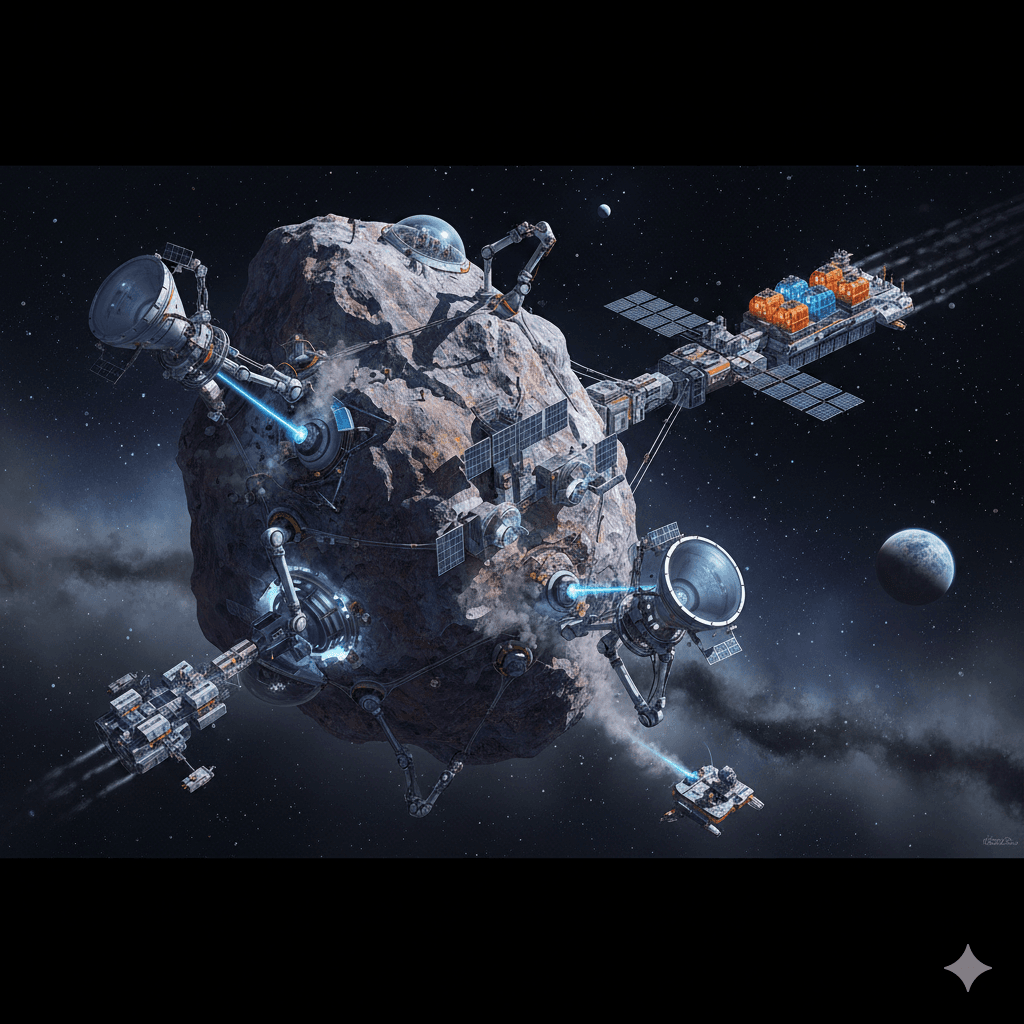
Asteroid Mining (Generated by Artificial Intelligence.)
Asteroids contain different types of resources depending on their origin and physical properties. Carbon-rich asteroids are more likely to contain water and volatile compounds. Metallic asteroids may concentrate iron, nickel, and other metals of industrial importance. This diversity renders asteroids potential sources of both essential inputs for use in space and structural and technological raw materials. However, due to significant variations in resource distribution from asteroid to asteroid, detailed analysis is required.
The first stage in asteroid mining is identifying suitable targets. In this process, the asteroid’s orbit, rotation rate, size, surface structure, and composition are considered. Near-Earth asteroids are prioritized due to their lower energy requirements for access. Remote sensing methods, spectral analysis, and radar observations are used to assess the resource potential of asteroids in advance.
Mining in the asteroid environment requires techniques different from those used on Earth due to low gravity and vacuum conditions. Robotic systems that adhere to the surface extract raw materials through mechanical excavation, surface material collection, or thermal processing. In-situ processing of extracted materials increases mission efficiency by reducing the mass that needs to be transported. Particularly, extracting oxygen and hydrogen from water creates a vital application for life support systems and fuel production.
The feasibility of asteroid mining depends not only on technical capabilities but also on economic and operational conditions. Mission architecture, system reusability, processing efficiency, and operational continuity are decisive factors in this evaluation. Generally, extracting resources for direct use in space is seen as more immediately viable than transporting them back to Earth. In contrast, introducing high-value metals to Earth markets requires more complex logistical and economic processes.
Asteroid mining is closely linked to fundamental principles of international space law. Regulations prohibiting sovereignty claims over celestial bodies have led to differing interpretations regarding resource utilization. Moreover, the use of asteroid resources must be evaluated in terms of global equity, environmental impact, and the long-term preservation of the space environment. Consequently, legal and ethical debates continue alongside technological advancements.
Asteroid mining, though still in experimental and conceptual stages, holds strategic potential in the development of the space economy. Advances in robotic systems, autonomous operations, and in-situ resource utilization are increasing the feasibility of these activities. In the long term, asteroid mining is regarded as an approach that could lay the groundwork for establishing permanent infrastructure in space and systematically exploiting extraterrestrial resources.
Broslav, Timofey, Chris Dreyer, and Joel Sercel. “Optical Mining of Carbonaceous Chondrite Simulants: Testing and Lessons Learned in Asteroid Mining Research.” *Acta Astronautica* 235 (2025): 1–16. Accessed December 15, 2025. https://doi.org/10.1016/j.actaastro.2025.04.033
Hein, Andreas M., Robert Matheson, and Dan Fries. “A Techno-Economic Analysis of Asteroid Mining.” ArXiv Preprint (Cornell University). (2018). Accessed December 15, 2025 https://arxiv.org/abs/1810.03836
Hepp, A. F., B. A. Palaszewski, G. A. Landis, D. A. Jaworske, A. J. Colozza, M. J. Kulis, and R. S. Heller. "In-Situ Resource Utilization for Space Exploration: Resource Processing, Mission-Enabling Technologies, and Lessons for Sustainability on Earth and Beyond." Report. Propulsion and Energy Forum 2014. Glenn Research Center. Cleveland, Ohio. December 2015. Accessed December 15, 2025. https://ntrs.nasa.gov/api/citations/20150023468/downloads/20150023468.pdf
NASA. "Asteroids and Comets." Jet Propulsion Laboratory. Accessed December 15, 2025. https://www.jpl.nasa.gov/topics/asteroids/
NASA. "In-Situ Resource Utilization (ISRU)." Accessed December 15, 2025. https://www.nasa.gov/mission/in-situ-resource-utilization-isru/
Rivkin, Andrew S., Moses Milazzo, Aparna Venkatesan, Elizabeth Frank, Monica R. Vidaurri, Phil Metzger, Chris Lewicki. “Asteroid Resource Utilization: Ethical Concerns and Progress.” ArXiv Preprint (Cornell University). (2020). Accessed December 15, 2025 https://arxiv.org/abs/2011.03369
Sanchez, J. P., and C. McInnes. “An Asteroid Resource Map for Near-Earth Space.” Journal of Spacecraft and Rockets 48, no. 1 (2011): 153-165. Accessed December 15, 2025. https://www.researchgate.net/profile/Joan-Pau-Sanchez/publication/253182657_Asteroid_Resource_Map_for_Near-Earth_Space/links/543ff4a30cf21227a11b9da3/Asteroid-Resource-Map-for-Near-Earth-Space.pdf
Sanders, Gerald B. "Space Resource Utilization: Technologies and Potential Synergism with Terrestrial Mining." Planetary & Terrestrial Mining Sciences
Symposium (PTMSS). May 10, 2015. Montreal, Canada. Accessed December 15, 2025 https://ntrs.nasa.gov/api/citations/20150003499/downloads/20150003499.pdf


Resource Potential of Asteroids
Exploration and Target Selection Process
Mining and Processing Methods
Economic and Operational Evaluation
Legal and Ethical Dimensions
Future Perspective