
This article was automatically translated from the original Turkish version.
+2 More
Dimension(s) | Approximately 3.5 light years | ||||||||
|---|---|---|---|---|---|---|---|---|---|
Temperature | Between 10 and 20 Kelvin | ||||||||
Density | Approximately 1000 particles per cm³ | ||||||||
Other Name(s) | Horsehead Nebula Barnard 33 (B33) | ||||||||
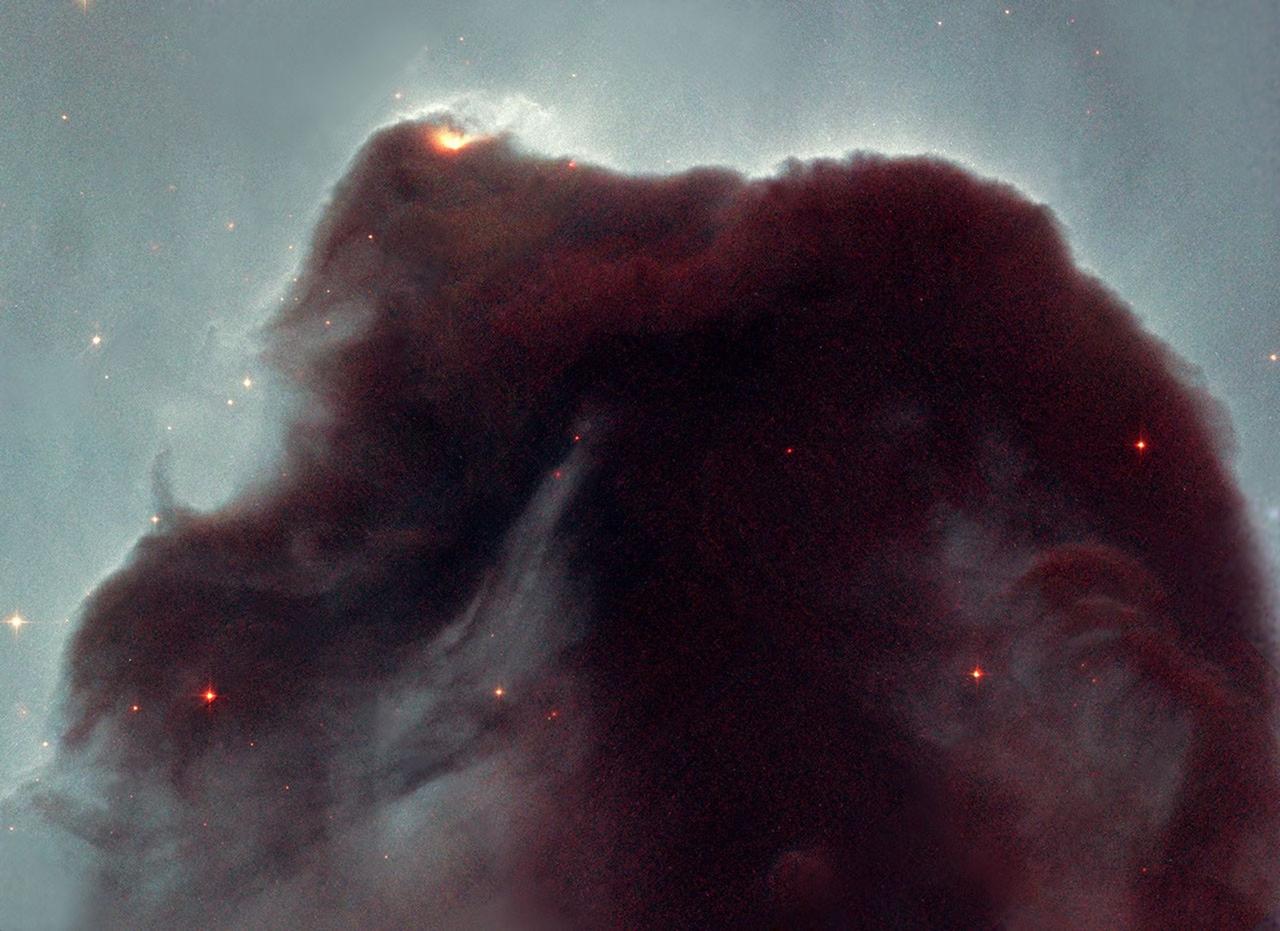
Dark Horse Nebula, a dark nebula named for its resemblance to a horse’s head, is located in the direction of the Orion Constellation. This structure, also catalogued as Barnard 33, was first identified in 1913 by American astronomer Edward Emerson Barnard through photographic observations. The nebula appears as a dark silhouette against the bright background glow of IC 434, a widespread emission region of hydrogen gas.

Dark Horse Nebula (NASA)
The Dark Horse Nebula is situated in the Orion Constellation, just south of the star Alnitak (Zeta Orionis). Located at a distance of approximately 1,375 light years (about 421 parsecs), it is part of the Orion Molecular Cloud Complex. Visually, it is too faint to be seen with the naked eye; however, it becomes clearly visible through long-exposure astrophotographic techniques.
The Dark Horse Nebula is classified as a dark nebula. Such structures consist of dense clouds of dust and gas that absorb the light from background stars and emission regions. The main physical and technical properties of Barnard 33 are as follows:
The formation of the Dark Horse Nebula resulted from the gravitational collapse of cold molecular clouds in the interstellar medium. The ionized gas of IC 434 has shaped the nebula’s outer edges through photon pressure, a process known as “photo-erosion,” typically triggered by the radiation from nearby massive OB-type stars.
The nebula’s “neck” region has been sculpted by radiation pressure from incoming ultraviolet radiation. Such structures are often found in regions where star formation is occurring. Indeed, protostellar objects have been detected forming within the Dark Horse Nebula.
The Dark Horse Nebula has been studied using telescopes across multiple wavelengths. Structures invisible in visible light have been analyzed in detail through infrared and radio observations. In particular, observations made by NASA’s Spitzer Space Telescope and ESO’s VISTA telescope have provided key data on ongoing star formation within the nebula’s interior.
Close-up of the Dark Horse Nebula. (HubbleWebbESA YouTube)
Additionally, high-resolution images obtained by the Atacama Large Millimeter/submillimeter Array (ALMA) have revealed detailed information about the gas dynamics and protostellar cores within the nebula. Observations have uncovered evidence of matter accretion and the influence of magnetic fields during the early stages of star formation.
The Dark Horse Nebula serves as an important example for understanding star formation processes. It is studied in terms of how molecular clouds are shaped by ultraviolet radiation, the effects of photon sources, gas condensations, and the evolution of magnetic field structures. Much of the research on the general nature of dark nebulae and the optical effects of interstellar dust relies on such prominent silhouette structures.
Moreover, due to its location within the Orion Complex, the Dark Horse Nebula is used as a reference for understanding the dynamic processes in this region. Models of star formation timing, density fluctuations, and how environmental factors trigger star birth are tested using data derived from this nebula.
The Dark Horse Nebula (Barnard 33) provides significant morphological and structural insights as a product of complex physical and chemical processes in the interstellar medium. Observational data have demonstrated that this structure is not merely a passive background feature but an active region of ongoing star formation. In this regard, Barnard 33 remains a fundamental object of study for understanding the nature of dark nebulae.
ESA (European Space Agency). "The Horsehead Nebula (Barnard 33) in Orion." YouTube. Accessed July 10, 2025. https://www.youtube.com/watch?v=-PQpNb_yJVE.
ESA/Hubble. “New Infrared View of the Horsehead Nebula.” ESA/Hubble. Accessed July 10, 2025. https://esahubble.org/images/heic1307a/.
ESA/Hubble. “Zoom into the Horsehead Nebula.” Video. ESA/Hubble. Accessed July 10, 2025. https://esahubble.org/videos/heic1307b/.
NASA. “The Horsehead Nebula.” *NASA Science*. Accessed July 10, 2025. https://science.nasa.gov/asset/hubble/the-horsehead-nebula/.
NASA. “Webb Captures Top of Iconic Horsehead Nebula in Unprecedented Detail.” *NASA Science*. Accessed July 10, 2025. https://science.nasa.gov/missions/webb/webb-captures-top-of-iconic-horsehead-nebula-in-unprecedented-detail/.

Dimension(s) | Approximately 3.5 light years | ||||||||
|---|---|---|---|---|---|---|---|---|---|
Temperature | Between 10 and 20 Kelvin | ||||||||
Density | Approximately 1000 particles per cm³ | ||||||||
Other Name(s) | Horsehead Nebula Barnard 33 (B33) | ||||||||
Location and General Characteristics
Physical Structure and Technical Properties
Formation and Evolution
Observations and Research
Scientific Significance