


This article was automatically translated from the original Turkish version.
+1 More
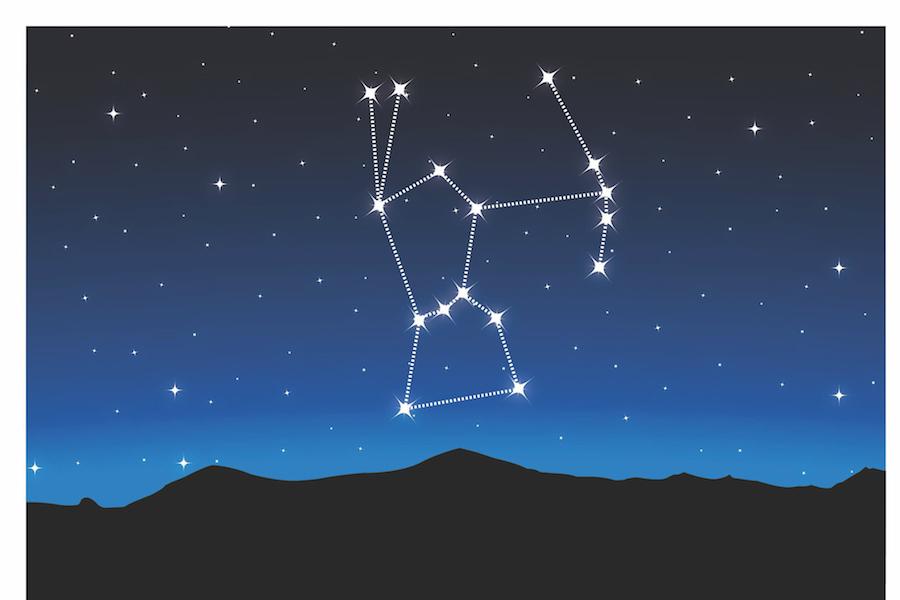
Orion Constellation
Abbreviation | Ori | ||||||||
|---|---|---|---|---|---|---|---|---|---|
Complement | Orionis | ||||||||
Surrounding Constellations | Twins, Bull, River, Rabbit, Unicorn | ||||||||
Orion Constellation is a constellation easily recognizable in the night sky, composed of bright stars. It derives its name from Orion, the great hunter of Greek mythology, and is therefore also known as the Hunter Constellation. Orion lies near the celestial equator and is visible from both the Northern and Southern Hemispheres across the globe. This constellation is clearly visible from both hemispheres, especially during winter months. It holds great significance both scientifically and mythologically.
Those wishing to observe the Orion Constellation from Türkiye should look toward the southern horizon during winter months. The position of Orion varies between southwest and southeast depending on the month.

AI-generated image: Orion Nebula and its Stars.
Orion is one of the most prominent constellations in the night sky and is typically depicted as a hunter. Some of its brightest stars are Betelgeuse and Rigel.
Within the Orion Constellation lies the Orion Nebula (M42), a region where young stars are forming and which is frequently studied by both amateur and professional astronomers. In addition to the Orion Nebula, other celestial objects within Orion include the Horsehead Nebula and Barnard’s Loop.
In mythology, Orion appears in various stories across different cultures:

AI-generated image: Mythological Hunter Illustration.
Orion holds great significance for modern and astronomy.
Although the Orion Constellation will retain its current appearance for several million more years, it will undergo significant changes over evolutionary timescales.
The explosion of Betelgeuse is considered one of the most important events that will alter Orion’s visual structure. Large stars like Rigel are also expected to undergo supernova explosions in the future, dispersing heavy elements into their surroundings. These processes may cause Orion to take on a different appearance over time.
The Orion Constellation is both visually striking in the night sky and of great scientific and mythological importance. Through its star-forming regions, work stars and cultural significance, Orion has always been a compelling subject for astronomers and historians alike. Orion’s future evolution will continue to provide new perspectives for astronomical research.
Bauval, Robert, and Adrian Gilbert. The Orion Mystery. New York: Crown Publishers, 1994. Accessed March 14, 2025.
Coe, Michael D., and Stephen Houston. The Maya. London: Thames & Hudson, 2015. Accessed March 14, 2025.
Hubble Space Telescope. Orion Nebula Observations. 2017. Accessed March 14, 2025.
Jones, Michael, and Laura Brown. Rigel and Stellar Evolution. Cambridge: Cambridge University Press, 2018. Accessed March 14, 2025.
NASA Exoplanet Archive. Exoplanet Discoveries in Orion. 2022. Accessed March 14, 2025.
Smith, John, et al. "Betelgeuse: A Supernova Candidate." Astrophysical Journal (2020). Accessed March 14, 2025.

Orion Constellation
Abbreviation | Ori | ||||||||
|---|---|---|---|---|---|---|---|---|---|
Complement | Orionis | ||||||||
Surrounding Constellations | Twins, Bull, River, Rabbit, Unicorn | ||||||||
No Discussion Added Yet
Start discussion for "Orion Constellation" article
Astronomical Features
Mythological Origins
Scientific Importance
Orion’s Future and Evolution