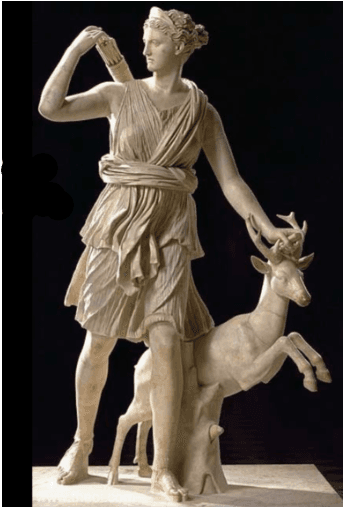


This article was automatically translated from the original Turkish version.
+1 More
Accompanying | Artemis (Hunting Group) | ||||||||
|---|---|---|---|---|---|---|---|---|---|
Symbols | Flying cloak, hunting materials, breeze | ||||||||
Primary Source | Nonnus, Dionysiaca (Book 48) | ||||||||
Personalization | Breeze, Morning Air and Light Wind | ||||||||
Title | Titan / Nymph (Air Nymph) | ||||||||
Parents | Lelantos (Father) and Periboia (Mother) | ||||||||
Region of Residence | Phrygia (Anatolia) and the Sangarius (Sakarya) River region | ||||||||
Spouse / Partner | Dionysus | ||||||||
Child | Twins (from Dionysus) | ||||||||
Aura is a Titaness or nymph in Greek mythology personifying the wind, breeze, and fresh morning air. The daughter of the Titan Lelantos and Periboia, Aura appears in ancient texts primarily through her identity as a huntress, her emphasis on virginity, and her tragic fate. According to the detailed account in Nonnos’s Dionysiaca, Aura lived in the lands of Phrygia and accompanied the goddess of the hunt, Artemis. This figure, known for her physical speed and purity, represents in ancient literature both the life-giving coolness and the uncontrollable force of the wind.
In mythological sources, Aura is regarded as one of the Second Generation Titans. Her father Lelantos is a Titan associated with air and invisibility; her mother Periboia is an Oceanid. This lineage strengthens Aura’s connection to atmospheric phenomena as well as water nymphs. Her name, derived from the Greek word for “breeze” or “air,” identifies her as the goddess of the light winds that appear at dawn. The ancient writer Nonnos emphasizes that her beauty and speed were inherited from her father Lelantos.
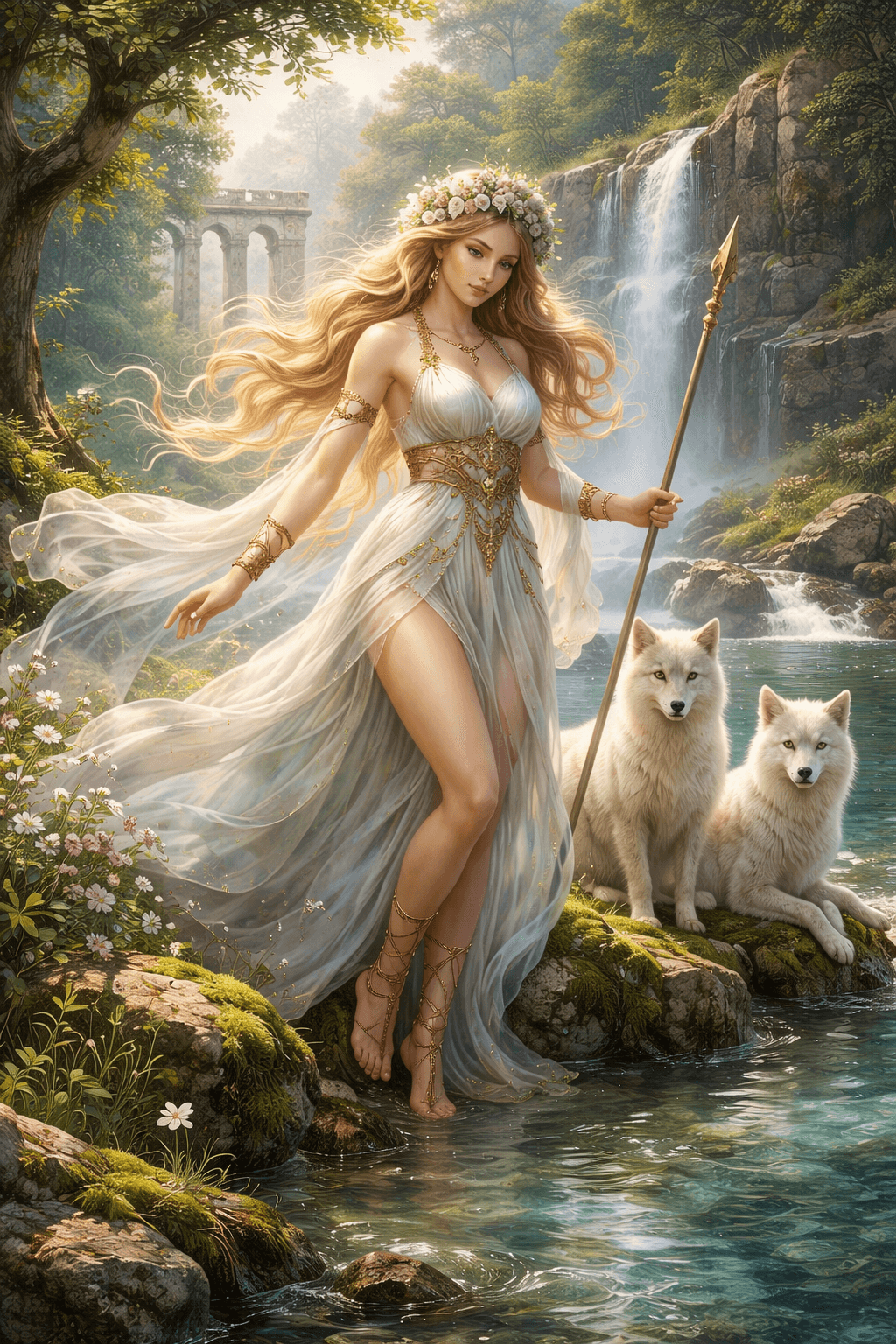
Representation of Aura (Generated by Artificial Intelligence)
In mythological narratives, Aura is typically depicted as one of Artemis’s attendant nymphs. Like Artemis, she devoted her life to hunting in the mountains and took a vow of virginity, avoiding men. However, Aura’s excessive pride and speed eventually fostered a sense of rivalry with the goddess.
According to one mythological account, Aura compared Artemis’s physique to her own athletic build, claiming that the goddess was “too feminine” and that such a form was unsuitable for a true hunter. She argued that her own breasts and body were more like those of a man, and therefore made her a superior hunter—thus committing the sin of hubris. This disrespect provoked the wrath of Artemis, the goddess of virginity and chastity. To punish this insult, Artemis sought the aid of Nemesis, the goddess of justice and retribution.
Nemesis accepted Artemis’s plea for vengeance and decided to strike Aura at her most vulnerable point—her chastity. The god of wine and intoxication, Dionysus, fell in love with Aura under Nemesis’s influence. Yet Aura, bound by her vow of virginity and her hatred of men, vehemently rejected Dionysus. When his divine desire was refused, Dionysus resorted to deceit.
According to the narrative, Dionysus transformed the water of a spring that Aura frequently drank from into wine. After drinking from it, Aura became intoxicated, lost consciousness, and fell into a deep sleep. Taking advantage of her defenseless state, Dionysus violated her. When Aura awoke, the horror of what had happened drove her to madness. This event is symbolized in mythology as “the pollution of pure wind by intoxication.”

The Legend of Aura, Greek Goddess of the Breeze (mitoloji)
Aura’s tragedy deepens with her pregnancy and childbirth. Having lost her mental balance, Aura gave birth to twin children fathered by Dionysus. But under the influence of her trauma, she developed intense hatred toward them. During a fit of madness, she killed one of the infants by tearing it apart. The other child was rescued and taken away by either Artemis or Dionysus.
Unable to endure the pain and shame of her actions, Aura threw herself into the waters of the Sangarios River (modern Sakarya). However, Zeus did not permit her complete annihilation; he transformed her into a breeze or an eternal spring, integrating her into the fabric of nature. Through this transformation, Aura returned to the form implied by her name: the morning breeze.
The most comprehensive and detailed accounts of the figure of Aura are found in the Dionysiaca (The Dionysiacs) of Nonnos of Panopolis, who lived in the 5th century CE. In Book 48 of this work, Aura’s story is presented in all its tragic dimensions. Additionally, in Quintus Smyrnaeus’s The Fall of Troy, Aura’s lineage as a Titan is confirmed.
In Anatolian mythology, Aura is particularly associated with the regions of Phrygia and Bithynia (modern-day areas around Sakarya, Eskişehir, and İznik). Her connection to the Sangarios River suggests she was also regarded as a local nymph of the river (Naiad). On some ancient coins and reliefs, a young woman depicted with a flowing cloak as if carried by the wind represents Aura’s iconographic form.
Mitolog. "Anadolu Perileri: Nikaia ve Aura." *Mitolojik Hikayeler.* Accessed March 4, 2026. https://mitolojikhikayeler.com/anadolu-perileri-nikaia-ve-aura/
Mitolog. "Aura Efsanesi." *Mitoloji.* Accessed March 4, 2026. https://mitoloji.org.tr/aura-efsanesi
Nonnos of Panopolis. "Dionysiaca." London: Harvard University Press, 1940. Accessed April 18, 2026. https://archive.org/details/dionysiaca01nonnuoft/page/n8/mode/1up?q=aura
Smyrnaeus, Quintus. "The Fall of Troy. Trans. Arthur S. Way." London: Harvard University Press, 1984. Accessed March 4, 2026. https://archive.org/details/falloftroy00quin/page/n6/mode/1up


Accompanying | Artemis (Hunting Group) | ||||||||
|---|---|---|---|---|---|---|---|---|---|
Symbols | Flying cloak, hunting materials, breeze | ||||||||
Primary Source | Nonnus, Dionysiaca (Book 48) | ||||||||
Personalization | Breeze, Morning Air and Light Wind | ||||||||
Title | Titan / Nymph (Air Nymph) | ||||||||
Parents | Lelantos (Father) and Periboia (Mother) | ||||||||
Region of Residence | Phrygia (Anatolia) and the Sangarius (Sakarya) River region | ||||||||
Spouse / Partner | Dionysus | ||||||||
Child | Twins (from Dionysus) | ||||||||
Mythological Origins
Aura and Artemis: The Cult of Virginity and Hunting
Encounter with Dionysus and Tragic Downfall
Infanticide and Transformation
Literary Sources and Archaeological Evidence