



Ayaş Tomato
Ayaş tomato is a registered designation of origin for tomatoes cultivated in the Ayaş district of Ankara province, Türkiye. It is known for its unique physical and taste characteristics and has been grown in the region since the 1960s.

Ayaş Tomato (AA)
The cultivation of Ayaş tomato in the Ayaş district dates back to the 1960s. The tomato received its national geographical indication registration in Türkiye on September 5, 2022, with the protection effective from October 15, 2020. Subsequently, it gained European Union (EU) geographical indication status, announced on November 29, 2023, making it Türkiye's 15th product to receive geographical indication from the EU and Ankara's first.
The Ayaş tomato plant is a local ecotype characterized by its narrow leaves and ground-sitting (dwarf) structure. The plant height is approximately 120 cm, and it exhibits late-season development. Its leaves are compound. Both its stem and leaves are covered with hairs that emit a tomato scent. The flowers are yellow and typically cluster-shaped. Despite intense sun exposure in the Ayaş region, the fruit does not suffer from sunburn due to the plant's large leaf blade and abundant foliage. The plant is self-pollinating.
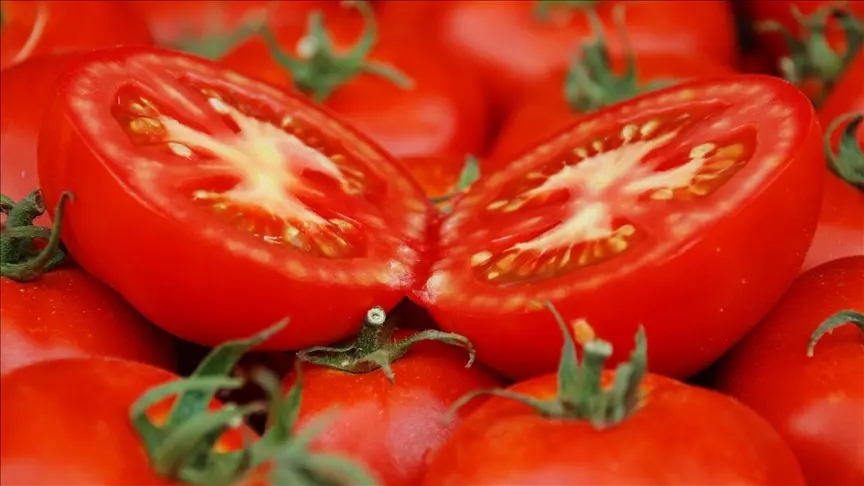
The Ayaş tomato fruit is large and quite fleshy; its average weight ranges from 250 to 300 grams. It has a thin skin and a very juicy texture. Its color is dull pink-red. A distinguishing feature is the indentations on the fruit's outer surface, which make it appear segmented. The tomato is not firm; its surface yields when touched with a finger. One of its most important physical characteristics is the frost-like whiteness of the fruit flesh when cut in half.
The Ayaş tomato has a high acid content, which gives it a slightly salty and lemony aroma. Its lycopene content is approximately 5,916 mg/100 g. Other specified chemical characteristics are:
The shape and structure of the fruit depend on local seeds and seedlings passed down from generation to generation within the geographical boundary.
Ayaş tomatoes are cultivated in the Ayaş district, where the typical continental climate characteristics are observed, with cold winters and hot, dry summers. Its altitude is 910 meters. The annual average temperature is 11.4°C, and the average relative humidity is 54%. The lowest average temperature is 0.5°C in January, and the highest average temperature is 22.2°C in July and August. The highest rainfall, 57.2 mm, occurs in December, while the lowest, 9.6 mm, occurs in August. The optimal temperature for pollen germination and fruit set is 18-26°C, with a relative air humidity of 50-80%. When the temperature drops below 15°C, the fruit set percentage decreases. When the temperature rises above 17°C, flowering begins, and the fruit develops after 25 days. During the fruit ripening process, the temperature should also be between 18-26°C; color pigments and thus lycopene are best synthesized at this temperature. The climate of the Ayaş district provides the most suitable conditions for fruit development.
Soil preparation is generally done in April by plowing the soil to ensure aeration. Seedlings become ready for planting when they have 2.5 leaves after the cotyledon leaves (approximately 5-10 cm tall). Seedling planting, which can be done by machine or manually, begins on May 1st and continues until the end of May. Planting distances vary. For table tomatoes, they are planted with 50-60 cm spacing within the row, and if the product is for industrial use, 25-30 cm spacing, with a distance of 1.8-2.0 m between two rows. It is stated that sparse planting by growers increases yield and thus fruit size by ensuring air circulation and sunlight exposure for the fruits.
The first hoeing is done 15 days after planting, and the second hoeing is done after the first month. If the land is too weedy, a third hoeing can also be done. If drip irrigation is preferred, it is applied once a week for 12 hours. If fertilizer is to be applied, it is done after soil analysis. If deemed necessary, monoammonium phosphate can be given to increase flowering, and potassium can be applied after fruits begin to form.
The harvest of Ayaş tomatoes begins in early August and continues until November. In open fields, it reaches harvest maturity in 60-80 days from seedling planting. The fruits are harvested by gently twisting them around their stem while holding them in the palm of the hand, ensuring no damage.
Ayaş tomato is registered as a designation of origin. The registrant is the Ayaş Chamber of Agriculture. Its national registration number is 1236, and it was registered on October 5, 2022, based on application number C2020/336 dated October 15, 2020. The geographical boundary for production is the Ayaş district of Ankara province. The use of the geographical indication requires the phrase "Ayaş Domatesi" (Ayaş Tomato) and the designation of origin emblem to be placed on the product itself or its packaging. If this is not possible, it is kept visible at the establishment. It is also recognized with a geographical indication by the European Union.
The inspection of Ayaş tomato production is carried out under the coordination of the Ayaş Chamber of Agriculture. The inspection authority is a committee consisting of at least three persons, formed with the participation of at least one expert from the Ayaş Chamber of Agriculture, Ayaş Municipality, Ayaş District Directorate of Agriculture and Forestry, and Ankara University Food Safety Institute. Inspections are carried out regularly once a year, and also whenever needed and/or in case of a complaint. Reports regarding the inspections are regularly sent by the Ayaş Chamber of Agriculture to the Turkish Patent and Trademark Office every year. The basic inspection criteria are:
The inspection authority may utilize or procure services from public or private institutions, or expert natural or legal persons employed therein, during the execution of the inspection. The registrant, the Ayaş Chamber of Agriculture, carries out legal processes for the protection of rights related to the geographical indication.

Ayaş Tomato
History
Botanical Characteristics
Physical Characteristics
Chemical Characteristics and Taste
Cultivation
Climate and Soil
Planting
Cultural Practices
Harvest
Geographical Indication and Registration
Inspection and Standards
This article was created with the support of artificial intelligence.