


This article was automatically translated from the original Turkish version.
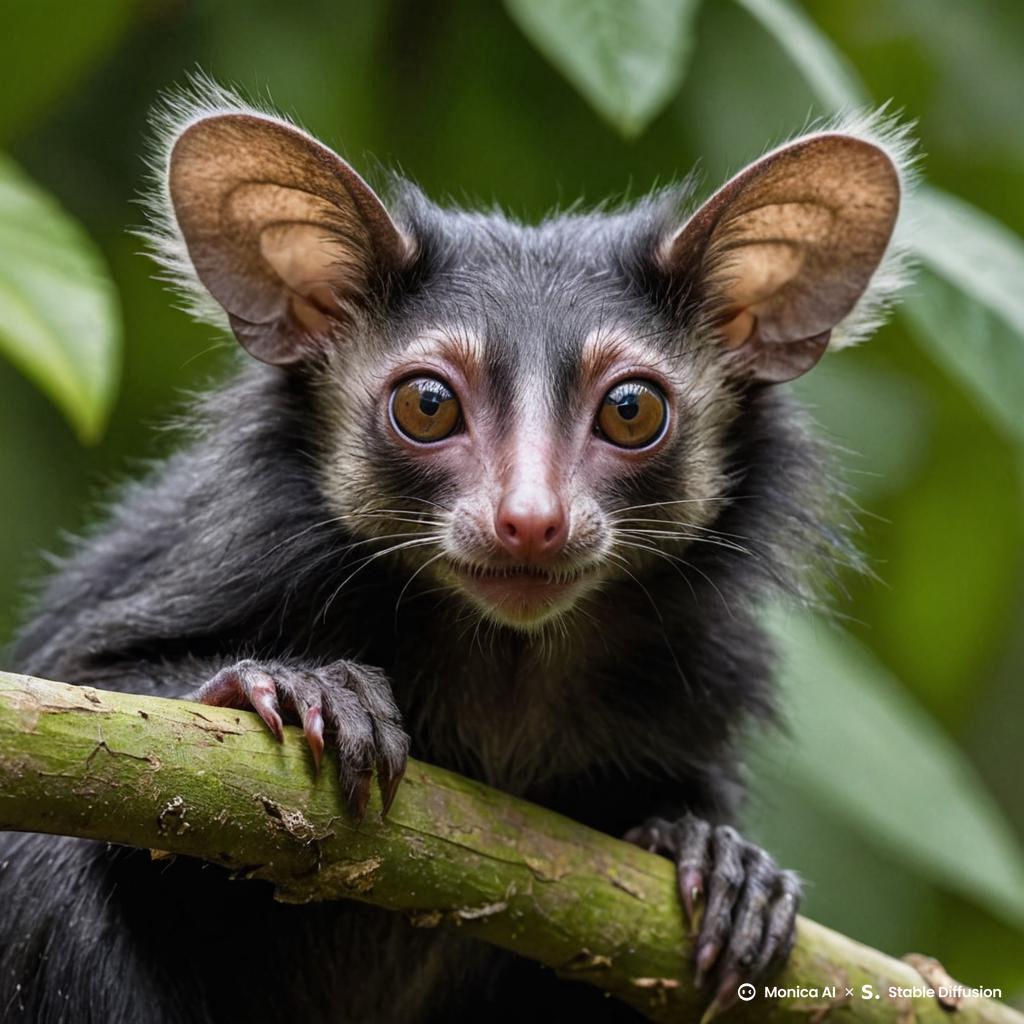
Aye-ayes are a nocturnal, arboreal primate species endemic to Madagascar. They are considered one of the most intriguing species among lemurs. This species is the only living member of the family Daubentoniidae and is distinguished from other primates by its distinctive anatomical features.
Aye-ayes have a body length of approximately 38 cm and a bushy tail measuring 55–60 cm in length. Their weight ranges between 2.5 and 2.8 kg. They are notable for their thick black or dark brown fur, large orange eyes, and an unusually long third finger. This specialized digit is used to tap on tree bark to detect insect larvae inside and extract them. Additionally, their continuously growing incisors give them a rodent-like appearance.
Aye-ayes inhabit the eastern rainforests, dry deciduous forests, and mangrove swamps of Madagascar. These nocturnal animals spend the day resting in nests made of leaves in tree branches. They prefer solitary lifestyles and roam over large territories; male home ranges vary between 100 and 200 hectares, while females occupy 30 to 50 hectares.

Aye-Aye Image (Generated by Artificial Intelligence)
Aye-ayes have an omnivorous diet. Their food includes fruits, seeds, nectar, and especially insect larvae found beneath tree bark. They use their long third finger to tap on tree trunks, listen for hollow spaces, and extract larvae. This behavior, known as “percussive foraging,” is a rare feeding strategy in nature.
Female aye-ayes reach sexual maturity at around two years of age and can breed at any time of the year. The gestation period lasts approximately five months, and they typically give birth to a single offspring. Young are raised in the mother’s nest and learn foraging techniques by observing her. Their adult teeth emerge at four months of age, and they begin to move independently from their mothers at around nine months.
The International Union for Conservation of Nature (IUCN) classifies the aye-aye as Endangered. Its population is declining due to habitat loss, deforestation, and local superstitions. In some regions, aye-ayes are believed to bring bad luck and are therefore killed. They are also targeted because they are thought to damage agricultural crops. Currently, at least 16 protected areas in Madagascar harbor aye-ayes, and some individuals are under conservation care in zoos.
“Aye-Aye.” *Animal Diversity Web*. Accessed May 3, 2025. https://animaldiversity.org/accounts/Daubentonia_madagascariensis/
“Aye-Aye.” *National Geographic*. Accessed May 3, 2025. https://www.nationalgeographic.com/animals/mammals/facts/aye-aye
“Aye-Aye.” *Wildlife Madagascar*. Accessed May 3, 2025. https://wildlifemadagascar.org/animals/aye-aye/

No Discussion Added Yet
Start discussion for "Aye-Aye (Daubentonia madagascariensis)" article
Physical Characteristics
Habitat and Behavior
Diet
Reproduction and Development
Conservation Status