


This article was automatically translated from the original Turkish version.
+2 More
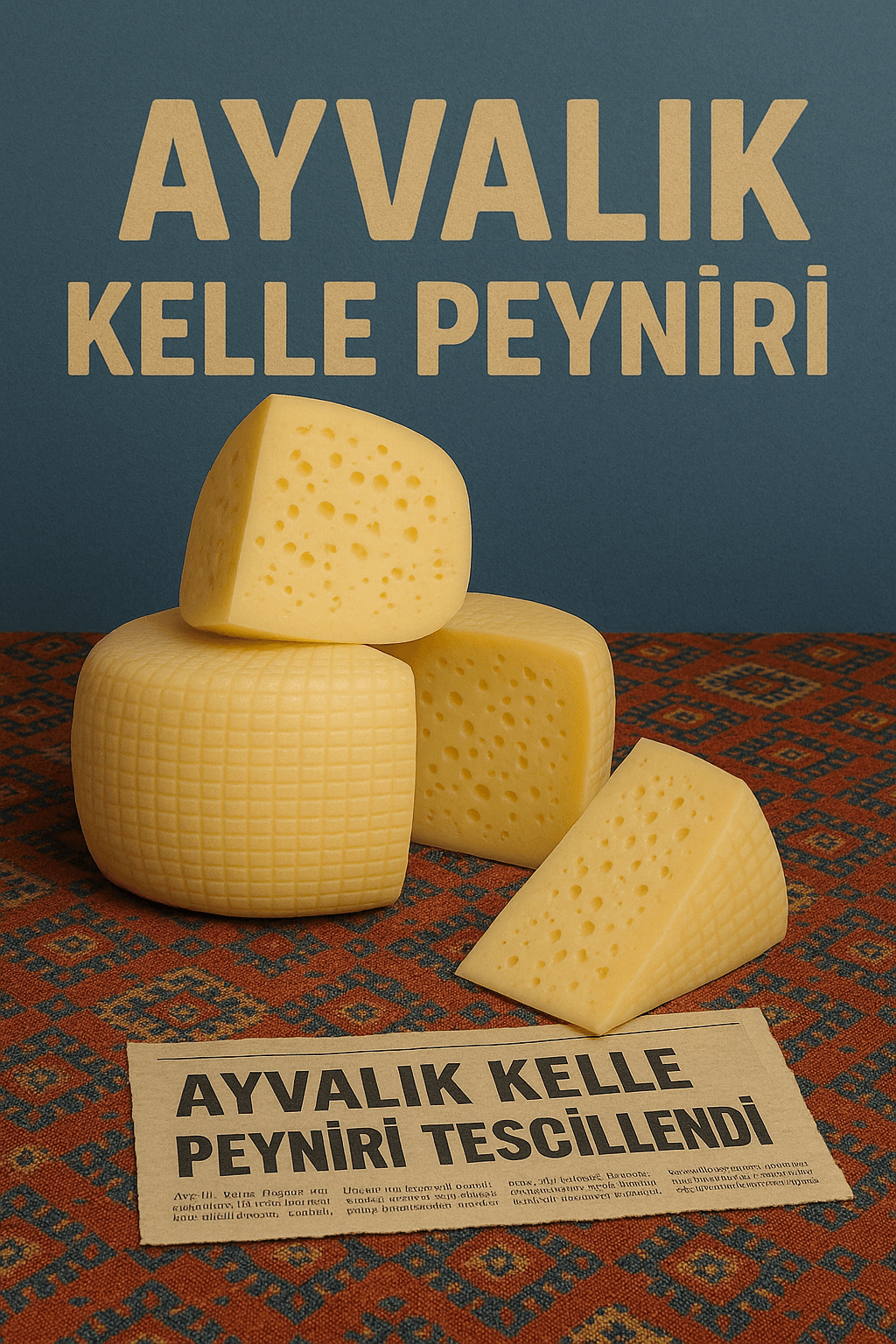
Ayvalık Kelle Cheese
Type of Geographical Indication | Mahreç Sign | ||||||||
|---|---|---|---|---|---|---|---|---|---|
File Number | C2022/000202 | ||||||||
Application Date | 2022-06-27 | ||||||||
Registration Number | 1664 | ||||||||
Registration Date | 2024-11-22 | ||||||||
Product / Product Group(s) | Cheeses | ||||||||
Province(s) | Balıkesir | ||||||||
Applicant/Registrant(s) | Ayvalık Municipality | ||||||||
Status | Registered | ||||||||
Ayvalık Kelle Cheese / Ayvalık Basket Cheese is produced in the districts of Ayvalık and Burhaniye in Balıkesir Province. The milk used in production must be sourced within the geographical boundary, and all stages of cheese production must be carried out within this geographical boundary.

Ayvalık Kelle Cheese (Generated by Artificial Intelligence)
Ayvalık Kelle Cheese / Ayvalık Basket Cheese is produced using sheep, goat, and/or cow milk, either individually or in combination. When sheep and/or goat milk is used in the milk blend, its proportion must be between a minimum of 10% and a maximum of 30%. The milk contains no substances that inhibit or neutralize acid development, and no processes such as fat removal or water addition that alter the milk’s composition are permitted. The cheese has a hard rind, a color ranging from yellow to white, and a non-cracked, porous structure. It belongs primarily to the hard cheese category, with a minor portion classified as semi-hard, depending on its firmness. It is a brine-aged cheese.
The cheese is round and perforated. It contains at least 40% milk fat by dry matter. The salt content does not exceed 6% of the dry matter. The ripening period is a key criterion for the cheese’s characteristic appearance. It is ripened for a minimum of 120 days. During ripening, the pores enlarge and spread uniformly, reaching a maximum diameter of 8 cm. Firmness increases with the length of ripening. Its basket-like shape and relatively low salt content after ripening are distinctive features of this cheese. The moisture content of the cheese does not exceed 60%.
The milk used in production is obtained from animals raised within the geographical boundary. The feeding of small ruminants is primarily based on pasture grazing, with a minor portion supplemented by alfalfa and barley-oat pellets. Large ruminants are fed roughage such as silage, hay, alfalfa, and straw, along with pellets. Additionally, olive leaves and olive pomace, by-products of olive oil mills located within the geographical boundary, are also used in the feeding of large ruminants. Raw milk is filtered to remove foreign substances. To extend its shelf life before processing, the milk is heated to a temperature between 57–68 °C for at least 15 seconds. After heat treatment, it is cooled to the fermentation temperature, which ranges from 27–36 °C depending on the season. For every 100 liters of milk, 10–20 grams of rennet starter culture is used during fermentation.
The curd, which forms in pea-sized particles during fermentation, is traditionally broken by hand or with a teleme knife. The curd is then cooked using hot water at 80–90 °C or by heating through a jacketed system; the whey temperature typically remains between 38–50 °C. High temperatures are avoided during this stage to preserve the formation of the cheese’s characteristic pores. After cooking, the teleme curd is separated from the whey, allowed to settle at the bottom, and the whey is drained. Depending on the desired firmness, the curd is transferred to a cheese-making table and shaped into a basket form using pasta strainers over a period of 60–90 minutes.
The shaped cheeses are rested for approximately one day at +4 °C. The outer surface is rubbed intermittently with salt, using 250–270 grams of salt per 2.5 kg mold. The cheeses are then rested for 10–21 days in rooms with temperatures between 10–25 °C. The cheeses are subsequently aged for a minimum of 120 days from the production date in a brine solution containing 10–12% salt. The porous structure develops during this aging phase.
Inspections are carried out by a control body composed of at least three experts from Ayvalık Municipality, Ayvalık District Directorate of Agriculture and Forestry, and Ayvalık Chamber of Tradesmen and Craftsmen, coordinated by Ayvalık Municipality. Inspections are conducted regularly once a year, and also whenever deemed necessary or upon complaint.
Inspection criteria include: the sourcing of raw milk within the geographical boundary; the suitability of milk and starter culture; compliance with the production method (particularly the ripening period); conformity of the product’s color, firmness, and porous structure; adherence to packaging and storage conditions; and proper use of the official geographical indication emblem.
Accessed November 26, 2025.
Turk Patent ve Marka Kurumu. "Ayvalık Kelle Peyniri." Coğrafi İşaretler. Accessed May 22, 2025.
Turk Patent ve Marka Kurumu. Ayvalık Kelle Peyniri. Ankara: TÜRKPATENT. Accessed May 22, 2025.

Ayvalık Kelle Cheese
Type of Geographical Indication | Mahreç Sign | ||||||||
|---|---|---|---|---|---|---|---|---|---|
File Number | C2022/000202 | ||||||||
Application Date | 2022-06-27 | ||||||||
Registration Number | 1664 | ||||||||
Registration Date | 2024-11-22 | ||||||||
Product / Product Group(s) | Cheeses | ||||||||
Province(s) | Balıkesir | ||||||||
Applicant/Registrant(s) | Ayvalık Municipality | ||||||||
Status | Registered | ||||||||
No Discussion Added Yet
Start discussion for "Ayvalık Kelle Cheese" article
Description and Distinctive Characteristics
History and Geographical Indication
Production Method
Inspections