


This article was automatically translated from the original Turkish version.
+2 More
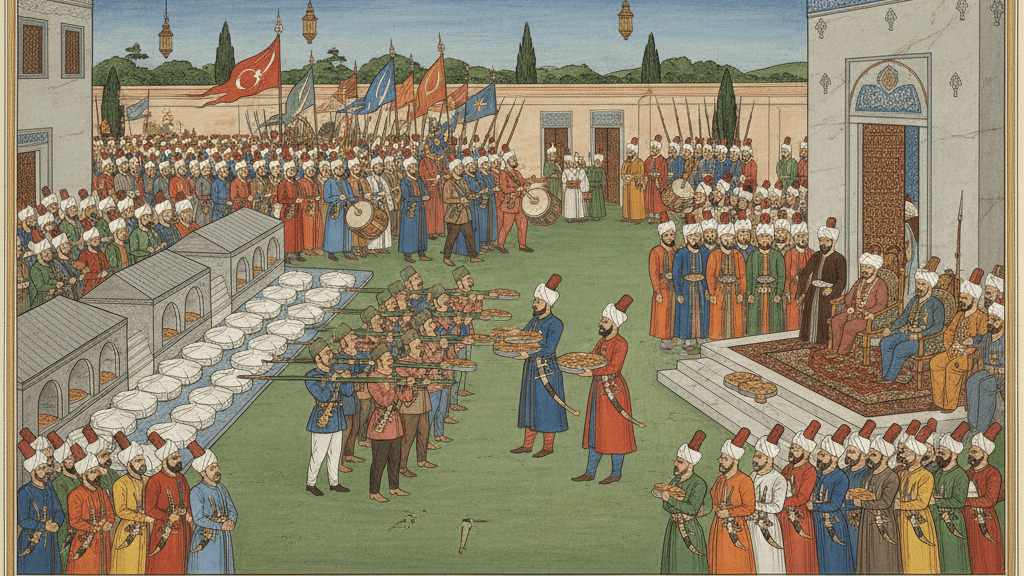
Baklava Parade (Generated with Artificial Intelligence.)
Reason for Conclusion | Abolition of the Janissary Corps (Vaka-i Hayriye) | ||||||||
|---|---|---|---|---|---|---|---|---|---|
Final Ceremony Date | 21 April 1826 (15 Ramadan 1241) | ||||||||
Presentation Format | One tray per ten people; carried in 'futa' (bundle) with green poles | ||||||||
Participants | Janissary Corps, Other military corps, Istanbul populace | ||||||||
Responsible Officer | Silâhdar Ağa | ||||||||
Space | Topkapı Sarayı (Middle Gate and Palace Kitchens), Istanbul streets | ||||||||
Time | The fifteenth day of every Ramadan month | ||||||||
Institutionalization | Late 17th century | ||||||||
Initial Period | The Reign of Sultan Süleyman the Lawgiver | ||||||||
Baklava Alayı is a state ceremony that became traditional during the reign of Kanuni Sultan Süleyman in the Ottoman Empire, performed as a gesture of favor to the soldiers and as a symbol of the sultanate’s grandeur. Held on the fifteenth day of Ramadan, coinciding with the visit to the Hırka-i Şerif, this ceremony attained its full formal structure by the end of the 17th century. According to this tradition, special baklava prepared in the palace kitchen was distributed to the Janissary Corps and other military units, with one tray allocated for every ten soldiers.
The tradition of the Baklava Alayı dates back to the reign of Kanuni Sultan Süleyman, one of the most brilliant periods of the Ottoman Empire. During this era, baklava began to be distributed to the Janissaries as a mark of imperial favor and a symbol of sovereignty, gradually evolving into an established state ceremony. By the late 17th century, this custom had transformed into an official annual ritual held precisely on the fifteenth day of Ramadan under the name Baklava Alayı.
This traditional ceremony also carried significant political weight, reinforcing the political legitimacy of Ottoman sultans and symbolizing the palace’s authority over the military. For approximately two and a half centuries, it remained one of the most important cultural and military rituals in the capital. However, the ceremony ceased with the abolition of the Janissary Corps. The last Baklava Alayı was held on 21 April 1826 (15 Ramadan 1241), approximately one and a half to two months before the corps was dissolved, and was never repeated after that date.

An Image Depicting the Baklava Alayı (Generated by Artificial Intelligence)
The Baklava Alayı ceremony took place annually on the exact fifteenth day of Ramadan, immediately following the feast held in conjunction with the visit to the Hırka-i Saadet. The central venue was Topkapı Sarayı, where military units, primarily the Janissary Corps, were invited to attend on this special day. Soldiers entered through the Orta Kapı into the palace’s second courtyard and were directed to the palace kitchens. There, baklava trays—prepared at a rate of one per ten soldiers—were wrapped and tied with special cloths called “futa” and arranged in orderly rows.
The Silâhdar Ağa, responsible for protocol, would emerge from Babüssaade with the Anahtar Ağası on his right and the Başlala on his left, proceeding to the area where the baklava trays were placed. The most notable feature of the protocol was the symbolic inclusion of the sultan as a member of the Janissary Corps’ “first orta”; thus, the Silâhdar Ağa personally received the first two trays on the sultan’s behalf. Subsequently, two soldiers from each orta would carry their assigned trays by placing them on long green-painted poles, threading the poles through the knots of the futas, and balancing them on their shoulders.
Upon the opening of the Orta Kapı, a noisy procession began, led by masters, elders, trustees, unit commanders, guards, and flag bearers. The procession marched through the streets of Istanbul to deliver the trays to the barracks. The following morning, the used trays and futas were returned to the palace kitchen in an orderly manner, formally concluding the ceremony.
The Baklava Alayı, a centuries-old tradition of the Ottoman state, ended with the abolition of the Janissary Corps in 1826. The final procession occurred approximately one and a half to two months before the corps was dissolved. According to records, on that day, an elderly man brought his young son, aged seven or eight, to watch the procession. While standing by the roadside, he was assaulted and humiliated by a group of Janissaries for allegedly obstructing their path.
Shaken by this treatment, the elderly man uttered a curse: “I brought this child because he asked; who on such a blessed day would leave the mosque to witness these people deserving of God’s wrath? O Lord, do not let this people reach the next Ramadan!” This curse is regarded as a reflection of popular discontent toward the Janissaries at the time.【1】 Indeed, shortly after this incident, the abolition of the corps brought the Baklava Alayı to a permanent end. From that point onward, baklava ceased to be a component of state ceremony and retained its place in cultural memory as a legacy of the Ottoman sultanate and its rich palace cuisine.

An Image Depicting the Last Baklava Alayı (Generated by Artificial Intelligence)
The Baklava Alayı was a highly anticipated annual social event in Istanbul, aligning the military power of the Ottoman state with its civilian population and court protocol. The routes of the procession were lined hours in advance by dense crowds known as “iki keçeli,” filling both sides of the streets. The public watched as hundreds of baklava trays carried on green poles, accompanied by a military escort, passed by, offering their loyalty to the sultan and applause to the soldiers. The disciplined return of the trays and futas to the palace kitchen the following morning symbolized to the public both the generosity and the order of the state. While reinforcing social hierarchies, this tradition also created a shared cultural space through the philosophy that “the people and the soldiers partake from the sultan’s table.”
Anadolu Ajansı. "Topkapı Sarayı'nda Baklava Alayı." Anadolu Ajansı. Accessed February 14, 2026. https://www.aa.com.tr/tr/yasam/topkapi-sarayinda-baklava-alayi/342276
GZT. "Osmanlı'dan iç ısıtan bir Ramazan geleneği: 'baklava alayı' ve Lokma'dan 5 baklava tarifi" GZT. Accessed February 14, 2026. https://www.gzt.com/lokma/osmanlidan-ic-isitan-bir-ramazan-gelenegi-baklava-alayi-ve-lokmadan-5-baklava-tarifi-blog-3647180
Kadir Has University. "İstanbul Ansiklopedisi, Cilt 4: 1939–1940." *İstanbul Ansiklopedisi*. Accessed February 14, 2026. https://istanbulansiklopedisi.org/handle/rek/5825
Ortaylı, İlber. "İstanbul’da Tarihi Yaşamak." Istanbul: T.C. Kültür ve Turizm Bakanlığı İstanbul Kültür ve Turizm İl Müdürlüğü, pp. 63–101. Accessed February 14, 2026. Accessed adresi
Sevimli, Y., and A. S. Sönmezdağ. “Özel Gün Tatlıları: Kültür Turizmi Açısından Önemi.” *Uluslararası Kırsal Turizm ve Kalkınma Dergisi (IRTAD)* 1, no. 2 (2019): 18–28. Accessed February 14, 2026. https://turizmvekalkinma.org/index.php/irtadjournal/article/view/66
Önal, Ahmet. “Payitaht İstanbul’da Osmanlı Merasimleri.” Antikçağ’dan XXI. Yüzyıla Büyük İstanbul Tarihi, Volume III, Istanbul, 2015. Accessed February 14, 2026. https://www.academia.edu/30794002/Payitaht_%C4%B0stanbulda_Osmanl%C4%B1_Merasimleri
[1]
Kadir Has Üniversitesi, “İstanbul Ansiklopedisi, Cilt 4: 1939–1940.” İstanbul Ansiklopedisi, Erişim tarihi: 14 Şubat 2026, https://istanbulansiklopedisi.org/handle/rek/5825
Baklava Parade (Generated with Artificial Intelligence.)
Reason for Conclusion | Abolition of the Janissary Corps (Vaka-i Hayriye) | ||||||||
|---|---|---|---|---|---|---|---|---|---|
Final Ceremony Date | 21 April 1826 (15 Ramadan 1241) | ||||||||
Presentation Format | One tray per ten people; carried in 'futa' (bundle) with green poles | ||||||||
Participants | Janissary Corps, Other military corps, Istanbul populace | ||||||||
Responsible Officer | Silâhdar Ağa | ||||||||
Space | Topkapı Sarayı (Middle Gate and Palace Kitchens), Istanbul streets | ||||||||
Time | The fifteenth day of every Ramadan month | ||||||||
Institutionalization | Late 17th century | ||||||||
Initial Period | The Reign of Sultan Süleyman the Lawgiver | ||||||||
History of the Baklava Alayı
Ceremony and Protocol
End of the Tradition
Social and Cultural Impact