

This article was automatically translated from the original Turkish version.
Location | İçerişehir Azerbaijan Baku | ||||||||
|---|---|---|---|---|---|---|---|---|---|
Construction Material | Limestone, lime mortar | ||||||||
Dimension(s) | Height: 29.7 m Wall thickness: 5 m (bottom) 4 m (top) Diameter: 16.5 m | ||||||||
Interior Layout | Eight stories, each with a domed single space, narrow spiral staircases between floors, a well 21 m deep, capacity for approximately 200 people | ||||||||
Current Function | Museum | ||||||||
Cultural Significance | Symbol of Azerbaijan, part of the İçerişehir complex within the UNESCO World Heritage Site | ||||||||
Baku Maiden Tower is a monumental structure located in the center of Baku, the capital of Azerbaijan, in the southeast of the Inner City and one of the city’s most iconic landmarks. Its cylindrical tower and attached wall sections draw attention, and the building holds a privileged place in the region’s cultural memory due to its architectural features and the legends that have formed around it.
Constructed along the shore of the Caspian Sea, the structure maintained this location until the second half of the 19th century, but over time it became detached from the coastline due to changes in sea level and land reclamation projects.
Many structures across Central Asia, Anatolia, and the Caucasus are known as “Maiden Tower” or “Maiden’s Tower.” These similar names are generally associated with folk legends circulating in local communities.

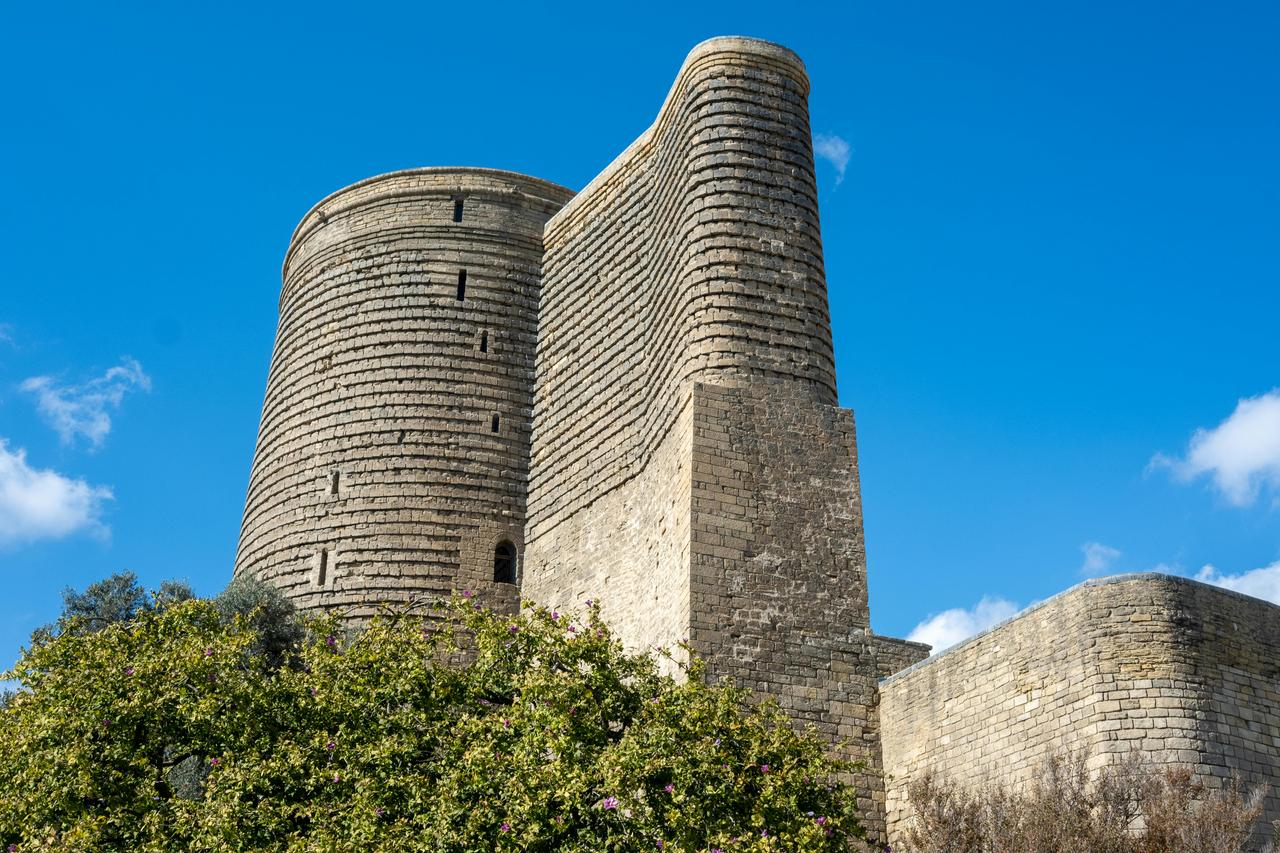
Exterior View of the Baku Maiden Tower (Photo: Duygu Şahinler)
The Baku Maiden Tower consists of a cylindrical tower 29.7 meters high and 16.5 meters in diameter, built on a rocky foundation. The structure is constructed of limestone blocks bonded with lime mortar and features an imposing appearance achieved through varied masonry techniques on its exterior facade. The wall thickness reaches up to five meters at the base and decreases to four meters in the upper sections. The facade rises on a rubble stone foundation, covered with precisely cut stone cladding; in the upper sections, alternating courses of stone are set inward and outward to create dynamic bands.
The interior layout comprises eight floors, each containing a single domed chamber. The ground floor is three meters high, while each upper floor is approximately 2.5 meters high. The rooms do not open directly to the outside and receive only minimal light through small arrow slits. Access between floors is provided by a narrow spiral staircase embedded within the southeast wall, starting from the second floor. The elevated position of the original entrance on the north facade, accessible only via removable wooden or ladders, indicates a deliberate design for security.
Inside the tower, there is also a well 21 meters deep. In addition, it is known that the tower was connected via underground passages to the Shirvanshahs Palace and the gates of Baku’s fortifications. The structure also contains pipe-like vents, believed to have been used for communication between floors. Although the interior spaces are now arranged as a museum displaying various weapons of war, they still preserve their dim atmosphere.

Entrance to the Tower (Photo: Duygu Şahinler)
On the western facade of the Baku Maiden Tower, at a height of approximately 14 meters, there is a Kufic inscription carved on a single stone slab. However, the inscription is now heavily damaged, with parts of the letters illegible. The text was first read in the mid-19th century by the Russian orientalist Hanikov, and subsequent researchers largely repeated his initial reading.
The inscription contains the name “Mesud bin Davud,” and it has generally been interpreted as “The Tower of Mesud, Son of Davud.” Nevertheless, due to the inscription’s poor condition, this reading is not definitive. Some researchers suggest that the text may instead refer to “Kubbetü Mesud bin Davud,” implying a connection to the tower’s domed sections.
Considering the position of the inscription and the nature of the stone, it is clear that the text was not added later but is an original component of the structure. However, evidence indicates that another inscription or emblem, likely located above the current one, was deliberately erased in later periods. This has contributed to gaps in the historical record concerning the tower.
Research has not established whether Mesud bin Davud was the builder of the tower or its master craftsman. Nevertheless, the inscription is widely dated to the 12th century. However, its simplicity, when compared with other contemporary structures in the region, appears too modest for such a monumental building, leading to scholarly debate.
There is no consensus on the construction date of the Baku Maiden Tower. Differences in facade stonework and variations in wall thickness suggest the possibility that the structure was built in multiple phases.
The inscription on the western facade points to the 12th century, leading to the widely accepted attribution of the tower to the Shirvanshah period. Following the major earthquake in Shamakhi in 1192, the capital was moved to Baku, and it is proposed that the Maiden Tower, along with the city walls, regained its functional role during this period. Thus, the tower is often linked to the reign of Shirvanshah Ahsitan.
However, some researchers argue that the tower predates this period. One theory posits that it was constructed in the pre-Islamic era, even as early as the Sasanian period (6th–7th centuries). Some interpretations go further, suggesting that the lower section may have been built between the 7th and 6th centuries BCE, or even that the tower could be a ziggurat dating back to the Sumerian era.
The simplicity of the inscription and its apparent incompatibility with the monumentality of the structure have led some to propose that it may have been added at a later date. Yet, the harmony between the inscription’s stone and the tower’s original masonry confirms it as an original element. Consequently, it remains difficult to definitively prove that the tower predates the 12th century.
The function of the Baku Maiden Tower has been debated throughout history. The most widely accepted view is that it served military purposes—as an observation and defensive structure. The ground-level layout and entrance arrangement support this interpretation: the entrance gate is positioned high above ground level on the north facade and was accessible only by removable wooden or rope ladders, indicating a strong emphasis on security.
The interior space has a capacity of approximately 200 people. Each of the eight floors consists of a domed chamber with no direct external openings. Lighting is provided solely by limited illumination through arrow slits. These features suggest the structure could also have functioned as a refuge during times of siege.
The 21-meter-deep well inside the tower not only met water needs but also demonstrates preparedness for prolonged defense and siege conditions. It is also claimed that the tower was connected via secret underground passages to the Shirvanshahs Palace and the gates of Baku’s fortifications.
Today, the Maiden Tower serves as a museum. Various weapons are displayed within its interior, and the tower is presented to visitors as one of Baku’s most important cultural heritage sites.
The Baku Maiden Tower is also an integral part of Azerbaijani culture through the legends that have developed around it. The name “Maiden Tower” or “Maiden’s Tower” is a recurring tradition across Central Asia, Anatolia, and the Caucasus. These names are commonly associated with tragic love stories or tales of sacrifice.
In Azerbaijani folk literature, the Maiden Tower has been the subject of numerous epics and folktales. One of the most famous legends tells of a ruler who imprisoned his daughter in the tower to protect her from an unwanted marriage, only for the young woman to ultimately throw herself into the Caspian Sea. This narrative has reinforced the tower’s dramatic and mysterious identity. Azerbaijani poet Cəfər Cabbarlı also incorporated the Maiden Tower legend into his literary works, embedding it into the modern cultural memory.
Algül, Emrecan. "Kız Kalesi." Pexels. Accessed September 14, 2025. https://www.pexels.com/tr-tr/fotograf/baku-nun-eski-kentindeki-gorkemli-kiz-kulesi-29232859/
Mehdiyeva, Ayten. “Kız Kaleleri ve Süslere Yansımaları.” *UMCAK I. Uluslararası Multidisipliner Çalışmalar ve Araştırmalar Kongresi Bildiri Tam Metin Kitabı*, 1–9. Şanlıurfa: Eğitim Yayınevi, 2019. Accessed September 14, 2025. https://www.researchgate.net/profile/Ibrahim-Aktas-3/publication/366200606_UMCAK_TAM_METIN_KITABI_121019-min/links/63974820095a6a777424ec92/UMCAK-TAM-METIN-KITABI-121019-min.pdf#page=15
Sayan, Yüksel. “Bakü Kız Kalesi.” *Sanat Tarihi Dergisi* 15, no. 1 (2006): 113–124. Accessed September 14, 2025. https://dergipark.org.tr/en/pub/std/issue/16520/172477

Location | İçerişehir Azerbaijan Baku | ||||||||
|---|---|---|---|---|---|---|---|---|---|
Construction Material | Limestone, lime mortar | ||||||||
Dimension(s) | Height: 29.7 m Wall thickness: 5 m (bottom) 4 m (top) Diameter: 16.5 m | ||||||||
Interior Layout | Eight stories, each with a domed single space, narrow spiral staircases between floors, a well 21 m deep, capacity for approximately 200 people | ||||||||
Current Function | Museum | ||||||||
Cultural Significance | Symbol of Azerbaijan, part of the İçerişehir complex within the UNESCO World Heritage Site | ||||||||
Architectural Features
Epigraphic Findings
Debates on Dating
Function and Use
Folkloric Significance